... Rop Fulop
By Scott Stilphen

Back in 1993, I had the privilege to speak with Rob Fulop - an accomplished 2600 game designer with both Atari and Imagic, and then the Creative Director and co-partner of P.F. Magic. His work with the 2600 earned him several industry accolades, and the prestigious Game of the Year award in 1982 for his groundbreaking achievement with Demon Attack.
DP: Let's start with your educational background.
 Rob
Fulop:
I have an
Electrical Engineering degree from the University of California in Berkley (in
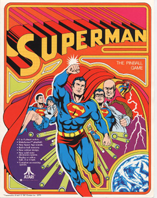
1978). From there, I went right to work at Atari. I was hired by Nolan Bushnell,
and actually started working in the coin-op division doing sound effects for a
pinball machine called Superman (Ed: Eugene Jarvis is commonly
credited with doing the sounds for this). After that, I moved to the home division
when the 2600 was released. My first games were Night Driver and
Missile Command.
Rob
Fulop:
I have an
Electrical Engineering degree from the University of California in Berkley (in
1978). From there, I went right to work at Atari. I was hired by Nolan Bushnell,
and actually started working in the coin-op division doing sound effects for a
pinball machine called Superman (Ed: Eugene Jarvis is commonly
credited with doing the sounds for this). After that, I moved to the home division
when the 2600 was released. My first games were Night Driver and
Missile Command.
DP: Those were the only two you did?
Rob Fulop: No, I also did Space Invaders for the 400/800 computers. That was also around the same time when Atari's home computers were released.
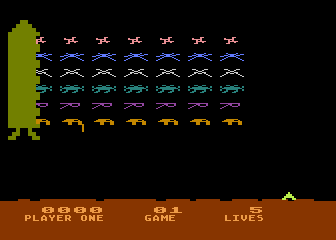
DP: Your method of hiding your initials was very ingenious!
Rob Fulop: My initials are in Missile Command, but I think it was later taken out in some versions of cartridges. That really upset me because I thought it was neat that when it was found, people could tell their friends. Atari was mad because I had left to go work at Imagic, so they went back into the code and took it out. As far as I'm concerned, that just made it a collector's item.
DP: Exactly, because not that many have them.
Rob Fulop: Right. But then, of course, games like Super Mario Bros. came out. Those games are just filled with Easter eggs.
DP: So after Atari, you went to Imagic.
Rob Fulop: I had first worked on some stuff that was never released, and them I went to Imagic and did Demon Attack, Cosmic Ark, and Fathom. Right after Demon Attack, I did a game called Cubicolor. It's a two-player puzzle game based on Rubik's Cube (the handheld puzzle). This was when Rubik's Cube was very popular. It wasn't released because Imagic wanted an action game at the time. It got put aside, and after Imagic folded, I ended up with about 50 prototype carts. If there's a market for 2600 games, this will be a collector's item. People who have played it seemed to like it -- it's a fun game.
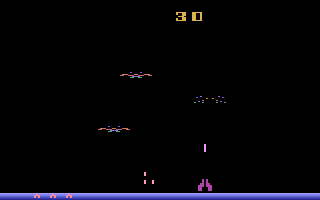
DP: Demon Attack was probably your biggest seller.
Rob Fulop: Yes, that was the best one.
DP: What was it based on? What was your inspiration for it?
Rob Fulop: Galaxian. That's pretty obvious! The idea was to have a game where there was a lot to see. The farther you got, the more there was. There are basically seven different monsters, and we colored them eight different ways. This led to 56 variations. Actually, there are 84 waves. It's a big game to see everything. (Note: the graphics and play mechanic more closely resemble Phoenix, obviously).
DP: The graphics for Demon Attack were rather impressive at the time.
Rob Fulop: Actually the trick to the Demon Attack graphics was it was the first game to use my scotch taped/rubber banded dedicated 2600 sprite animation authoring tool that ran on the Atari 800. The first time Michael Becker made a little test animation and we ran Bob Smith's utility that successfully squirted his saved sprite data straight into the Demon Attack assembly code and it looked the same on the VCS as it did on the 800 was HUGE! Before that day, all 2600 graphics ever seen were made using a #2 pencil, a sheet of graph paper, a lot of erasing, and a list of hex codes that were then retyped into the source assembly code, typically introducing a minimum of two pixel errors per 8*8 graphic stamp.
DP: The manual mentions that after 84 waves, the game stops.
Rob Fulop: That's an interesting story. I thought no one would ever "wrap" the game. I actually programmed it so, at the end of the game, if you beat the demons, they would just turn off. Two days after the game was released, some kid wrapped it. After the initial run of carts, I went back and took the "bug" out. I changed one line of code. I made it so you can play the game forever, but it never gets harder past the 84th wave.
 DP:
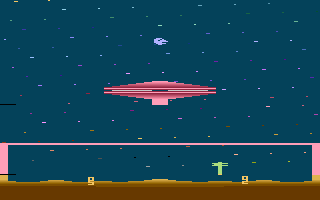
Cosmic Ark was a
pretty hard game.
DP:
Cosmic Ark was a
pretty hard game.
Rob Fulop: That was difficult?
DP: I thought so.
Rob Fulop: You see, that's the problem with making a video game. If it's more difficult than the designer can play, then how do you test it? I don't know if it's possible at the higher levels.
DP: I've gotten up to these "Pac-Man" type beasties, at which point it gets so fast, it's unbelievable.
Rob Fulop: We actually had a promotion at Imagic to try to name all the creatures.
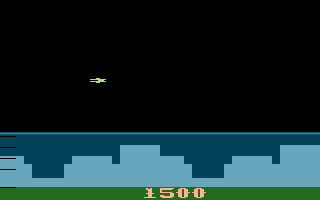
DP: Is there some kind of connection with Cosmic Ark and Dennis Koble's Atlantis?
Rob Fulop: Oh, right, the little space ship! At the end of Cosmic Ark, this little space ship flew away, and we wound up putting it in Atlantis. We were going to put the ship in a bunch of games.
DP: I noticed on some versions of Cosmic Ark, the TV type switch flips the star background on and off. Were you aware of this?
Rob Fulop: No. The star field was done because of a bug in the 2600 hardware. Later models don't have this, so there may be some differences there.
The year Ark was introduced, if I recall, we actually rented a big motor home so that we could put our dev system in the back and get two extra days of programming time driving across the country instead of flying so we could be editing code right up to the MOMENT before the show launched. It was all about trading off time vs quality.
DP: Getting back to Demon Attack, what was the lawsuit with Atari all about?
Rob Fulop: Atari sued us (Imagic) over the Demon Attack version for the Intellivision. It looked like a game that Atari did, but the suit was later dropped.
 DP:
Were there any
games in your 2600 career that you never finished?
DP:
Were there any
games in your 2600 career that you never finished?
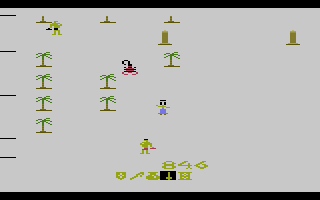
Rob Fulop: I worked on an Egyptian-themed game at Atari before I left. It never quite worked out, and we didn't like it so it never got finished. Later on, it became Riddle of the Sphinx. About half the games that got started were never completed. Bob Polaro did a neat Road Runner game. Was that ever released?
DP: Yes, it actually came out about four years ago. I think it was done very well.
Rob Fulop: He started that game about eight years before. I think the best cart of all time was Douglas Neubauer's game...
DP: Solaris?
Rob Fulop: Yes. That was the best thing when I left and he spent two years "in the dark" just doing that game. But there was no market for it when he was done.
DP: That's a fantastic game.
Rob Fulop: What do you think is the best 2600 game?
DP: Probably Solaris. It's definitely one of my favorites.
Rob Fulop: I also have a Game Line unit from back then. It let you load carts over the phone...
DP: That's definitely a collector's item! I remember seeing the ads for it when they were trying to get people to sign up. Did you ever use it?
Rob Fulop: No, it never worked.
DP: What was it like developing for the VCS back then?
Rob Fulop: You would have loved some of our last resort byte saving tricks, when we were trying to crunch the code to fit into 4k. By the end, we were DESPERATE. One of my favorites, was changing a sound (or graphic) table to begin with hex code $60, which would allow that byte to do double duty .. as a RTS at the end of a subroutine, and as the first byte in the sound data table. There were other doozies, but this one in particular stuck in my memory as truly representative of how sick we were at the time.
DP: With your Imagic games, were there any little tricks that you put in? In Fathom, the company's address is shown at the end of the game...
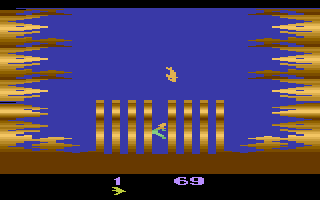
Rob Fulop: I never liked Fathom.
DP: Really? I thought it was a good game. The layout is quite big.
Rob Fulop: It was an 8K game. That was the last game I did. I never knew what it was when I started. For all the other games, I had a vision for what they were going to be. Fathom started with a neat picture that Michael Becker drew of a dolphin jumping out of the water. He drew this graphic and we made a game out of it. There was never any vision of what the game was. It was this kind of "epic" where you're underwater, and then you fly in the air. There are mermaids, too. It just never felt like a game. The best games are simple with a real vision of what it is -- like Pitfall (by Activision).
I never really liked how the dolphin jumping out of the
water never really seemlessly segued from the dolphin swimming up from under the
water .. it's a real cheat, obviously .. at some point I take away joystick
control from the user and just smash the animation up on the screen .. letting
the user control the dolphin again when it lands. The "right" way to do it would
be to actually move the dolphin itself OUT of the water and either morph it into
a seagull right in front of your eyes ... OR .. have the dolphin arc and dive
back in to the water ... with a little splash animation. Such is how I wanted it
to work, anyway.
But nobody could bare the thought of tossing out the little dolphin jump
animation .. after all .. such had been the genesis of the whole game ... that
animation was truly a "precious little child" .. and my wanting to "kill it" was
quickly shot down by Dennis Koble ... and when we disagreed .. Dennis brought in
the marketing people, and Bill Grubb, the CEO .. and they beat me up pretty bad
that it was fine as it is. So that little animation remained ... and to this day
.. I can't look at Fathom because of it .. it's just sooooo annoying knowing
that another week or so would have made the dolphin jump sequence sooooooo much
cooler. Ever since then, I make it a point to kill my children a LOT earlier in
the dev cycle .. tossing out our early first efforts that looked great the first
time, but as we got better at the task at hand, quickly became "second rate" ..
until if left in the whole .. becomes a true eyesore.
DP: That had a similar beginning as well. It started with a little demo of a running man. He (David Crane) just sat down and figured out the rest.
Rob Fulop: Well, we can't do that anymore! Now, with CD games, it's like making a movie. You have 10 people working on a project, and you can't just sit down and make it up as you go along.
DP: After Imagic, what did you end up doing?
 Rob Fulop:
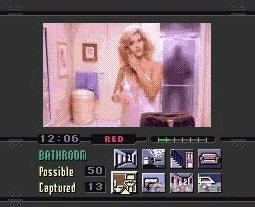
I did some on-line
games for Quantum, and then started making active video for Hasbro. I did a few
games for them, one of which is for the Genesis CD called Night Trap.
It's basically a movie. It's interesting -- if you look back at Night Driver, it
had 2K of code. The last project we finished involved 650 megabytes of code.
Even though 12 years have gone by, and we have 2000 times as many resources to
use, the skills that make use of those resources to design a game are exactly
the same.
Rob Fulop:
I did some on-line
games for Quantum, and then started making active video for Hasbro. I did a few
games for them, one of which is for the Genesis CD called Night Trap.
It's basically a movie. It's interesting -- if you look back at Night Driver, it
had 2K of code. The last project we finished involved 650 megabytes of code.
Even though 12 years have gone by, and we have 2000 times as many resources to
use, the skills that make use of those resources to design a game are exactly
the same.
DP: It's still the same process of approaching it?
Rob Fulop: I think so. You're basically resource-constrained. It's funny -- I often call these CD players the "VCS" of video. The 2600 VCS was really a horrible machine to program on.
DP: Other programmers have mentioned the same thing -- it was really hard to get a good game out of it.
Rob Fulop: It took a year.
DP: How long does it take you to do a CD game?
Rob Fulop: A year, but now its 20 people and the budgets are half of a million dollars. With games such as Night Driver, it was one guy sitting down for nine months -- like writing a book.
DP:
So after Hasbro,
you went to PF. Magic?
Rob Fulop: Yes. At PF. Magic, we do about five or six large projects a year
DP: Is this your own company?
Rob Fulop: I have a partner - John Scull. There are 18 people in the company.
DP: May I ask what "PF." stands for?
Rob Fulop: We don't ever tell anyone-it's our secret! (Ed: See below for what it actually stands for.)
DP: I thought maybe there was something with the names -- Imagic and PF. Magic.
Rob Fulop: I just like "magic" in the title of a company. There's really no connection.
DP: What exactly are you working on?
Rob Fulop: We're working on games for the Sega Genesis CD, the 3DO platform, CDI, and the Super Nintendo.
DP: People in the industry are predicting the 3DO to be...
Rob Fulop: We don't know. At this point, I've worked on 15 platforms in my life. To me, they're all the same. It's the next "2600." Whatever comes out next -- they'll say it's wonderful and it won't have enough memory! The 3DO is definitely the next big thing to get excited about. But it's all the same -- none of them have enough memory or processing power to do what you want, and they all take a year to do products for. That's been the same for the last 12 years.
DP: What do you think about virtual reality?
Rob Fulop: Well, there's definitely no rush. I don't think it's going to happen anytime soon -- not in the way it's being portrayed. It's just not that exciting. At the end of the day, I think Tetris is more fun! I think something cool can come of it, but it won't be for a while.
DP: It will be interesting to see where they take it. Right now, it's sort of a gimmick, or a toy. Virtual Reality has been around for years.
Rob Fulop: Battlezone was a "virtual" game
DP: What are some of your favorite games?
Rob Fulop: Tetris, Q*Bert, Pac-Man... I like puzzle-type games, and those that are abstract, rather than those that are more realistic or that try to imitate reality.
DP: Have you kept anything from your days at either Atari or Imagic?
Rob Fulop: Somewhere in my basement I have a folder filled with yellowed sheets of graph paper from Atari containing the final sprite graphics from Night Driver, Atari 800 Space Invaders, and Missile Command including the infamous "RF" sprite graphic which stood in place of the rightmost destroyed city at the end of Game #13.
DP: Do you have any stories from those days?
Rob Fulop:
The competition between 2600 developers 'back in the day' was OUT OF CONTROL.
Sure, we were paid salaries, some of the lucky ones were even paid a modest
royalty. But let there be NO DOUBT .. when we showed up at the June Consumer
Electronics Show in Chicago, where Imagic, Activision, and Atari rolled out
their new releases for the upcoming Xmas season ... there was SERIOUS
competition going on. Deadly serious. The pecking order was Activision, then
Imagic, with Atari holding up the rear. My former colleagues at Atari ran over
to the Imagic booth, were we smugly showed off Demon Attack, refusing to say ONE
WORD about how the graphics were done. But as soon as they left, I remember
running over to the Activision booth straight away and seeing Pitfall for the
fist time, and just getting SICK over how crisp and clean the execution was ..
and how much gameplay was squeezed into a 4K ROM. I was inconsolable for the
remainder of the show .... no joke. And the Activision guys were so much more
smug then we were .. here's how smug they were.
David Crane never even bothered coming to see the Imagic stuff, which really
annoyed the stuffing out of me. None of them came by, actually. Whitehead,
Miller, Kaplan ... not one of them ever came by. If I wanted to chat with them,
since we had all worked together at Atari ... I'd have to go to the Activision
booth, and ohh and ahh over Pitfall a few more times. Seriously, I mean, weren't
these guys even CURIOUS about what we had done at Imagic? Like Crane can't be
bothered to come by and take a little peek, what?
It was totally about "one upsmanship" in those days .. and NOTHING to do with
money. Not from my perspective anyway. I vowed to myself that the next time
Imagic was at this show, a year later, that I would show people something so
cool on the VCS, that even David Crane himself would have no choice but to come
by our booth and check it out. And then he would start crying. That was my goal.
To show Crane something so cool that he would have no choice but to start crying
because he didn't know how it was done.
And such is when the starfield from Cosmic Ark was born. In that moment of pure
competitive resolve. The whole reason I made Cosmic Ark, was to show Crane the
starfield and hopefully offer him a tissue.
The starfield already existed .. it appeared one day from a total accident,
btw ... a few years earlier I was stumbling through making the kernal for
Missile Command ... and was trying to reposition the ball graphic over and over
again for some reason, and I think maybe I put the wrong value in the wrong
place at the wrong time, I dunno ... all of a sudden this cool starfield just
APPPEARS on the screen, like a magic trick. I had NO CLUE why, or what was going
on. Nobody could figure it out ... but it seemed to be pretty replicable on any
unit.
Anyway, Cosmic Ark was made for the express reason to show off the starfield
trick to Crane and Whitehead .. no other reason. And one year later, there was
Cosmic Ark featured in the Imagic booth at CES ... and about two hours after the
show opens .. sure enough .. Crane and Whitehead come strolling by .. just as
casual as they can be .. "dum de dum, dum de dum". Obviously they could not
appear overly interested in Cosmic Ark .. but it was just as obvious that it
just TORTURED them ... they walk up and down the aisle three times .. it made me
SOOOO happy. Finally Crane just cannot take it anymore, and comes over and ever
so subtle, chats me up "how ya doin, Rob? Cosmic Ark looks great, blah blah". We
make nice for about three minutes. "I like the way you are using the Playfield
for the stars, Rob". GAWD, I was soooo luvin life at that moment. Can he be any
more obvious in his attempt to probe how the starfield was made? Of course I
said NOT ONE WORD, other than "Yup, it's just the playfield, obviously". Truly a
memorable moment in my young life!
So yeah, make no mistake ... the 2600 was ALWAYS about who could show the
coolest stuff .. and NEVER about the money. Obviously we all knew that the
coolest stuff would usually get the most money anyway at the end of the day, but
our motivation was to blow each other away .. plain and simple.
DP: Do you ever see any of your old fellow 2600 programmers?
Rob Fulop: Oh yeah. I see Dennis Koble all the time, and David Crane. Many of them are still active in the industry. I think Warren Robinett went to work for the military, and Howard Scott Warshaw doesn't design games anymore...but most of them are still around today.
Right after the interview was done, Rob mentioned that he had several copies of an unreleased game that he was interested in selling. For more information about Cubicolor, check out Tim Duarte's article HERE. You can find a current list of Cubicolor owners HERE.
* Note: PF. Magic stands for “pure fucking magic”. The following is a website quote from Fulop that I recently found:
|
Pure F---ing Magic
Such was an old saying from my days at Atari…that ultimately our customers care not for our slick technical skills…they really don’t give a hoot about how clever our engineers are…what they REALLY care about is the overall EXPERIENCE they are having with our products…
Like who CARES how the software that is running inside your PC works. All that matters is that it makes you believe that a living DOG is running around your desktop?
From the perspective of a customer, it’s simply pure f---ing MAGIC. That’s all they really need to know, so such reminded us that all we care about is that our customers are ENCHANTED…and not to get overly in love with our technology, which is a real problem in some companies.
But we told people different things over the years, depending on who was asking.
Positive Future (told to Venture capitalists)
Partially Funded (told to people we owed money to)
Perpetually Fighting (told to employees, when they asked why everything seemed so difficult at times, and why did so many smart people have so many different opinions)
Hope that helps
Cheers
Rob Fulop Co-Founder and Creative Director of PF. Magic |
In 1998 Fulop sold PF. Magic, Inc. to The Learning Company. Currently it's owned by UbiSoft - http://www.petz.com/ (the former official site is no more - www.oddballz.com).
In 2000, I had the
opportunity to ask him a few more follow-up questions…
DP: I recently learned
about the hidden initials in your game, Fathom. Besides VCS Missile Command and
400/800 Space Invaders, do you know of any Easter eggs in your other games? Rob Fulop:
The little green saucer, which appears in Cosmic
Ark, flies around somewhere in Fathom, but I don’t recall how to trigger it.
There were no other hidden things in any carts that I worked on, however Night
Driver has a terrible screen glitch. If you drive with the paddle hard left and
then turn hard right at certain parts of the track, the screen will roll –
there’s too much calculation going on in the processor and it misses a screen
retrace. The original version of
Night Trap we did for Hasbro featured a hidden scene with a topless Dana Plato,
but I don’t know if it was added into the Digital Pictures version that came out
on the Sega and PC. Dogz/Catz II and III contain a few hidden animation
sequences, but I ain’t telling what they are nor how to trigger them! Rob Fulop:
Basically I first
did the initials because programmers received no credit for our work. Then
after a few games at Imagic, with my name on the box, people could actually
contact me. I had a big bunch of responses to the earlier hidden initials. I
realized that people just plain LIKED the little hidden treats, so I put them
back in Fathom.
DP: Can you tell me
anything about Reaction (the precursor to Cosmic Ark)? Was Midway’s 1980 coin-op Space Zap an inspiration? Rob Fulop:
Cosmic Ark started
with a bug discovered during Demon Attack that filled the screen with stars! To
this day, nobody has ever explained to me WHY the player/missile register in the
chipset goes crazy if diddled with the wrong way, but the effect blew me away
and I wrote down how to recreate it. So then I started fooling around with
trying to make Space Zap – a game I adored and thought perfect for the VCS. I
added the star field trick, and then I turned the cannon into a big space ship.
At that point the game could have shipped, but it didn’t feel done; it felt sort
of boring, so the secondary game of flying to the planets took up about 6 months
of trying different stuff.
DP:
Being a former
professional poker player, I’m surprised you never designed a poker game (before
RabbitJack, under Advanced Program Technology. Dan Peri did the
sounds and Ernest Adams did the PC-end software). Any reasons why? Rob Fulop:
I didn’t think it
made any sense to play a game involving “secret information”, such as poker,
with a computer player/dealer, as players would worry that the computer was
“peeking”. Let’s face it, if I deal the cards and also know what they
are, how fair of a game is it?
In Jan. 1999 Fulop posted about Actionauts - his
only unreleased VCS game - in RGVA:
It (very) briefly appeared
at the CGE2K1 Blue Sky Ranger's booth, and it looked close to being complete. In
2002 Fulop posted this
thread on
Atariage:
Unfortunately, the thread ended due to people overwhelming
Rob with requests to finish the game. Another 5 years would pass before he
publicly mentioned the game again, this time in a 2007 interview
with Planet Atari:
Later that year, Rob finally went forward with plans to
release the game, via an announcement on his website. A few months later
he posted a follow-up that the game was being completed (with the help of John
Payson)! Rob started another
thread
on Atariage in early 2008, this time inquiring about a fair price for the game.
Once again, the thread turned sour, with a few people even insulting Rob for
wanting a fair compensation for his efforts (one person suggested he should
release it "for fun" instead of for money...). Thankfully, Rob
released boxed copies of the game for the community to enjoy. You can learn more about
Rob Fulop and his work at:
www.robfulop.com 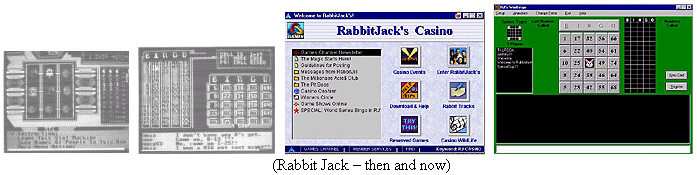
"I was about 35% completed with on the VCS before I left
Imagic in 1983 after finishing Fathom. I have NO IDEA what I should do
with this. It was code named ACTIONAUTS. And take my word for it ... as a
game ... it STINKS. It really stinks. But as a collectible ... well ...
given that only one exists ... I gotta believe it has some value in the
world. I'll post the object code on a WEB SITE in the next month or so ...
and all you cowboys can come check it out."
"I have an unreleased prototype of a game that I made in
1984, soon after leaving Imagic. The game is called "Actionauts" ... it
involves the user programming a little robot around the screen so that it
can navigate itself through a series of mazes. The game was abandoned
before it was completed due to the lackluster market for 2600 games at
that time. It's quite playable, but lacks the "finish" and polish of a
released title. I'm hardly in a position to add anything to the game -
it's sort of an 'as-is' sort of thing. I don't have a 2600 development
system, and even if I did, I long ago tossed out a printed version of the
source code - the game is a big jumble of op codes. It didn't get finished
for a reason - the interface and game concept turned out to be better
suited for a machine with more RAM and a keyboard. The concept was
explored on the 2600, and later found its way onto the Commodore 64. The
reason I originally abandoned the game when it was 80% completed ...
remain true ... there are some games better left to more resource-rich
systems ... Actionauts is one of those games. It's fun, but after playing
it, it was clear that this sort of game deserved to be offered on a higher
powered computing platform."
"And somewhere in my box of 2600 stuff, remains a sole
copy of "Actionauts", a robot programming game that is maybe 1/2
completed, that I probably should get around to making available to the
collector community."
GAMEOLOGY
GAME
SYSTEM
COMPANY
STATUS
Superman
pinball
Atari
released
Space Invaders
Atari 400/800
Atari
released
Night Driver
Atari VCS/2600
Atari
released
Missile Command
Atari VCS/2600
Atari
released
"Ping Pong" game
Atari VCS/2600
Atari
not completed
"puzzle" game
Atari VCS/2600
Atari
not completed
Demon Attack
Atari VCS/2600
Imagic
released
Cosmic Ark
Atari VCS/2600
Imagic
released
"unknown game"
Atari VCS/2600
Imagic
unreleased
Fathom
Atari VCS/2600
Imagic
released
Cubicolor
Atari VCS/2600
Imagic
unreleased
Actionauts
Atari VCS/2600
Imagic / Advanced Program
Tech.
not completed
Actionauts
C-64
Advanced Program Technologies
unreleased
Rabbit Jack's Casino
C-64
Advanced Program Technologies
(for Quantum Link/America On-Line)
released
Techforce
Interactive Productions (w/
Axlon)
unreleased
Scene of the Crime (demo)
NEMO
Interactive Productions (w/
Axlon) for Hasbro
unreleased
Sewer Shark
NEMO (later released by
Digital Pictures for Sega CD, 3DO)
Interactive Productions (w/
Axlon) for Hasbro
released
Night Trap
NEMO (later released by
Digital Pictures for Sega CD 32X, 3DO)
Interactive Productions (w/
Axlon) for Hasbro
released
Third Degree
CD-I
Interactive Productions (for
Philips)
released
Max Magic
CD-I
Interactive Productions (for
Philips)
released
Edge 16 (hardware interface)
Genesis, SNES
Interactive Productions
(became PF. Magic), for AT&T
unreleased
PaTaank
3DO
PF. Magic
released
Ballz
Genesis, C-64, SNES, 3DO
PF. Magic / Accolade
released
Dogz: Your Computer Pet
PC
PF. Magic / Virgin
released