By Scott Stilphen
Although there are many more games that were planned or started than those listed here, this article only covers games either having some related artwork (box art, artist renderings of screens, or actual screenshots) or are known to exist. It also covers known early versions of released games, and advertised artwork or screenshots that differed (sometimes drastically) from the released version.
|
20th CENTURY FOX |
9 TO 5
Listed on a flyer as one of 6 upcoming games.
Catalog description: “A secretary's work is never done: dictation, typing
letters, filing, and it all has to be done on time. Now, the boss wants
coffee, and time is running short. Can she keep up with the pace?"

THE ENTITY
Listed on a flyer as one of 6 upcoming games. Programmer Mark Klein
allowed a copy of the game to be released at CGE in 2003.

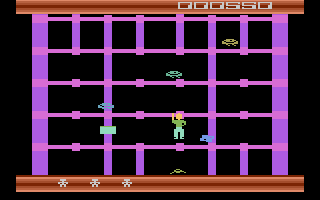
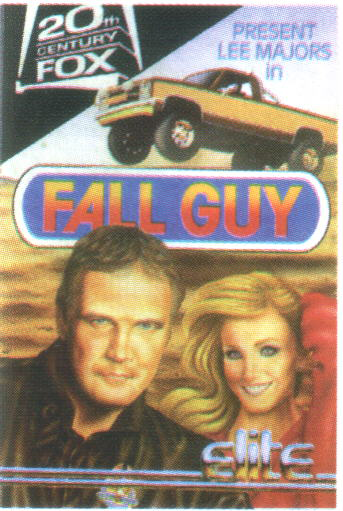
THE FALL GUY
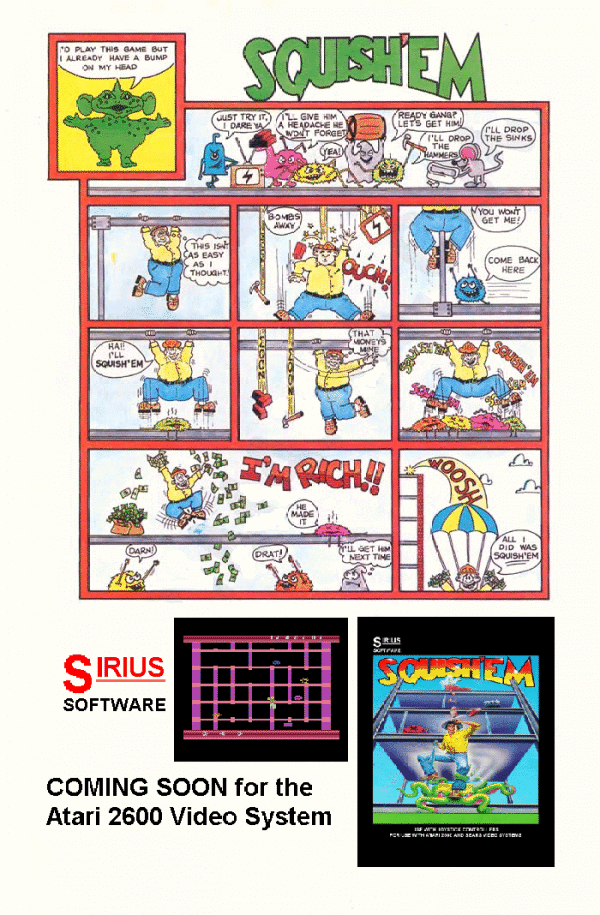
Sirius planned to release this themselves, under the original name, Squish 'Em
(Atari 400/800 flyer, picture #2), until they struck a deal with 20th Century
Fox to release it (and several others) - most of which ended up getting tied
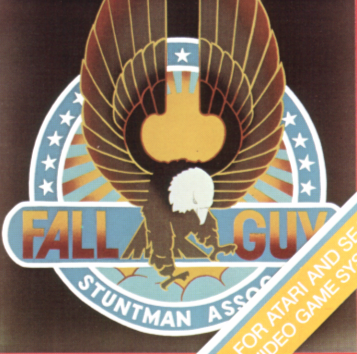
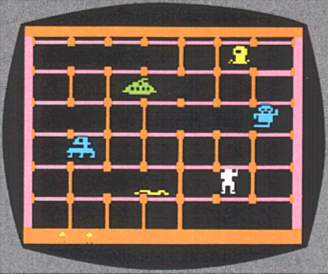
into various TV movie properties of theirs. Pictures #3 and #4 are from a
flyer. A near-perfect version was done by Bob Montgomery in 2007 (picture #5). A
game by the same name was released for the C-64 in 1984 under license by Elite
(box art - picture #6), but it's a completely different type of game. Catalog description: “Let me tell ya, being a stunt man is no easy job – car
wrecks, falls, fights. I thought I’d done it all. Wrong! This new one is
really something else. See, I’ve gotta climb up the side of a 48 story building
and grab a suitcase on the top floor. But that’s not all! This is a monster
movie and this place is crawling with creepy creatures actually trying to knock
me off! And I didn’t even tell you about the bricks they throw at me from the
roof. I’m tellin’ ya, this is really a tough one! Well, gotta go now, time for
another ‘take’. I hope they remembered to put film in the camera this time.”

MELTDOWN
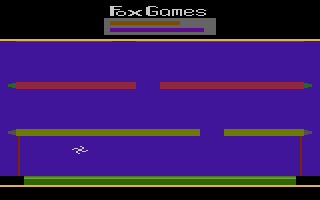
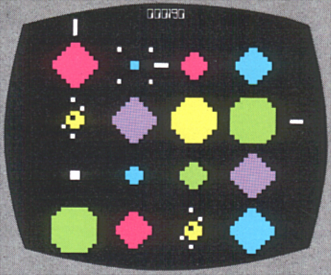
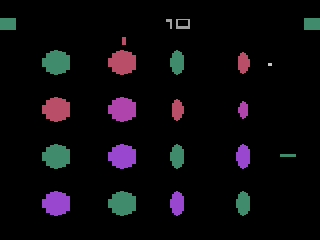
Discovered at CGE2K4 and released by Digital Press
(actual screenshot is picture #3).
Catalog description: “Watching the screen that monitors the reactor core, you
notice something odd, an atom is beginning to throb. Uh oh, this means
trouble! Closer inspection reveals a deadly Quark racing through the core
agitating the atoms. It has to be stopped before it causes a chain reaction of
exploding energy! You must line up the Stabilizing Emitter and fire cadmium
rods at the hot spots. Hurry, the action is really heating up in there. The
Geiger Counter is clicking at a frantic pace. Already the monitor is lit up
with furious pulsing action. This is your challenge – you must meet it or
MELTDOWN!”

REVENGE OF THE CHERRY TOMATOES
This was an early name for Revenge of the Beefsteak Tomatoes.

ROARING 20s
This was one of
the early names for Bank Heist.

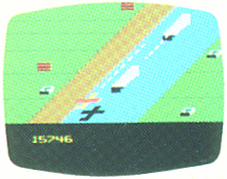
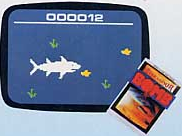
VOYAGE TO THE BOTTOM OF THE SEA
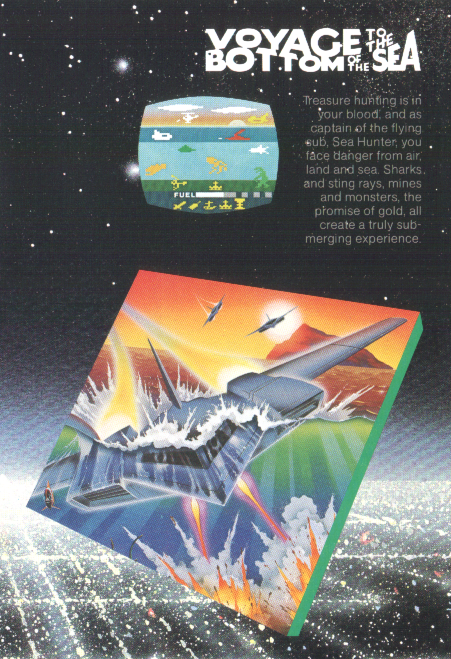
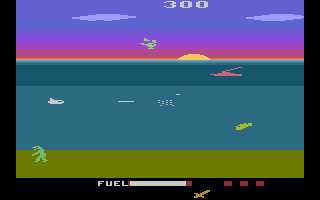
According to programmer Bill Aspromonte, it was based on the popular 60s
movie and TV series, "Voyage to the Bottom of the Sea" and slated for June 1983
release, but it was eventually released under the bland name "Crash Dive"
(picture #2) when they failed to obtain the rights to use the name... even
though it was a 20th Century Fox property! The description for it,
from a 1983 CES Press Kit catalog, shows a rendered screenshot (picture #1), which confirms
they are one and the same.
|
AMIGA |
3-D GENESIS
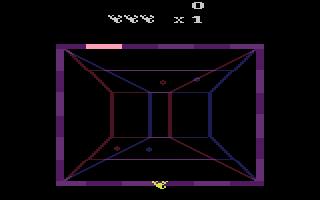
A Tempest clone, but with some unique differences. Originally planned to be 1 of 3 "3-D" games on Power-Play Arcade cart #1. A screenshot was shown in a catalog for Amiga's Power System, but no description was included. It was programmed by Dan McElroy and Jerry Lawson implemented the use of 3-D. Now available for purchase: (LINK)

3-D GHOST ATTACK
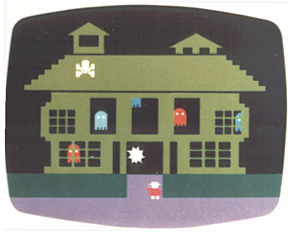
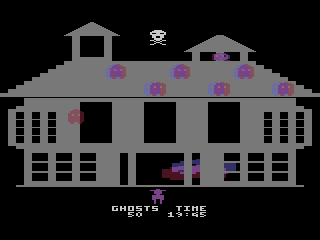
An early screenshot appeared in a catalog (picture #1), which is similar
to the prototype (picture #2) that
was found in 2007.
Catalog description: “They say the mansion is haunted. But
nobody really knows for sure. And you’ve just got to find out. Armed with your
photobeam, you begin your search. Suddenly, there’s a flash of light. Then
another. And another. They’re all around you, coming from the walls, doors,
windows, everywhere. You reach for your trusty photobeam. Now somebody knows
for sure…”
Now available for purchase:
(LINK)
3-D HAVOC
2 different
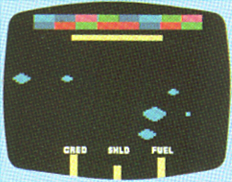
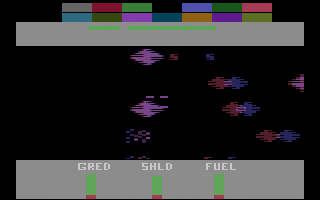
screenshots have been found, the 2nd of
which is similar to the prototype (picture #3)
that
was found in 2007.
Catalog description: “Your stellar cruiser begins to
shudder as the hyperwarp drive suddenly cuts out. Slowing down, you realize
you’ve entered an asteroid field. A BIG asteroid field. You bolt for the
high-density laser-pulse inverter. Your only chance is to blast your way out.
And you’d better start now…”
Now available for purchase:
(LINK)

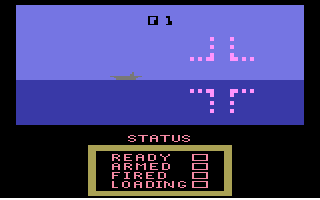
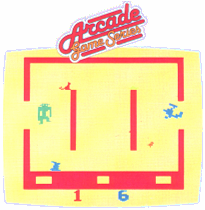
DEPTH CHARGE
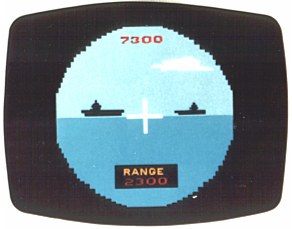
An early screenshot appeared in a catalog (picture #1), which is similar
to the prototype (picture #2) that
was found in 2007. Catalog description: “You know he’s down there. But where?
Your sonar is picking up indiscriminate blips. Then a pattern emerges. You’ve
found him. You launch a round of depth charges over the side, and the
explosions rock the ship. You smile confidently and check the scanner:
completely blank. Suddenly, there’s blip. And another blip. And another.
Or… You know he’s up there. But where… (a one or two-player,
machine-interactive game)”
Now available for purchase:
(LINK)
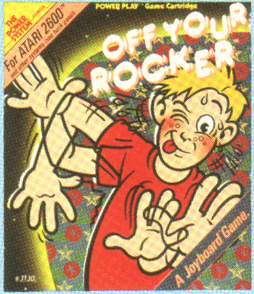
OFF YOUR ROCKER
For use with Amiga's Joyboard controller. A prototype game that
was mass produced! It seems that Amiga sent these carts off to a company that
handled the task of labeling them. During this time Amiga was in trouble and the
games never got labeled or retrieved by Amiga. Years later they were sold off as
scrap to a videogame dealer who added his own label and sold them to the classic
community. Gameplay is similar to the handheld game, Simon.
THE POWER MODULE
A Supercharger-like device that contains its own microprocessor along with an
extra 6K of RAM. Games are loaded via cassette but the Power Module also has a
modem port to allow two players to connect directly to each other over the phone
line for interactive play. It also includes a "unique programming procedure"
that allows for 3-D games. Other features included expanded sound
capabilities and more complex graphics. Packaged with two games: 3-D Ghost
Attack and Depth Charge.


POWER PLAY ARCADE #1
This one featured all 3 of the 3-D games (Ghost Attack,
Genesis, and Havoc) along with a set of 3-D glasses.
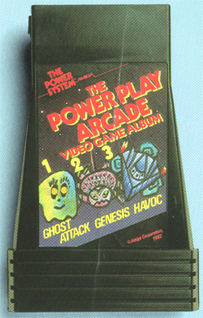
POWER PLAY ARCADE #2
This one featured 1 Amiga game (Scavenger Hunt) and 4 US
Games (Gopher, Eggomania, Galleon's Gold, and Word Zapper).

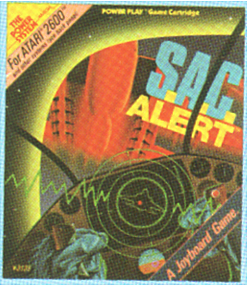
S.A.C. ALERT
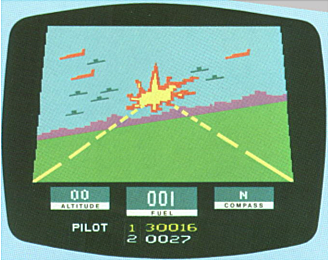
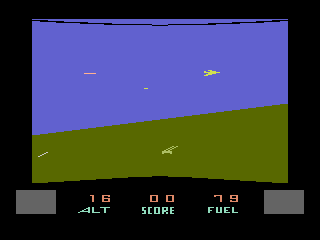
Box artwork (picture #1) and an early screenshot (picture #2) appeared in a
catalog, which is similar to the prototype (picture #3) that was found in 2007.
Catalog description: “You’re guiding your plane through a
routine surveillance mission when suddenly, you’re surrounded by enemy bombers
and fighters. But they’ve seen you first. And you’d better think fast. You
squeeze off a few rounds, just to let them know it isn’t going to be easy. You
pull back hard on the stick, and head straight for the sky. It’s not going to
be easy for you either…”
Now available for purchase:
(LINK)
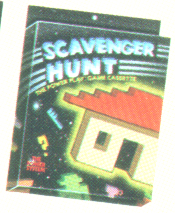
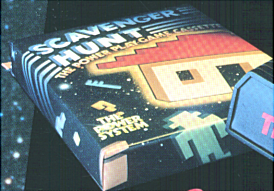
SCAVENGER HUNT
Catalog description: “The perfect game for kids of all ages
– from 6 to 60. The object is to locate each of the items the computer asks you
to find. A comb. An iron. A telephone. Or just about anything else. Just as
easy as you remember it, right? Well, does ‘Beware of Dog’ sound familiar? How
about, ‘you’d better be home before dark’? It’ll be just like ‘old times’…”

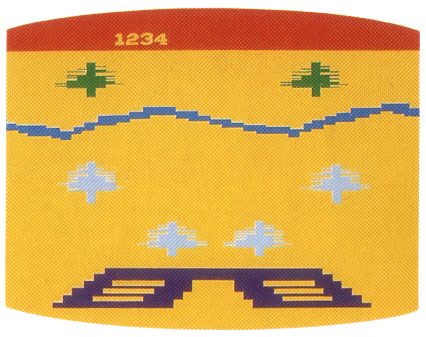
STRAFE
Originally planned as a pack-in cassette
game for Amiga's Power Module peripheral, and later as 1 of 5 games on
Power-Play Arcade cart #2. According to Video Soft founder Jerry Lawson, "It had
very impressive graphics and was an adventure-type of game" and was either
finished or close to being done. Catalog description: “Your objective: destroy all of the
enemy’s oil tanks and land-based missile silos. And, if you can, the central
missile battery: the heart of the enemy complex. But you’ve got to go it
alone. Fly low. Fly high. Through narrow canyons. Under bridges. Let your
instincts be your guide…”
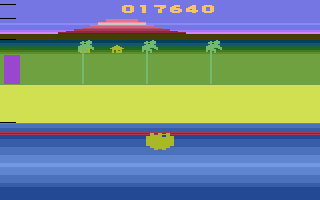
SURF'S UP
For use with Amiga's Joyboard controller. There are approximately 6 known
prototypes found to date. The gameplay appears to be unfinished (flashing lines
and blocks appear in the upper-left corner as you approach the beach - picture
#3). Early box
art and screenshots (pictures #1 and #2) show you having to avoid sharks, and there does appear to be
unused graphics in the code.


|
ANDROBOT |
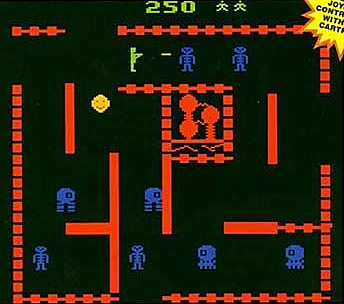
ANDROMAN ON THE MOON
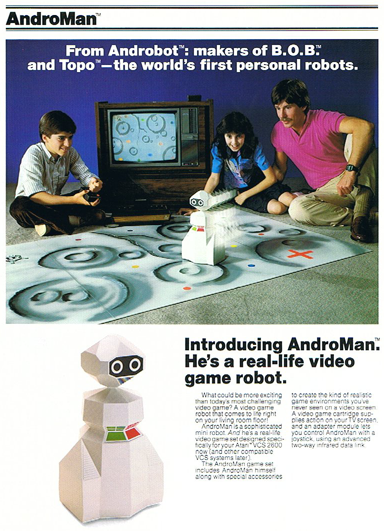
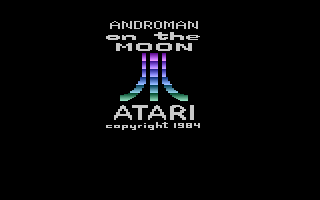
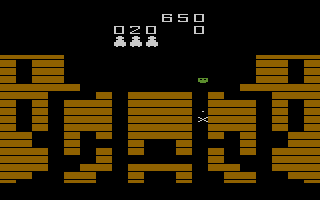
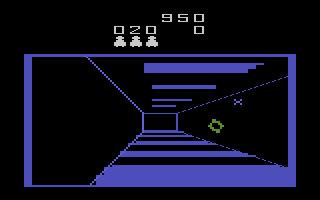
From programmer Michael Case: "The only VCS game I did (at Western Tech.) was AndroMan on the Moon. This was one of the games being done for the AndroMan robot. I don't remember much of the plot, but AndroMan was on the moon (I think we used the floor map shown in the advertisements). I think the enemies were supposed to be aliens. AndroMan was supposed to be harvesting minerals on the moon. He would move over bar codes on the map, which signified mines, and then the video game would show him enter the mine (the maze part - picture #3), being attacked by 'moon aliens' along the way. He dropped bombs to kill them. If he got hit, I think he would jerk around or make some noise, which is why the game hangs. After getting further into the mine, the corridor is shown from a first person 3-D view (picture #4), and he is attacked by flying circular shaped 'moon bats'. He can shoot at them using the joystick to control the cursor on the screen. When he makes it to the end, he gets the resources in the mine. He then has to move on the map to return the resources to the base, and so on."
|
ANSWER SOFTWARE |
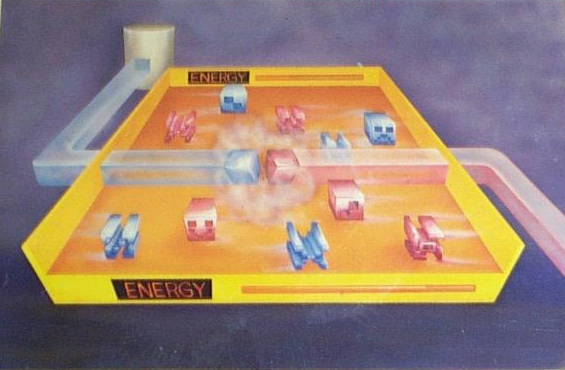
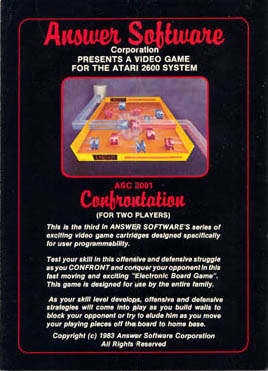
CONFRONTATION
The 1st picture
is
|
APOLLO |
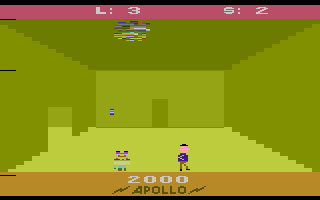
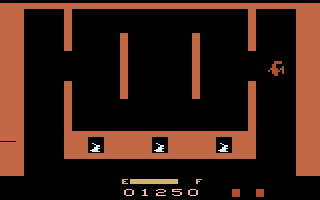
KYPHUS
A maze game set within a pyramid.
According to Ed Salvo: "Kyphus ended up with that name because it sounded
mysterious. We originally thought Kyphus was a distortion of reality, but we
looked it up and (kyphos) it's a distortion of the backbone." There was also a
sign on the wall in the designers' room wall at Apollo that read 'Kyphus is more
than a game - it's a disease'. Talk about viral marketing." A partial photo of
the box appeared on a poster (picture #1). A prototype Apollo game was found in 2006
(picture #2) that
might be Kyphus, but so far it hasn't been confirmed.

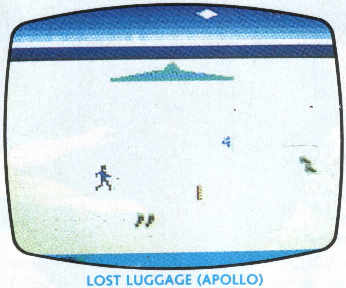
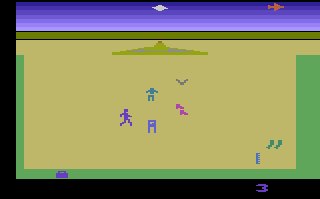
LOST LUGGAGE
The first picture is from Electronic Games 5-84, and
shows different colors from the actual release (picture #2).
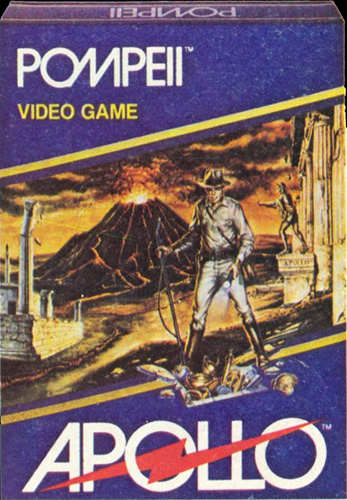
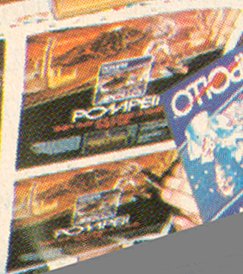
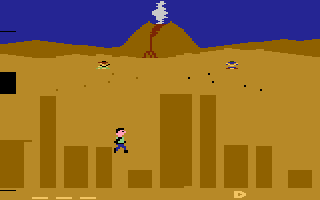
POMPEII
The only known prototype of this
game was discovered in November 2001 by Digital Press and is not playable
(picture #4). Early description is a game involving the perils (of) moving
around an active volcano. Several pictures of the box exist - box artwork appeared in the Jan 1983 issue of Elec. Fun w/ Computers & Games
magazine (picture #1); the same issue also mentioned Pat Roper stating this was
originally called Labyrinth.
A box was shown in a magazine, taken at a 1983 CES,
A partial photo of the box appeared on a poster (picture #3).

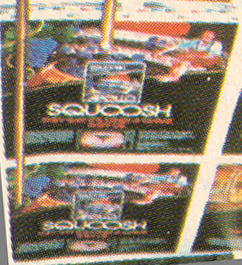
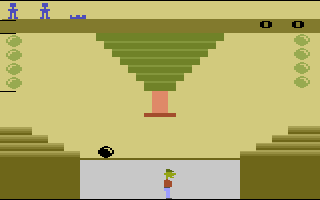
SQUOOSH
Description: "You work for the
Apollo Grape Company and must stomp grapes without getting stomped yourself.
Avoid plunger and falling grapes while turning other grapes into wine". Box
artwork appeared in the Jan 1983 issue of Elec. Fun w/ Computers & Games
magazine (picture #1); the same issue also quotes Pat Roper as saying, "We thought about
calling it 'Vats Incredible' or 'The Grape Escape', but decided Squoosh
instead.". 2 prototype versions exist - the earlier version allows you to move
around and jump (picture #2); in the later version grapes can move around and you can hit the
press (#3).

|
ATARI |
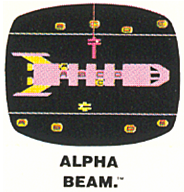
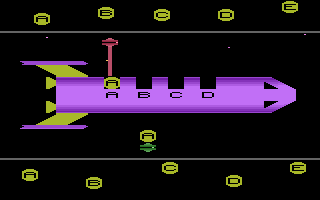
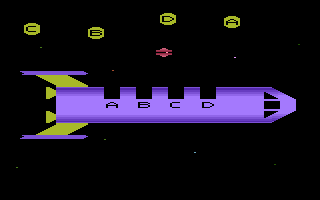
ALPHA BEAM WITH ERNIE
An Atari Kid’s Library brochure shows a screen picture (#1)
of what is actually a prototype version (#2). The release version (picture
#3) doesn’t have
lines above and below the space ship.
ASTEROIDS
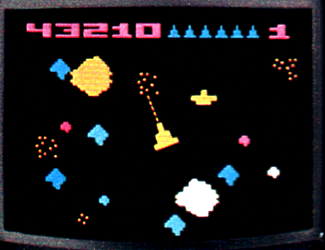
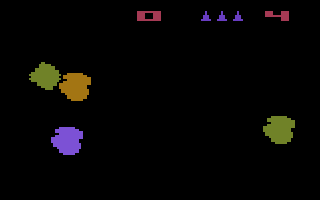
Early catalog screen depictions (picture #1) showed reserve ship icons in
addition to the reserve counter. There is actual code in the program for
displaying these icons, but it was disabled - Brad Stewart feels it was probably
done as a result of him and Bob Smith trying to squeeze the cart down to 4K, and
he forgot to enable it when he was given 8K. The 2nd picture is
an actual screenshot showing
what it looks like enabled.
COUNTERMEASURE
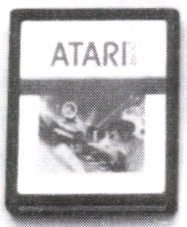
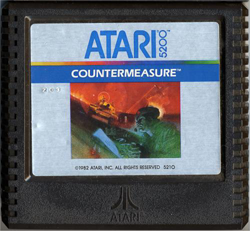
A picture of a 2600 cart (picture #1) with the same artwork as the 5200 cart
(picture #2) appeared in the 1983 Rev 1 2600 system
manual. Whether or not Atari actually had any plans to make a port of the 5200
title is unknown.
DEMONS TO DIAMONDS
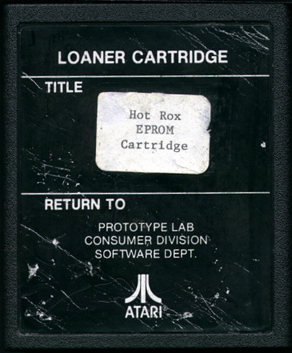
The original working title for this game was "Hot Rox". Box art can be seen on
the inside cover of Atari's 1982 Rev D and E catalogs (pictures #1 and #2), as well as
the 2nd revision of the Log Book.
Some prototypes have surfaced with this name as well (picture #3).

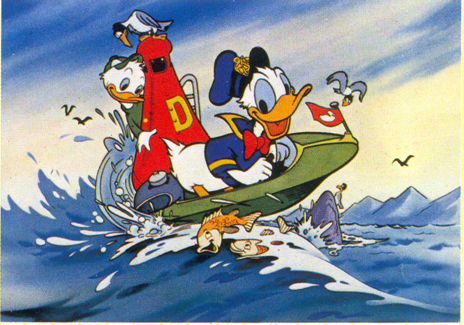
DONALD DUCK'S SPEEDBOAT
One of 3 games featuring Disney characters that was never released (although it
was pirated by Polyvox and a few other companies, and released in Brazil). From
a 1983 CES Press Release: "A speedboat obstacle course is always an adventure
with Donald Duck at the controls. Donald must avoid rocks, whirlpools, seaweed,
fish, and the bobbing buoys of nephews: Huey, Dewey, and Louie. The faster he
finishes the race, the more points he scores. The multiple obstacle screens and
game variations add to the game-play challenge, and the graphics and music make
this an enjoyable game for kids from ages 5-10." Originally scheduled to be
released in September of 1983. Suggested Retail Price: $30.45. The tentative
title for it was "Donald Duck's Regatta" and a prototype with this name has been
found. A promo box exists (picture #1), and the full artwork was shown in a
Brazilian catalog (picture #2).

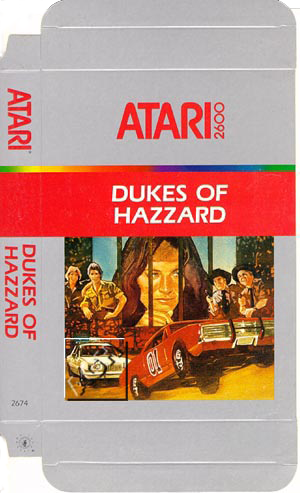
THE DUKES OF HAZZARD
The game
was first mentioned in the Atari Age magazine (Nov/Dec 1982 issue).
This version came 3 years after Atari's 1st attempt. Unlike most of the other
prototypes/pre-production games, this was actually produced on ROM chips (using
the new Chip-On-Board design), and in large quantities... which is odd since
Hahn states the game wasn't finished! Atari apparently was just about to slap
the labels on thousands of Dukes cartridges – finished or not – before deciding
against releasing it at the last minute; the reason Atari gave Hahn was the
game's graphics weren't on part with other releases at that time. Notice of its
cancellation was announced in the Sept/Oct 1983 issue of Atari Age.
Below is a picture of the promo box.
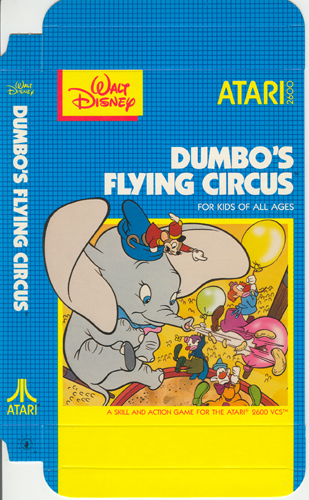
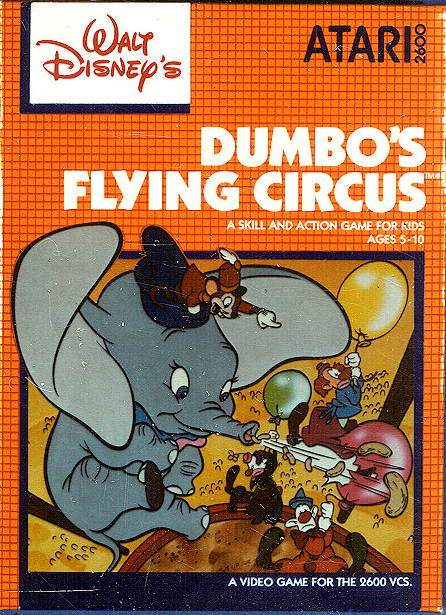
DUMBO'S FLYING CIRCUS
One of
3 games featuring Disney characters that was never released. Several prototype
boxes have been found for this title. From a 1983 CES Press Release: "Dumbo, the
flying elephant with the big heart, takes to the air in this high-flying home
video game. By shooting peanuts out of his trunk, Dumbo pops balloons and scores
points. If he pops those balloons that are carrying a clown and brings that
clown safely to earth, Dumbo scores even more points. Designed for kids of all
ages, Dumbo's Flying Circus features fast-paced aerial action that the whole
family can enjoy." Originally scheduled to be released in October of 1983.
Suggested Retail Price: $30.45. Picture #1 is of a promo box, and picture #2
apparently came from a marketing slide.
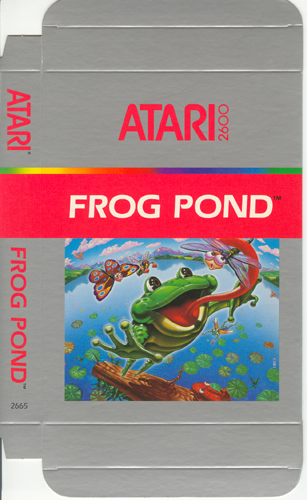
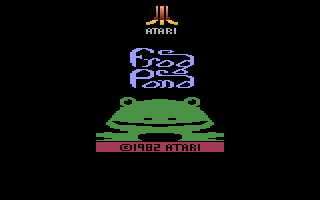
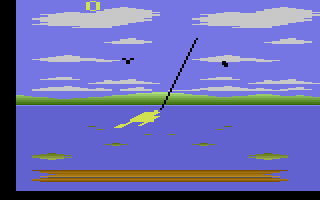
FROG POND
A couple of prototype boxes
(picture #1) have also been found for this title, as well as 2 different
prototype versions -
one with a "rainbow" title screen (picture #2), and one with a detailed graphics
screen (picture #3 - most likely the final version). The game looks and
plays the same with both (picture #4). A picture was show in the
12/82 issue of Electronic Games (page 50), and the game was actually reviewed in
Videogaming Illustrated, 12/82 (page 27)!

GATO
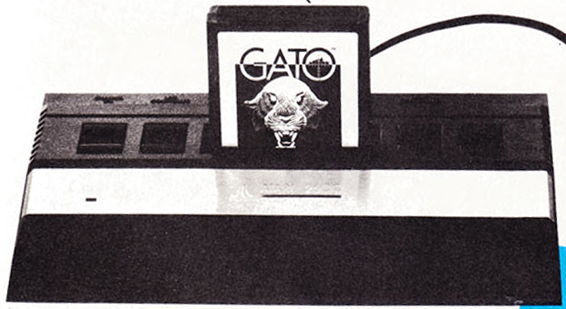
A picture of a labeled cart in a
2600JR appeared in a German ad. Whether or not Atari actually had any plans to
make a port of this 8-bit computer title is unknown, but a 7800 port was being
worked on (a prototype exists).
THE GRADUATE COMPUTER
This was to be Atari's
entry into the emerging 2600 keyboard market.
The unit plugged into the VCS cart port and was self-contained, much
like how the 5200 VCS adapter works (using the base system for power and display
only). It was actually developed outside of Atari, by a company called
Peripheral Visions, Inc., which was formed in late 1982 by
3 former Commodore VIC-20/C-64 engineers (Charles Winterble, Al Charpentier, and
Bob Yannes). Winterble conceived of the idea to turn the VCS into a
computer, and they called it "My First Computer". Designed with a $29.95 price,
it was to feature a membrane computer and have BASIC built-in. PVI approached
Ray Kassar with the idea, and he agreed to purchase it for a million dollars.
Under the deal, PVI would develop the hardware and Atari the software. The
product was given the model number CX-3000, and was known by several names during its
development ("My First Computer",
"2600 Computer", "The Graduate"), undergoing
several changes (case designs, features, price points, etc) before ultimately being cancelled by James Morgan when he took
over as the new CEO in 1983. An ongoing lawsuit against PVI by
Commodore was likely the main motivating reason for its cancellation. Soon
after PVI was formed, Jack Tramiel heard PVI approached Atari and filed a
("exploratory") lawsuit against them, claiming they stole trade secrets. PVI
were forced to disclose details of their VCS project. Tramiel insisted that was
his product, and pursued the case. PVI eventually won, but it cost them
several years and approximately $300,000.
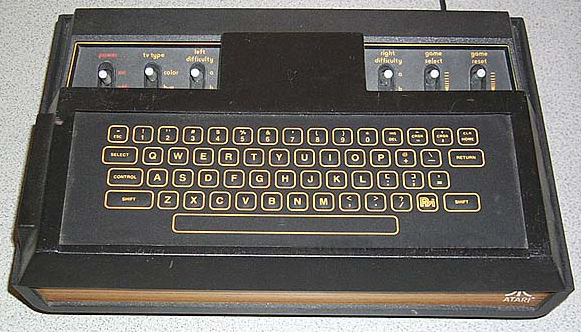
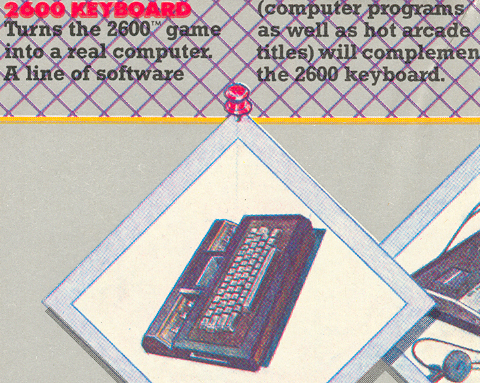
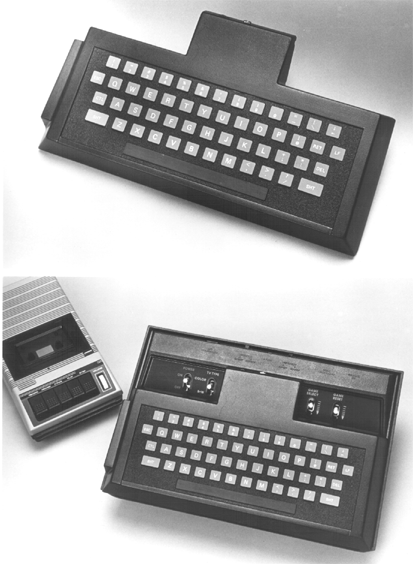
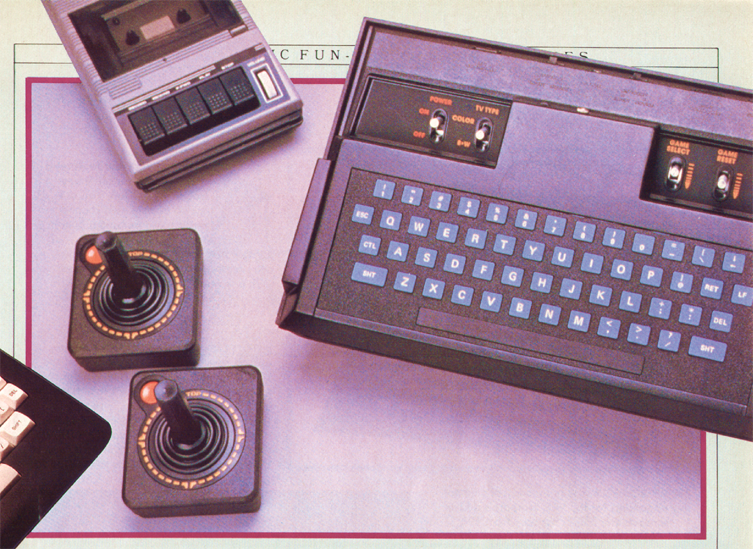
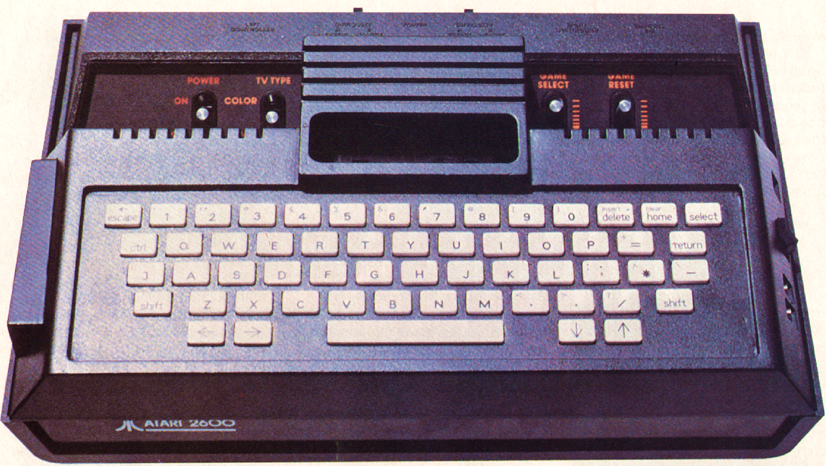
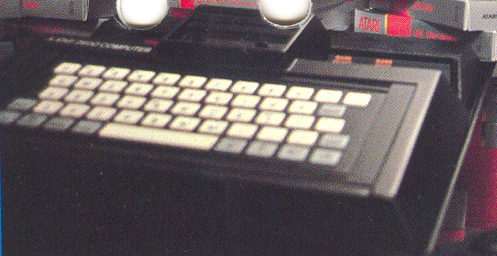
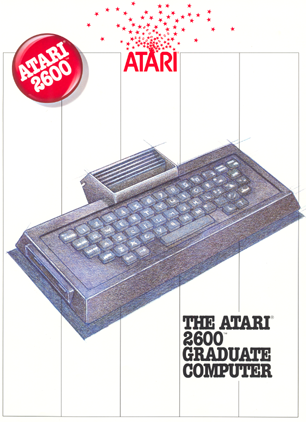
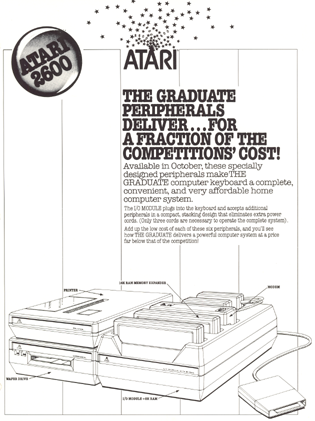
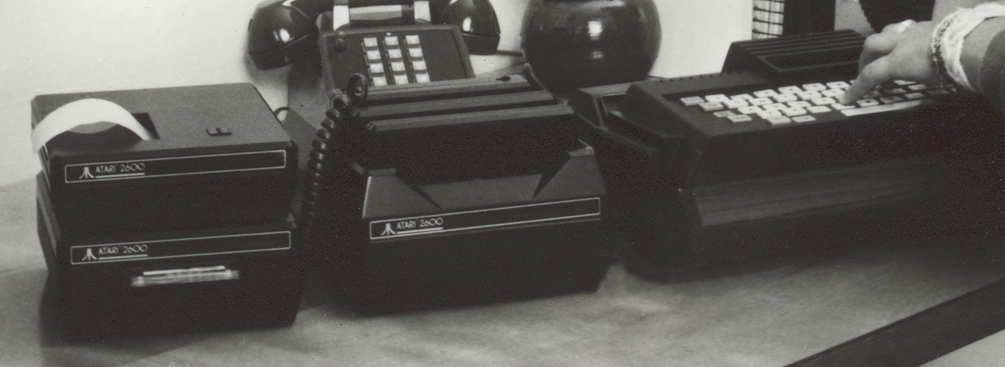
The only known existing (and functional) prototype (picture #1) has a 56-key membrane keyboard (note the key labeled "PVI") and a side cart port. It was shown at the World of Atari show in 1998. A February 1983 press release states the keyboard would be available by 3rd Quarter nationally. It featured 8K of memory (expandable up to 32K) and 56 raised keys (although early drawings and even the first mock-up show only 53 keys), plus a suggested retail price of less than $90. The side cart slot ("expansion port") could also be used for optional peripherals such as a portable cassette recorder, printers, disk drives, and modems. The same press kit mentions the official name was to be "My First Computer", even though "2600 Computer" is shown as being trademarked. A drawing of it was first shown in Atari's 1983 "Ticket to the Stars" catalog (picture #2) - note the full-size keyboard and the "hole" at the top. Photos of the unit (sans "hole") were shown in both the Feb 1983 press kit (picture #3) and the May/June 1983 issue of Atari Age magazine (picture #4) - note the power jack on the back edge of the unit. According to hardware designer Regan Cheng, the unit shown was actually a mock-up (the keys were simply glued on). A larger photo of it appeared in the July 1983 issue of Electronic Fun with Computers & Games magazine (page 47, picture #5); a design was shown in their September issue (page 36, picture #6). Note the extra connectors on the right side. A 1983 TV commercial showed yet another design (picture #7); a better photo from that spot appeared in the "2nd Half" press kit (picture #8) clearly shows the name "Atari 2600 Computer" on the upper-left, a 55-keymembrane keyboard, and a cartridge port on top (where the "hole" originally was). The same press kit also include several flyers which showed drawings for both the keyboard (picture #9) and peripherals (picture #10). The keyboard drawing shows yet another design, with raised keys and the cartridge port back on the left side. The peripherals are:
I/O MODULE + 8K RAM
PRINTER
MODEM
16K RAM MEMORY EXPANDER
GRADUATE DATA CASSETTE DRIVE
WAFER DRIVE
Another flyer listed 9 software titles (in 4 different categories) were slated to be available by October:
PROGRAMMING - $40.95 each:
An Introduction to Programming
Children's Introduction to Programming
HOME MANAGEMENT - $40.95 each:
Home Filing Manager
Family Finances
EDUCATION - $35.45 each:
Typo Attack
Monkey Up a Tree
GAMES - $40.95 each:
Donkey Kong by Nintendo
Robotron 2084
Caverns of Mars
A June 1983 press kit refers to it as "The Graduate" (also trademarked) and states the unit had 8K of built-in Microsoft BASIC. The accompanying photos show the keyboard and optional devices almost exactly the same as depicted on the earlier flyer (picture #11).


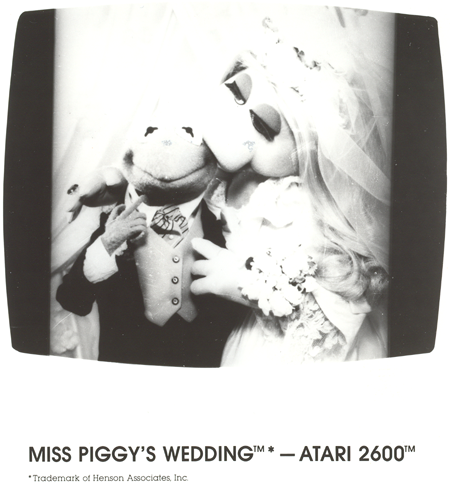
MISS PIGGY'S WEDDING
Was to
be the 2nd "action" game cartridge featuring Jim Henson's Muppets characters
(after Pigs in Space). 3 different prototypes of this game are known to exist,
none of which are complete. The photo below is from a 1983 press kit, with the
following description: "The wedding bells are soon to ring... until Kermit, the
reluctant groom, changes his mind and leaves Miss Piggy at the altar. The church
becomes a video maze, with Kermit on the run and Miss Piggy in hot pursuit. The
chase becomes even more elaborate when the wedding guests move about. Players
can choose to be either Miss Piggy or Kermit in this Atari-The Muppets game,
designed to be enjoyed by all age groups."
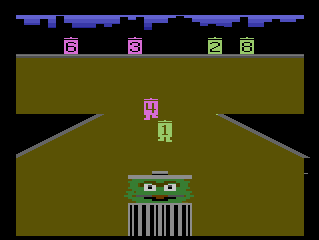
OSCAR'S TRASH RACE
Early
pictures from Electronic Games (picture #1) and an Atari Kid's Library
brochure (picture #2) resemble an actual prototype that was recently discovered
(picture #3), which is
noticeably different from the release version (picture #4).


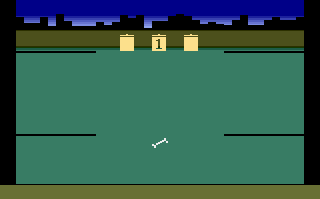
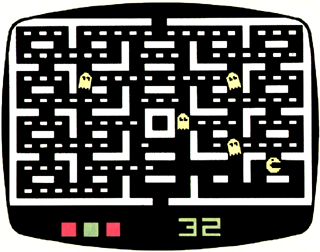
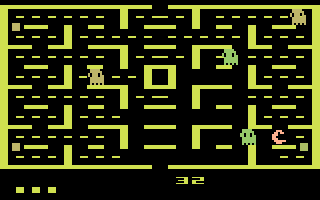
PAC-MAN
Early screenshot (picture #1), shown in the 1982 green poster/catalogs,
showing a black background (like the arcade version). A variation of this
(picture #2) was shown in magazines such as Electronic Games (note the missing
power pills and multicolored reserve lives indicators), even well after the game
was released! A
hacked version of the original was made by Jason Parlee in an effort to match
this photo (picture #3).

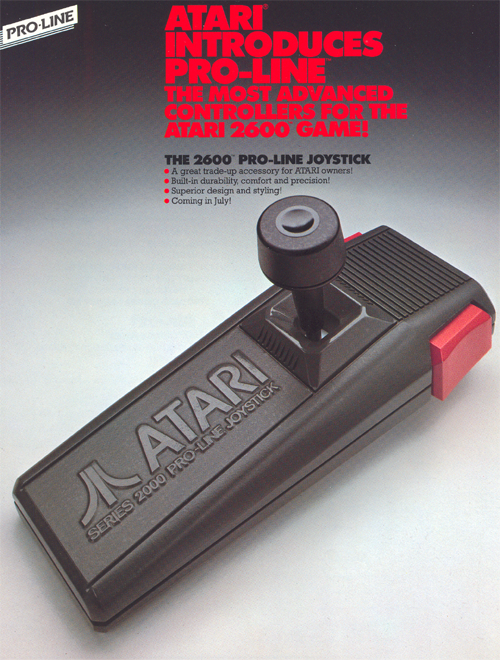
PRO-LINE JOYSTICK
Originally one of Atari's
"Pro-Line" Advanced Controllers. A company flyer (picture #1) notes it was coming in July
1983, with a photo showing "ATARI SERIES 2000 PRO-LINE JOYSTICK" molded into the
top of the plastic base. However, this version was never released. When the 7800
was finally released in 1986, it included a slight variant of it - in place of
the molded plastic was a metal plate on the base with "Atari" on it, and the
fire buttons were modified for 7800 games that required 2 fire buttons.
Also released separately for the XL computers (with similar packaging - picture
#2).

RAIDERS OF THE LOST ARK
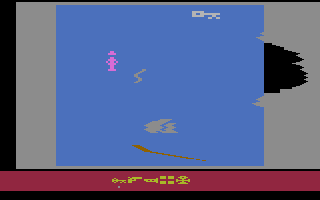
A 1982 dealer ad shows an artist’s rendition of the
Entrance screen (picture #1) that depicts the original location for the key! A modified
version of the game shows what the key would have actually looked like (picture
#2) - the code
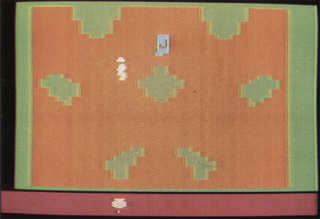
for it still exists in the game! Picture #3 was
an actual screen photo that appeared in several publications in at least 7
separate instances:
Consumer’s Guide book, How to Win at Home Video Games, (page 56)
Electronic Fun with Computers & Games magazine (November 1982, page 64 - picture is flipped horizontally)
Electronic Games magazine (November 1982, page 8)
Electronic Games magazine (March 1984, page 24 - picture is upside-down)
.
Joystik magazine (November 1982, page 5 – picture is flipped horizontally)Videogaming Illustrated magazine (December 1982, page 59)
Book, Videospelletjes - Complete Handleiding Voor Winnaars, (by Arnie Katz, Bill Kunkel and Kees van Toorn, page 52)
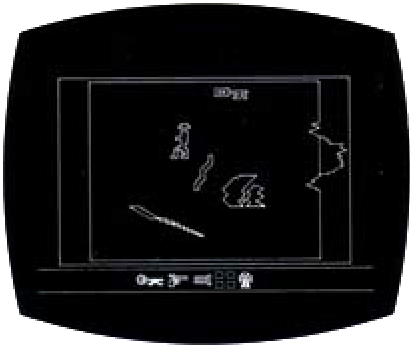
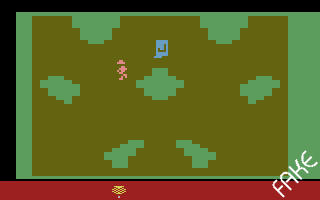
The photo is famous for showing graphics artist Jerome M. Domurat’s initials (shown as a graphic “logo”) in the mesa field. For reasons unknown, this graphic was removed in the released version, although there are some "holes" in the program that hint where it belonged and how it was to be used. A fake, pixel-perfect screenshot (picture #4) was created by Scott Stilphen to more clearly illustrate the photo (picture #3), although the colors are wrong due to imperfect emulation.
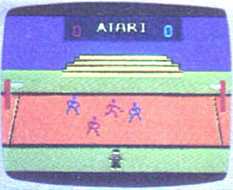
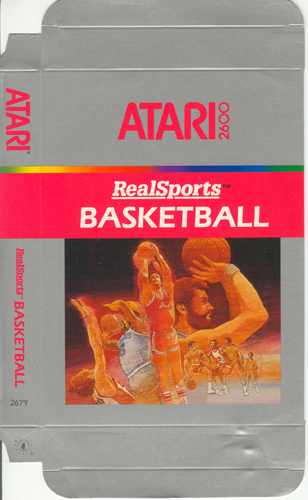
REALSPORTS BASKETBALL
A 1983 catalog screen picture shows a referee at the bottom
of the screen (picture #1); although the only known prototype version doesn’t show one
(picture #2), the
graphics for him are in the code (picture #3). According to Joe Gaucher,
Atari canceled it before he was finished with it and that he had to take out the
ref due to memory constraints. The ref was interactive and would mess with the
players and run alongside them. A promo box also exists (picture #4).


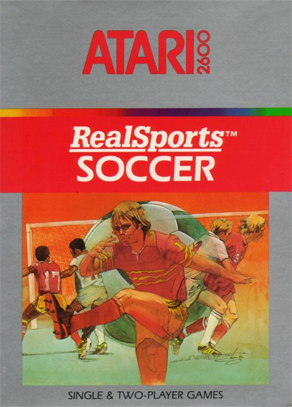
REALSPORTS SOCCER
Alternate box artwork (picture #1) appeared in
the September 1983 issue of Electronic Games (page 34), which was actually used
for the 5200 version of RealSports Soccer (picture #2), and not the non-Realsports-labeled Soccer version, which had different artwork.
Picture #3 is the artwork used in the released 2600 version.
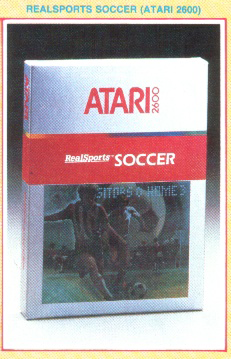
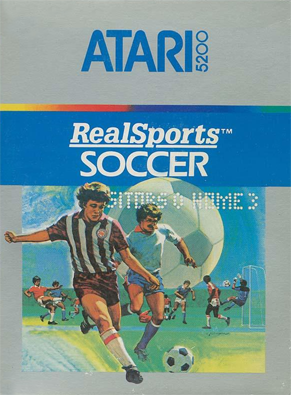
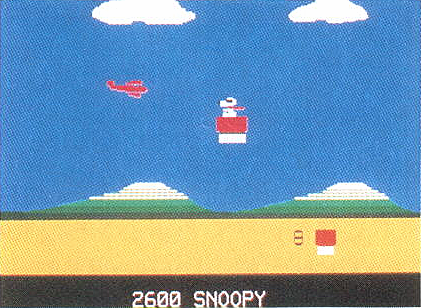
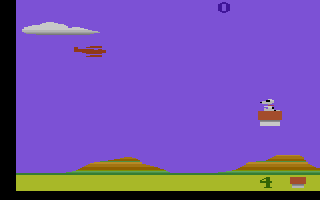
SNOOPY & THE RED BARON
The first picture is from Atari Age magazine, and shows different colors
from the actual release (picture #2).
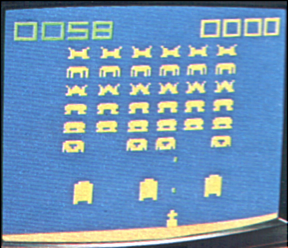
SPACE INVADERS
Early catalogs pictured a completely different version on
the introduction page (picture #1), while the entry description page showed an
accurate version compared to the release (picture #2).
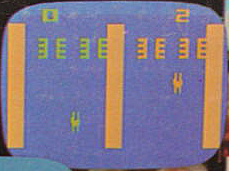
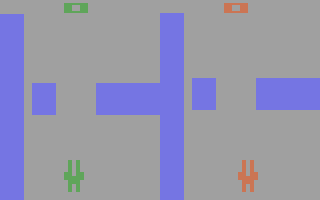
STREET RACER
This photo (picture #1) appears on the original 1977 system
box. While all of the screenshots on the box are artist renderings, this is the
only one that is noticeably different from the actual game (picture #2).
SUPER BASEBALL
This alternate box was shown in a commercial featuring Ozzie Smith. The game is
likely Super Baseball,
although the artwork doesn't match any Atari versions. The box shown for the
7800 version was also different (it uses the same artwork but the title is RealSports
Baseball instead of Baseball).

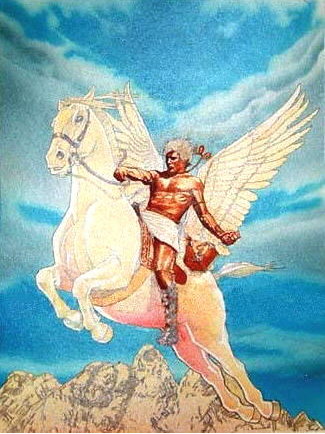
SWORDQUEST AIRWORLD
Although the game was never finished, 2 different artwork
pictures were circulated – one a small box art picture from an early ad (picture
#1) and the other a painting that was found within Atari when it closed up,
which may have ended up being the final art (picture #2). Note the Philosopher’s Stone just
under the rider’s left arm, which was to be the prize for that game’s contest.
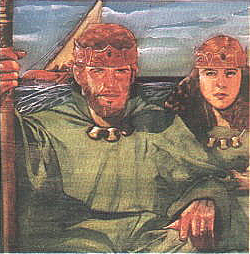
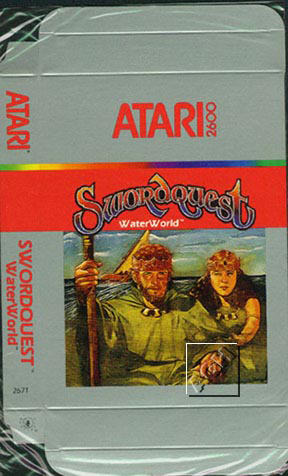
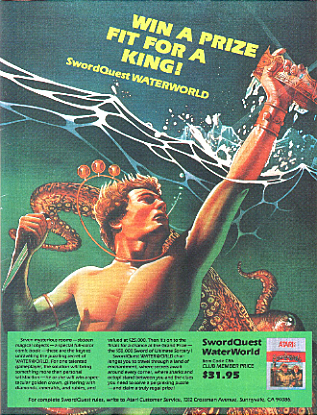
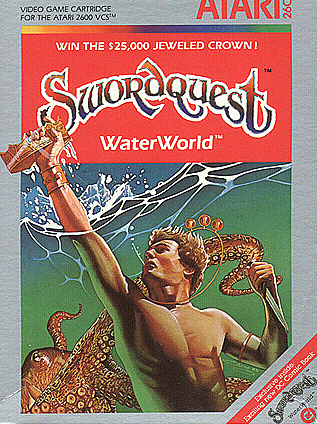
SWORDQUEST WATERWORLD
2 Alternate artworks were first shown. The first (picture
#1) appeared in an early magazine ad. Afterwards, some catalogs showed a
different picture (picture #2), which also appeared on a promo box (picture #3). Just before its release, the Atari Age
magazine showed what would be the final released art (pictures #4 and #5),
although the artwork was a mirrored image, and the ad also included a box
showing the catalog art!
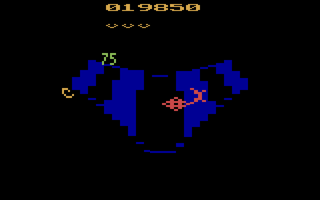
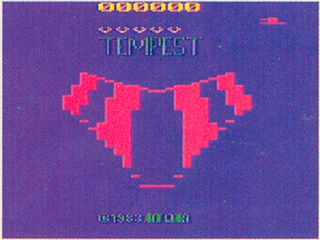
TEMPEST
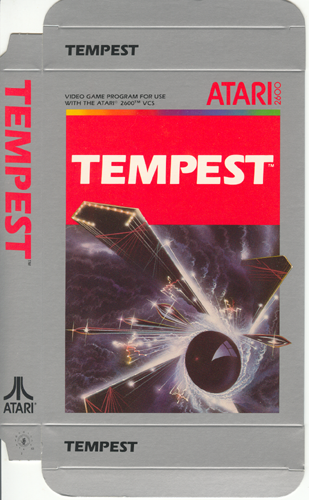
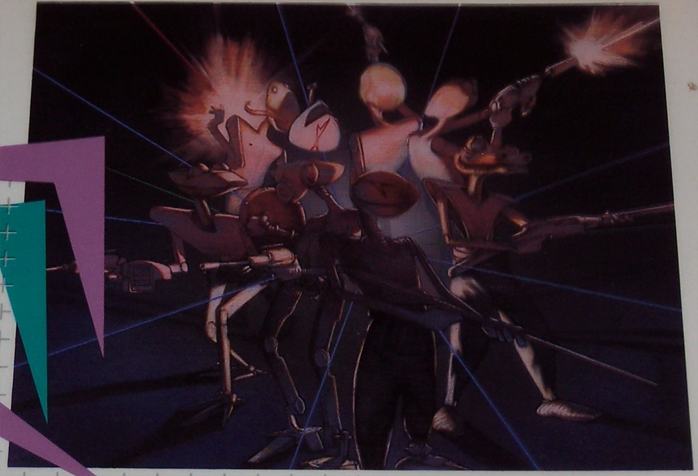
A promo box (picture #1) exists for this game, as well as some alternate artwork
that was intended for the 5200 version (picture #2). At least 2 different
prototypes exist. The earlier version, dated 1-5-84 (picture #3), is very
similar to the later version, dated 2-28-84 (picture #4), except that it lacks a
copyright and a title screen. Both versions are incomplete, and only show one
layout As of now, the only person who has a copy of the later version is John
Skruch (both appeared in an article in the January 1996 issue of Ultimate Gamer
magazine). Due to its CX (part) #, this may have been slated to become an Atari
Club exclusive release title.
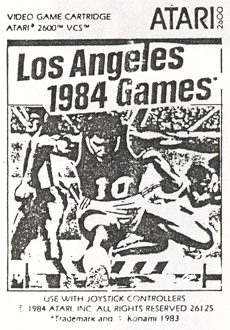
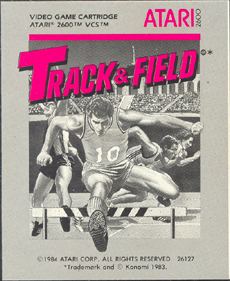
TRACK & FIELD
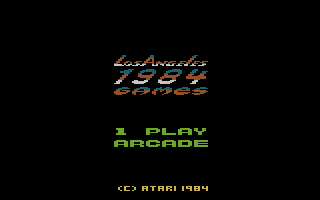
An early photocopy of the cart's label was found with the game's original name
(and correct CX #) - Los Angeles 1984 Games (picture #1). Konami is
credited on this label as well, so apparently Atari bought the home rights for
Track & Field and planned to use it as a tie-in to the 1984 Olympics (which
Atari was a sponsor of) but for whatever reason decided not to. A prototype exists with the alternate name
(picture #3). Picture #4 is the released version.

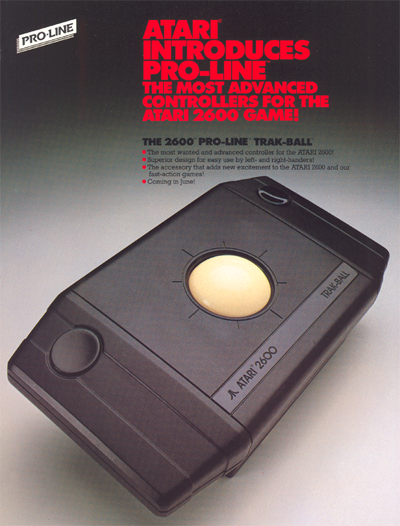
TRAK-BALL CONTROLLER
One of Atari's "Pro-Line" Advanced Controllers. A company flyer
(picture #1)
notes it was "coming in June '83", with a photo showing "ATARI 2600 TRAK-BALL"
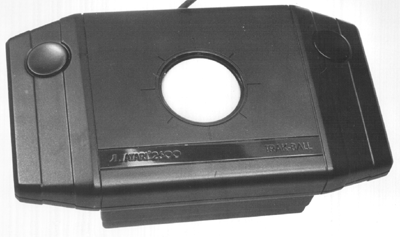
and with fire buttons that are full concave. A marketing photo (picture #2)
clearly shows the letters being molded into the top of the plastic case. Another
photo (picture #3) showed it having red fire buttons, which none of the released
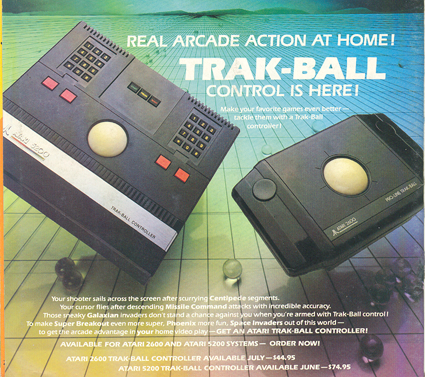
versions had. Yet another photo appeared on the back cover of the May/June
1983 issue of Atari Age magazine (picture #4), showing the text in white
lettering. However, none of the 4 released versions looked exactly like the
marketing photos.
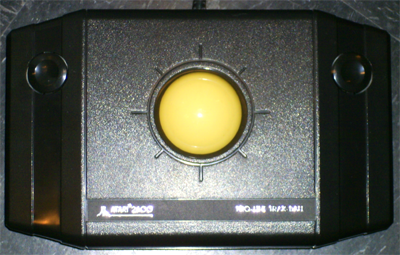
The version originally released (picture #5) has buttons that aren't fully concave, the lines radiating from the ball on the top case aren't as long, and the text on top isn't the same ("ATARI 2600" is underlined on the left and is smaller, with "PRO-LINE TRAK-BALL" to the right). Also, the text isn't molded in the case but instead printed in raised, chrome lettering on a black sticker. Although the case has a hole and markings on the left side for a Trak-Ball/joystick mode switch, the pcb design doesn't support it (and the hole is covered up). The sticker on the bottom notes that it was manufactured at Atari's El Paso, TX plant.
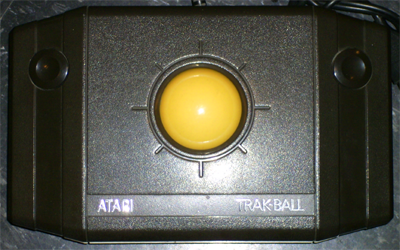
The 2nd released version (picture #6) has a white base and different text ("ATARI" on the left with no logo, and "TRAK-BALL" on the right) and the pcb has the mode switch, although Atari never released a VCS game that supported Trak-Ball (i.e. analog) mode. The sticker on the bottom notes that it was manufactured in Mexico.
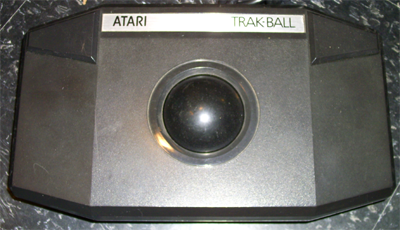
A 3rd version was later released with a redesigned case, a black ball, triangular fire buttons, and a silver plate across the top with black lettering printed on it (picture #7). The mode switch is now on the back and is marked "JS" (for joystick) and "TB" (for Trak-Ball). Note that there are 2 different (internal) versions of this model as well - the 1st is compatible with the CX-22; the 2nd is compatible with the Atari ST mouse (some jumpers were added to the board inside). The only way to tell which version you have is to either try it, or open it up and look for the jumpers.

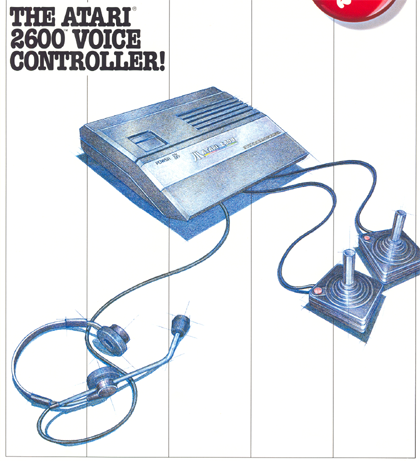
VOICE CONTROLLER
This was a
joint-collaboration between Atari and Milton Bradley, with MB to develop a
version of their TI MBX speech synthesis and voice recognition system for the
2600 and 5200. It used a combination headset/microphone which enabled players to
control games by voice commands. It was originally called the Voice
Commander, and a drawing was first shown in Atari's 1983 "Ticket to the Stars"
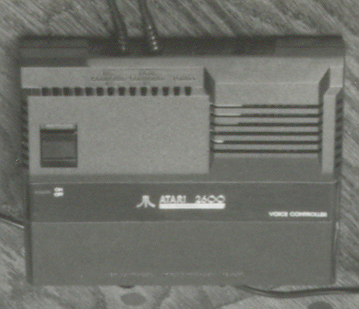
catalog (picture #1). Both a flyer and an actual photo of the unit were shown in Atari's June 1983
press kit (pictures #2 and #3), and the accompanying letter states it was demoed at the
Chicago CES show, using a version of RealSports Baseball! It also included a
headset, and that 3 other VC games were Star Raiders, Battlezone, and Berzerk.
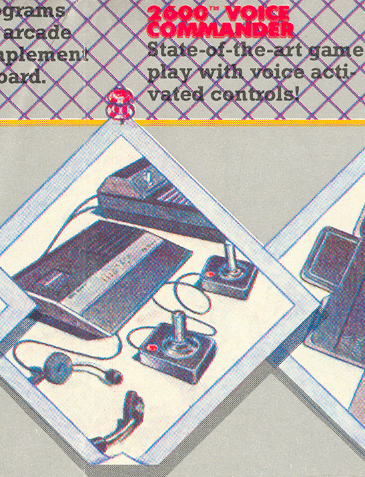
The unit was shown in press releases and at least 1 TV spot (where it was
referred to as a "voice module" - picture #4), but to date no prototype (or even a
mock-up) has been found. MB was also to develop a total of 18 (!) cartridges
over 3 years, with most to incorporate use of the Voice Commander. Suggested
Retail Price: $99.95. According to a CES Press Release, this unit was scheduled
for an October, 1983 release. Atari apparently backed out, prompting MB to sue
them for breach of contract. Atari's case design was eventually reused for their
2600JR system.
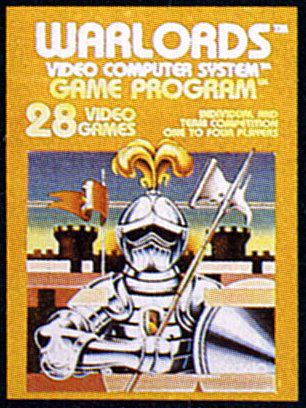
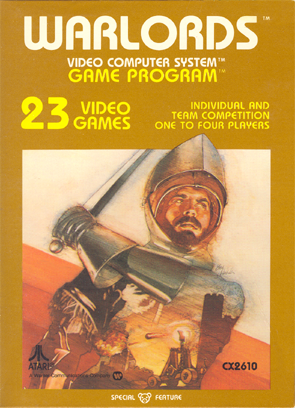
WARLORDS
Different box
artwork (picture #2) was initially shown in early catalogs. Atari programmer Jim
Huether was actually the artist's model for the released version (picture #2).
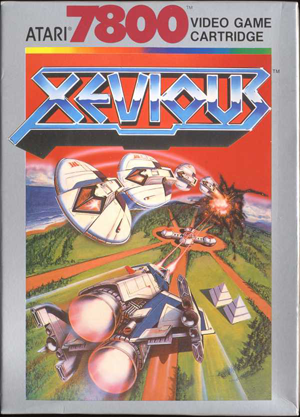
XEVIOUS
A box (picture #1)
was show for this at the 1983 Winter CES, which is identical to the 7800 artwork (picture #2).

YARS’ REVENGE
This early catalog screen depiction
(picture #1) shows both the Zorlon
cannon and the Neutral Zone (referred to as the "rainbow ion zone" in the first
Atari Age magazine) as being comprised of multi-colored horizontal
lines. At certain points in the released version, the Zorlon cannon has a
similar appearance, except that it is pink in color (picture #2).

|
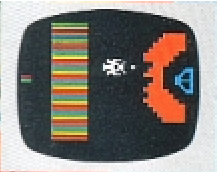
BOMB |
SPLENDOUR
Catalog description: “Jaws bit and flight ambitiously in the ocean. Time is
limited and points will be given when the jaws clear up surroundings, do not
miss the bombs. Two players can play this game alternatively.”
|
CBS ELECTRONICS |
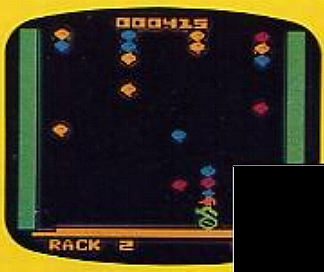
KICK-MAN
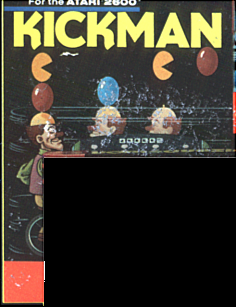
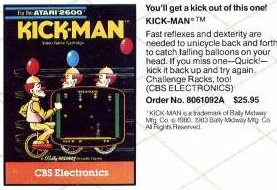
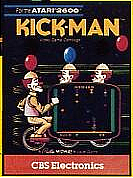
Announced at the 1983 CES. The screenshot (picture #1) is most likely a mock-up, since it shows 5 balloons
falling at once (on rack 2!). 2 different box artwork were shown - one
showing the title as one word (and with Pac-Man) and the other showing the name
hyphenated (and w/o Pac-Man). Description: "Fast Reflexes and
dexterity are needed to unicycle back and forth to catch falling balloons on
your head. If you miss one - Quick! - kick it back up and try again. Challenge
Racks, too!"
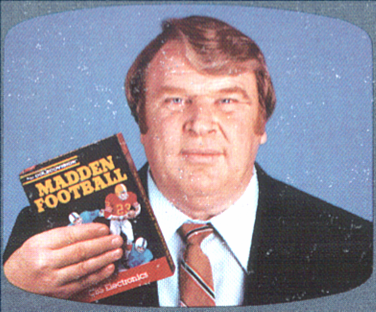
MADDEN FOOTBALL / MADDENESS
Boxes were shown in ads, but no screenshots. Programming was at least
started on it, and it closely resembled the Atari Football coin-op. Catalog
description: “The video football game for the coach in all of us! Developed by
the man who wrote the book on offense and defense: John Madden. Realistic
gridiron action with eleven players on a side and advanced play options!”
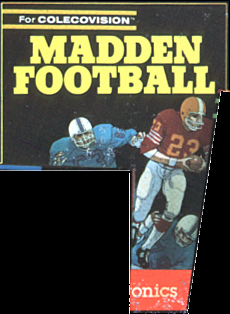
TARG
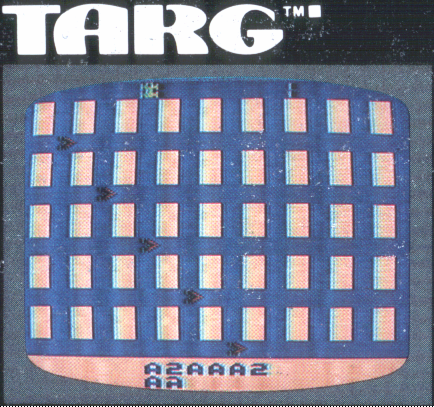
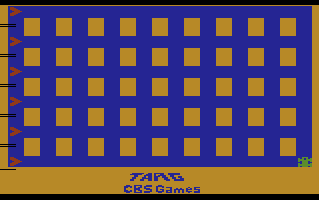
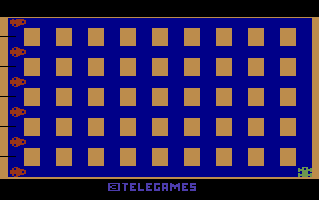
This actual screenshot (picture #1) appeared
in some 1983 CBS literature. A prototype version was found in 2004 that is very
close to complete (picture #2). The
game was eventually released by Telegames under the name Universal Chaos, with
slightly altered graphics (picture #3).
TUNNEL RUNNER
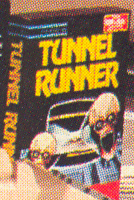
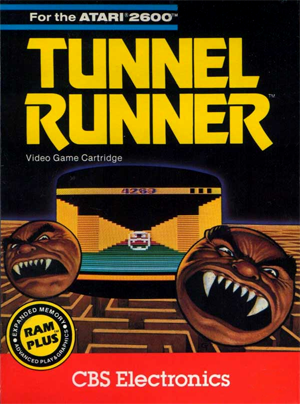
A promo box with alternate artwork (picture #1) appeared in an interview with CBS Video Games' Robert Hunter in
the July 1983 issue of Video Games magazine (page 26). Picture #2 is of the released
version.
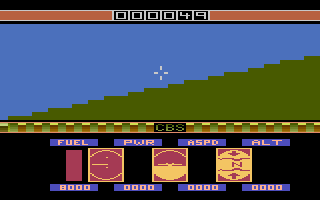
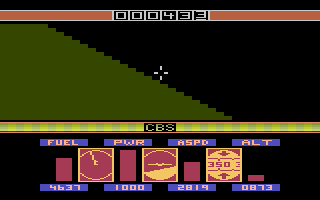
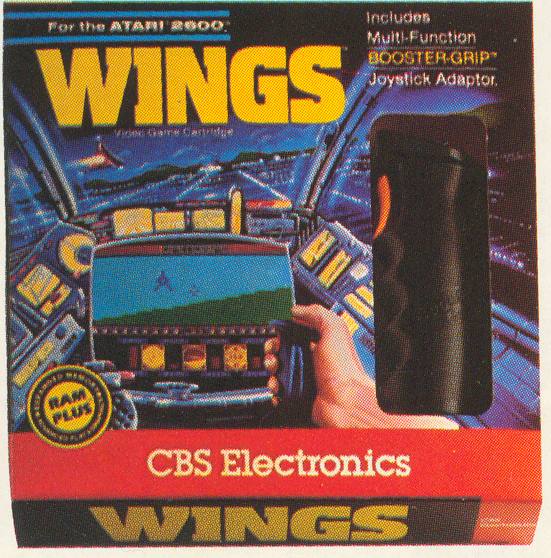
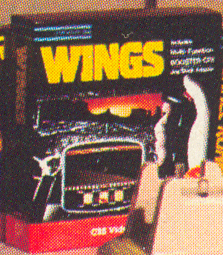
WINGS
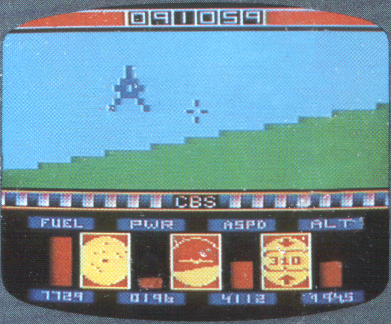
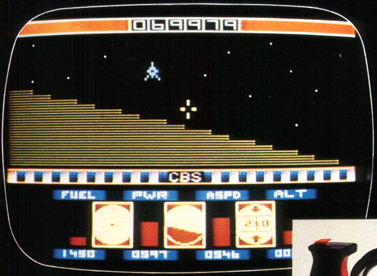
These screenshots (pictures #1 and
#2) appeared in some 1983 CBS literature. 2 prototype versions were found
(pictures #3 and #4) in 2004,
but neither are 100% complete.
A box (picture #5) was shown in magazine advertisements, which differed from a promo box
(picture #6) that appeared in an interview with CBS Video Games' Robert Hunter
in the July 1983 issue of Video Games magazine (page 26). For more
information, check out this
DP article.
|
COLECO |
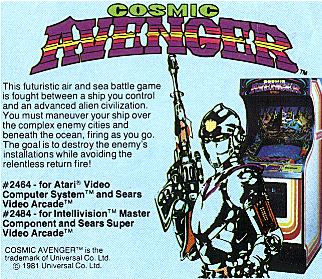
COSMIC AVENGER
Advertised in several VCS catalogs.

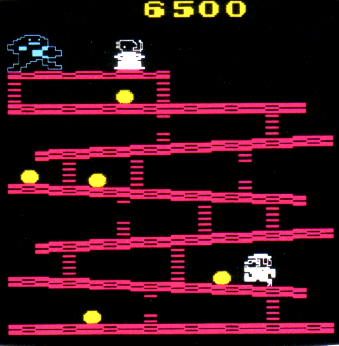
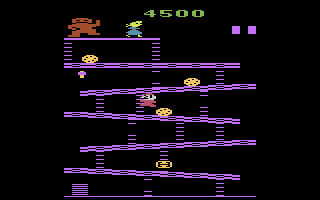
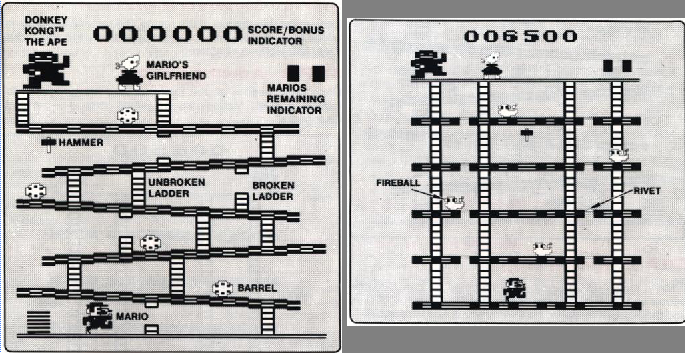
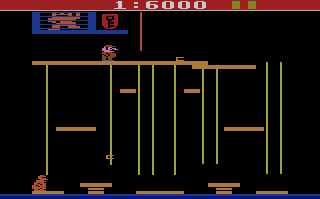
DONKEY KONG
This screenshot (picture #1) is from a flyer, which is slightly different from
the release - especially Donkey Kong himself (picture #2). The style (as
well as the same score) were also used in the manual (picture #3).
DONKEY KONG JR.
This screenshot (picture #1) is from a publicity slide, which is
noticeably different from the release (picture #2).

FRENZY
This picture is from a flyer.
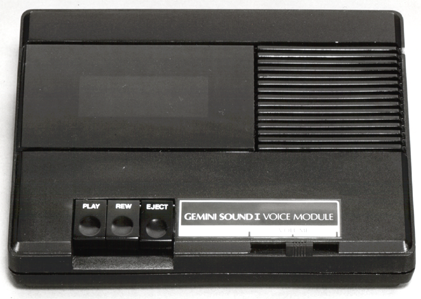
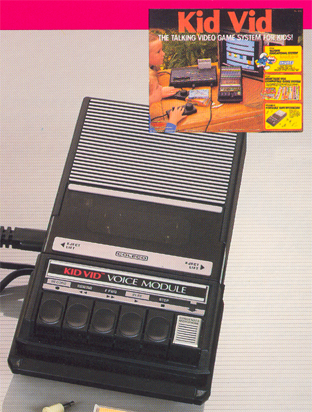
GEMINI SOUND I VOICE MODULE
This (picture #1) was an early version of the Kid Vid Module (picture #2) and
was originally going to include Berenstain Bears, instead of Smurfs Save the Day.
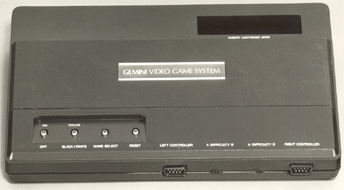
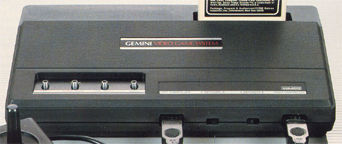
GEMINI VIDEO GAME SYSTEM
A photo of the system from a press kit (picture #1) shows a minor difference in
the casing, compared to the released version (picture #2).
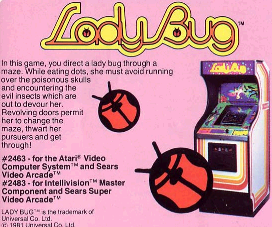
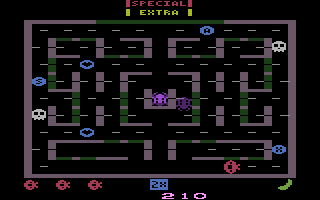
LADY BUG
Advertised in several VCS catalogs.
John Champeau (of Champ Games) did a spot-on port of the game in 2006 (picture
#3).

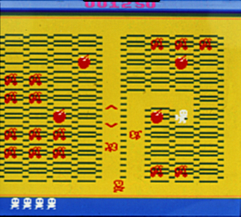
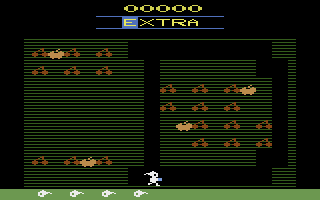
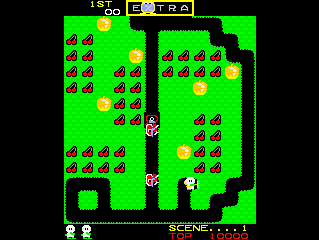
MR. DO!
This screenshot (picture #1) is from a publicity slide
(which was used as late as 1984 in Coleco's own literature!), and is
drastically different from the release (picture #2). Programmer Ed English was
given a prototype coin-op version of the game to use for programming the
conversion, which depicts Mr. Do holding a rake (picture #3), as is depicted in
the publicity slide!
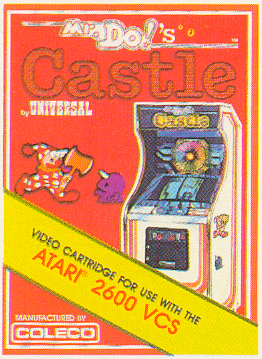
MR DO!'s CASTLE
Advertised in a 1984 catalog. Somehow Parker Brothers (who ironically only
advertised it in a 1984 catalog of theirs) ended up releasing it instead. We're
guessing Coleco either worked out a deal with Parker Brothers, or they passed on
it, and whoever the subcontractor was sold it to PB. Coleco catalog description: "Mr.
DO! returns to do battle against meaner Badguys in an all-new adventure, inside
his castle. You race him around the castle, climbing ladders, jumping through
holes, and looking for keys. If you're quick enough, you can use Mr. DO!'s
hammer to knock out blocks onto unsuspecting Badguys below. Watch out, your
enemy can multiply! But if you can get the keys, maybe you can win an extra Mr.
DO!"
PEPPER II
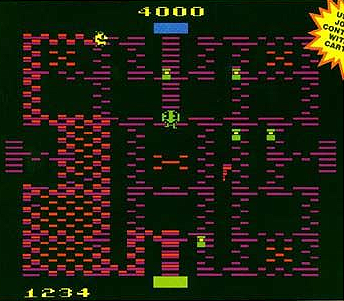
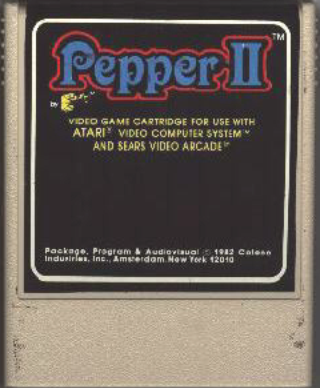
The screenshot (picture #1) is from a flyer. Jerry Greiner found a labeled cart, sans board
(pictures #2 and #3).

ROCKY BATTLES THE CHAMP
This picture is from a publicity slide. It also appears on a flyer.

SMURF: RESCUE IN GARGAMEL'S CASTLE
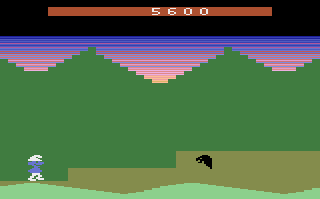
This screenshot (picture #1) is from a flyer, which is
drastically different from the release (picture #2). It also appears on the Colecovision
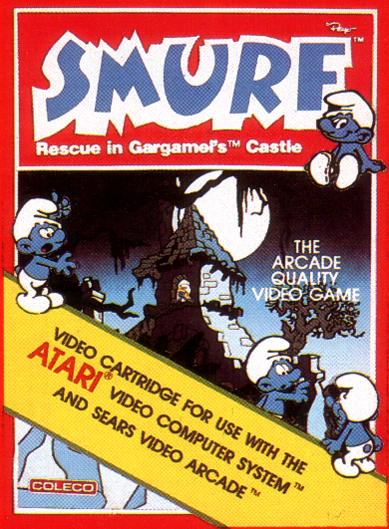
Module #1 box. A slightly different box
(picture #3) from the released version (picture #4) was shown on the same flyer.


SMURFETTE’S BIRTHDAY
This picture is from a publicity slide. It also appears on a flyer.
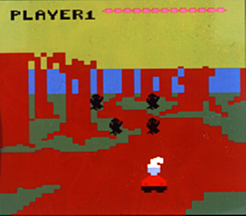
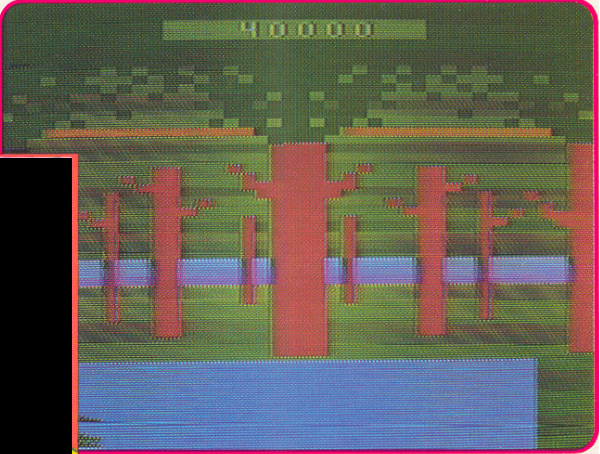
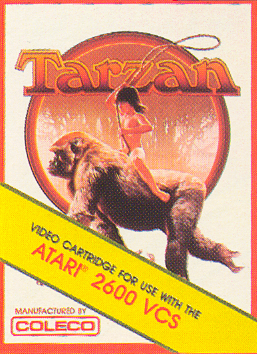
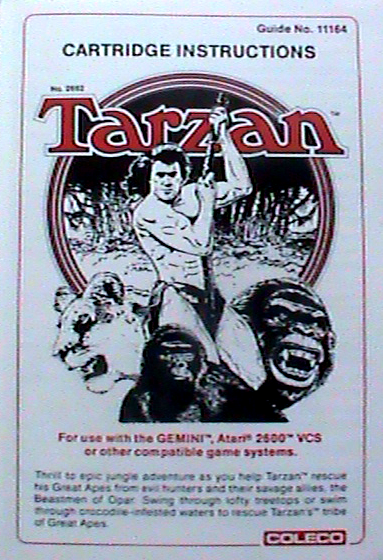
TARZAN
Based on the ColecoVision game. According to the company that
designed it, Wickstead Design, the game was completed but unreleased due to a
chip shortage. From a February, 1983 CES Press Release: "Practice up on your
Tarzan yell, because it's your turn to help the famous Ape Man save his jungle
friends from the Great Safari Hunters! Only you can guide him through the deep,
dark, danger-ridden jungle, swing him safely across lethal waters, and give him
the right moves to fend off and eliminate the intruders. Watch out for the
hunters' weapons, deadly jungle beasts and other obstacles, but remember - one
false move and you'll perish in the jungle!". From a 1984 CES catalog: "Evil
hunters have invaded the jungle to carry Tarzan's tribe of apes off to a zoo.
You race through the jungle, leaping from vine to branch, running along the
jungle floor... all the time looking out for the hunters' traps. You reach a
clearing and have to fight your way through the captors to liberate your ape
friends. If they get away again, you'll have to catch up and free the apes
before they leave the jungle forever." The same catalog also showed an actual
screenshot (picture #1) and box art (picture #2). Video footage of the game was
apparently shown at a CES show. An Atari 8-bit version was found, so a VCS
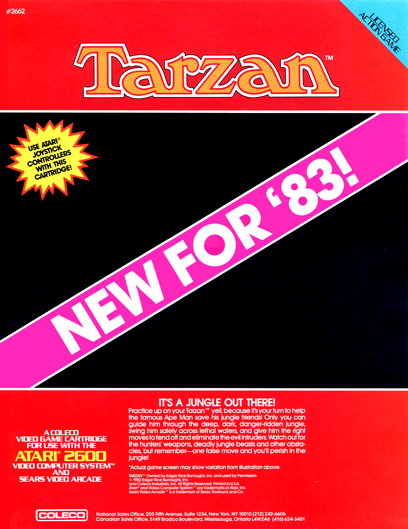
version may still exist as well. A manual was found in 2011 (picture #3). A
flyer also exists (picture #4) but it doesn't have a screenshot.
TURBO
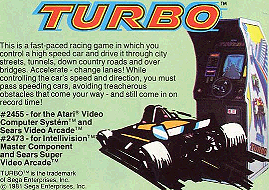
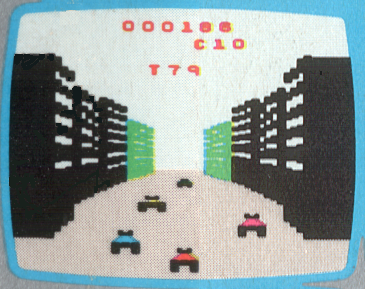
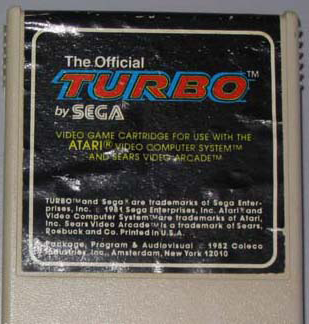
The game was originally advertised in
several VCS catalogs, along with a picture of a labeled cart (pictures #1 and
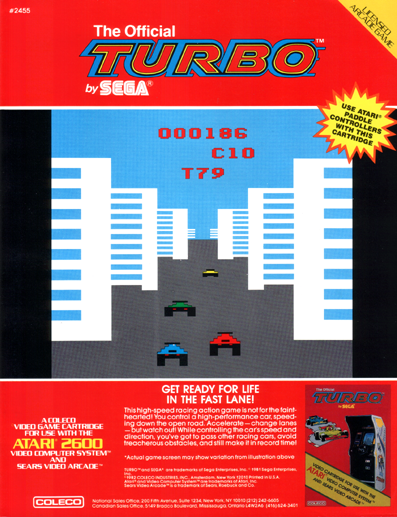
#2), and even reviewed by Electronic Games! A flyer (picture #3) shows a screenshot and a box (picture
#4), and had this to say: "GET READY
FOR LIFE IN THE FAST LANE! This high-speed racing game is not for the
faint-hearted! You control a high-performance car, speeding down the open road.
Accelerate - change lanes - but watch out! While controlling the car's speed and
direction, you've got to pass other racing cars, avoid treacherous obstacles,
and still make it in record time!" The same screenshot also appeared on a
flyer. Picture
#5 is from a demo by Thomas Jentzsch to show the picture was as least technically
possible. Picture #6 is from the Colecovision
Expansion Module #1 box, and is noticeably different from the original.
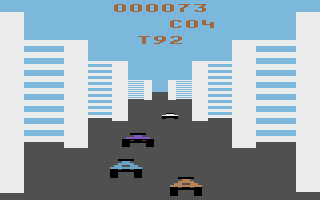
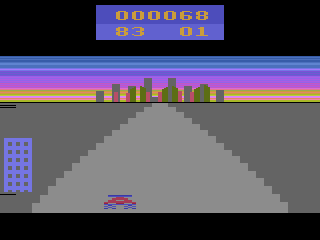
A prototype cartridge (picture #7) was discovered in 2006 by Anthony R.
Henderson, who was one of 2 programmers who worked on it. Note the
screenshot (picture #8) is drastically different from the earlier ones. Leonard Herman
claims this version is not the same version he saw at a CES show, which he describes as such: " The screen shot that I used in ABC To
The VCS (picture #3) closely resembles what I remember from CES. I also
remember another city scene where there is water on the left and buildings on
the right and the road is in the center. It gave the appearance of riding on a
lake-view road."


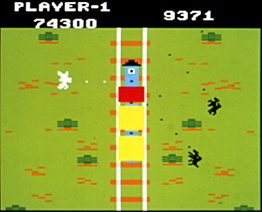
WILD WESTERN
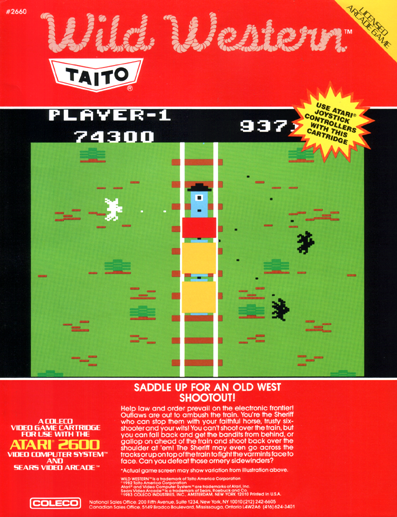
Picture #1 is from a publicity slide. A flyer (picture #2) shows a screen shot, and had this to say: "SADDLE UP FOR AN OLD
WEST SHOOTOUT! Help law and order prevail on the electronic frontier! Outlaws
are out to ambush the train. You're the Sheriff who can stop them with your
faithful horse, trusty six-shooter and your wits! You can't shoot over the
train, but you can fall back and get the bandits from behind, or gallop on ahead
of the train and shoot back over the shoulder at 'em! The Sheriff may even go
across the tracks or up on top of the train to fight the varmints face to face.
Can you defeat those ornery sidewinders?"
ZAXXON
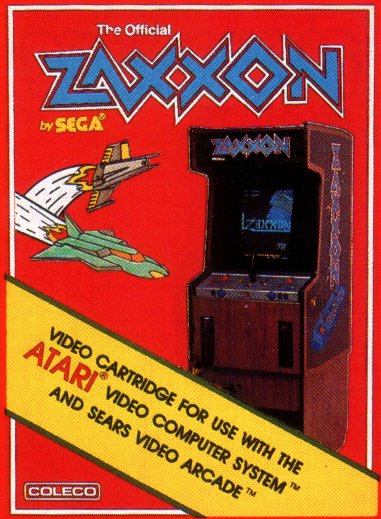
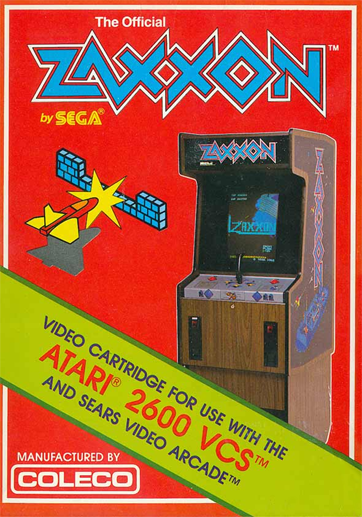
A slightly different box (picture #1) from the released version (picture #2) was
shown on a flyer.
|
COMMAVID |
MISSION OMEGA
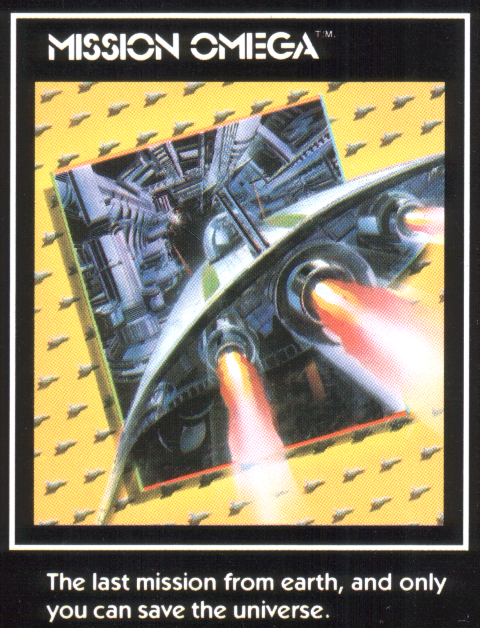
Artwork was shown in even the earliest of CommaVid advertisements (it was
announced as one of CommaVid's 4 debut titles at the summer 1982 CES).
Description: "You are flying the last mission from Earth... Mission Omega, to an
artificial world built to rescue the population and supplies of the planet.
Somehow the power that propels the immense space world has been redirected by
BlackHeart. You must pilot your ship through the support columns and evade the
defensive fire from the interceptor ships sent to blast you. If you manage to
save your ship and pilot it accurately, you may be able to trigger the collapse
that will cause BlackHeart to consume itself and make the world safe to live in
once again."
RUSH HOUR
First announced at the Winter 1982/83 CES and later mentioned in the April 83
issue of Creative Computing magazine. A prototype was shown at the Summer 1983 CES.
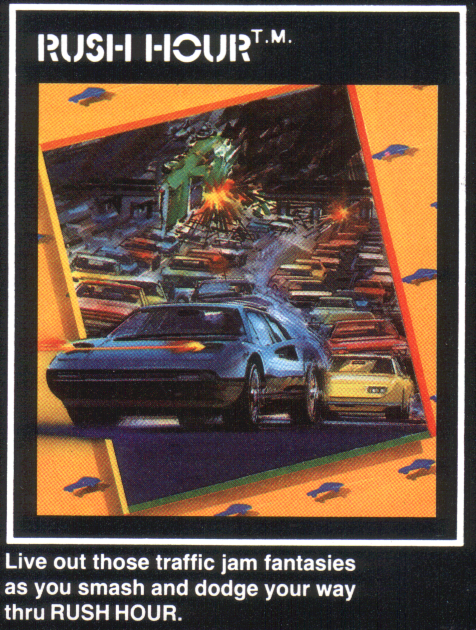
Artwork also appeared in a 1983 flyer (picture #1).
The game was outsourced by CommaVid and designed by Ben Burch, who was actually
a consultant hired by CommaVid. Ironically, Burch was in an automobile accident
during the development and it's believed the project was eventually scrapped
before completion. 2 different descriptions exist: (from Winter 1982/83 press
release) "You're in a hurry and you can't afford to be one minute late. You are
driving along smoothly and then you're caught in a drivers nightmare - a traffic
jam during rush hour. But you just won't creep along - you must blast, dodge,
and weave your way through the traffic until you reach your destination."; (from
Summer 1983 press release) "Caught in a drivers nightmare, a traffic jam during
rush hour, you must blast, dodge, and weave your way through high speed traffic.
Your super auto is equipped with lazer-blasting headlights; but you must avoid
the debris cluttering the autobahn to reach your destination. This new concept
in driving/racing video game will challenge the most sophisticated driver." A
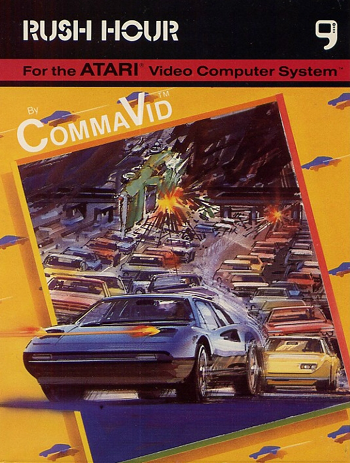
finished box (picture #2) and several unfinished prototype versions of this game
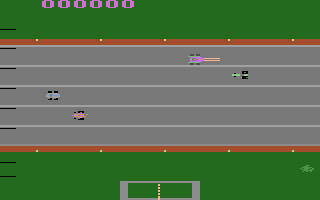
were discovered by Digital Press in September 2002. A reproduction of the
most complete and stable prototype version (picture #3), with help from Mike
Mika, was released
by CGE Services (who at that time acquired the rights to all of CommaVid's
properties) at CGE2K3 - 250 boxed copies were made.
|
DATA AGE |
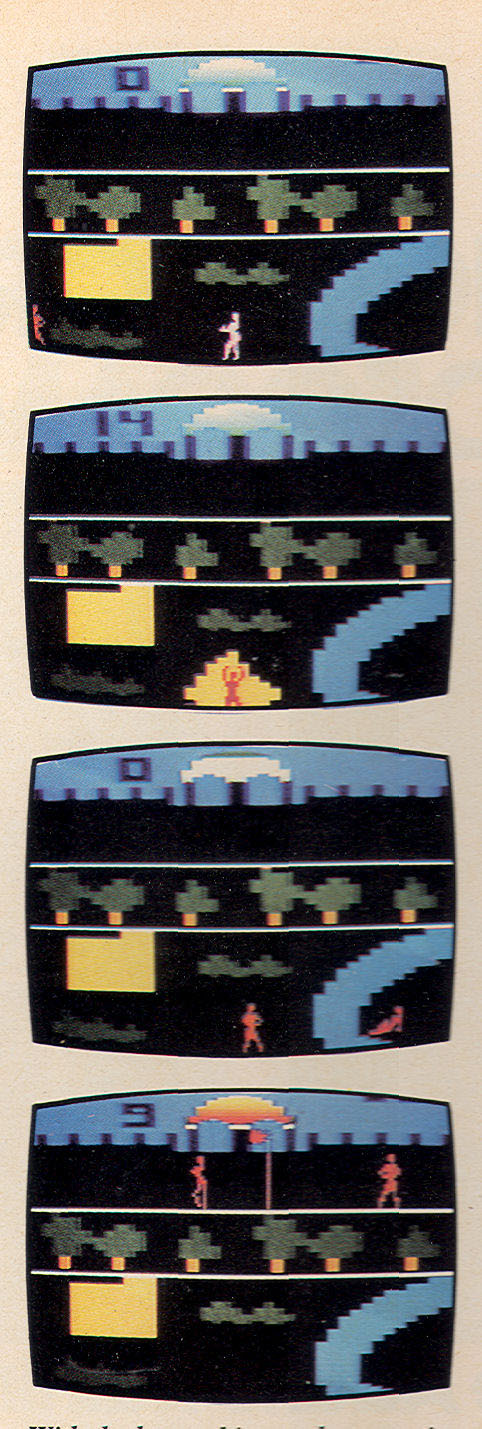
SURVIVAL RUN
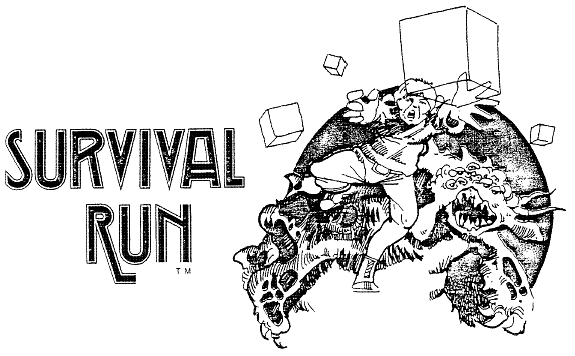
1982 CES literature description: "No one has ever returned from the deadly
cosmic portal, yet driven by intense curiosity you enter. Suddenly you plunge
into a negative universe and find yourself on a labyrinth of narrow walkways
spanning a sea of deadly liquid nitrogen. You let out a sign of relief a moment
too soon as the sharp pain in your throat tells you that the air is as deadly as
the sea. Your only hope for survival is the Korbinian cubes -- an energy rich
diet that will also neutralize the poisonous air. In sheer desperation you run
for your life to the nearest cube.
Just then you confront the diabolical Dylak, an ammonia breathing monster
lurking in the dark corners. His purpose: guard the Korbinian cubes and destroy
the intruder. With only seconds of life remaining, you must avoid Dylak and
retrieve the cube. You make it just in time. As you absorb its energy, you
achieve super strength, possibly enough to push Dylak into the deadly sea. But
beware! Your strength is short lived. Soon you will need another cube."
|
IMAGIC |
NO ESCAPE
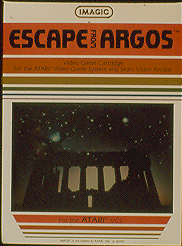
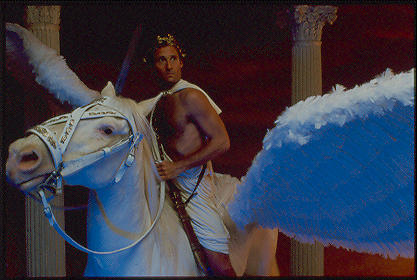
Different artwork was made for it (picture #1), when it was known by its
original title – Escape From Argos. It was eventually released with a different
name and artwork (picture #2).
SHOOTIN’ GALLERY
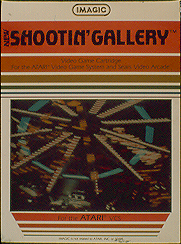
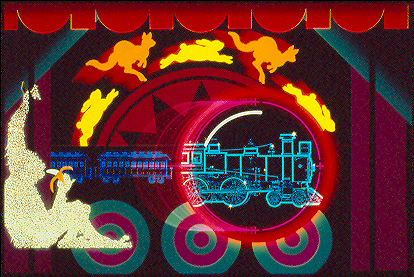
The original artwork shown (picture #1) is much different
from that shown on the actual release (picture #2).
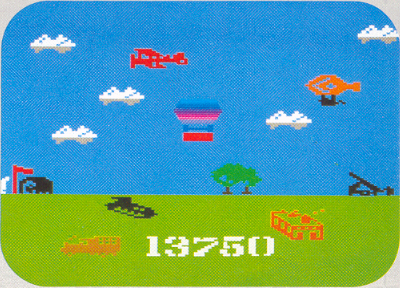
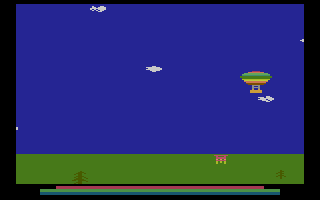
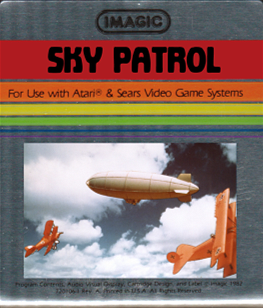
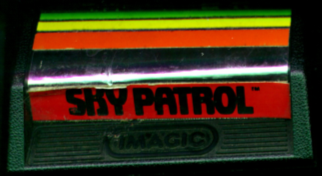
SKY PATROL
The mock-up photo (picture #1) shows a multitude of objects (including a
biplane, which is depicted in the artwork). Most of these actually appear
in the game - see this
DP article for
more info. Although the game was
planned to be a race between 2 hot air balloons, the name and artwork seem to
suggest something more war-themed. Picture #2 is an actual screenshot from
the prototype. Pictures #3 and #4 are of the prototype cart.
|
KONAMI |
SUPER SCRAMBLE
Catalog description: “This exciting game is the 3-D version
of the popular amusement game “SCRAMBLE” and the player can enjoy a feeling as
if he were in the cockpit of the fighter plane. Take off from the aircraft
carrier. Control your fighter plane and attack enemy’s territory to destroy
their headquarters!! Get ready for enemy missile, antiaircraft guns and enemy
formation flights. Breakthrough all the enemy’s attack using powerful missiles
and machine guns. And then, come back safe to the aircraft carrier.”

|
M-NETWORK (MATTEL) |
(More information on unreleased/unfinished M-Network games can be found HERE)
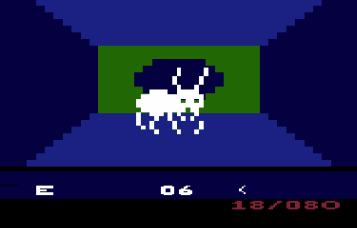
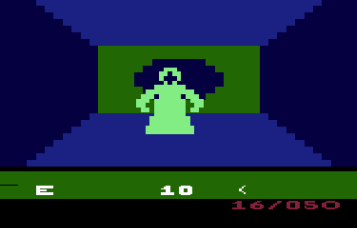
ADVANCED DUNGEON & DRAGONS: TOWER OF MYSTERY cartridge
Never completed. It’s a 16K game, which also required 2K
of onboard RAM. Pictures #3-#5 are from the actual prototype. Catalog description: “Stuck on top of the Tower of Mystery, you
must preserve your strength and protect the treasure as you attempt to escape.”
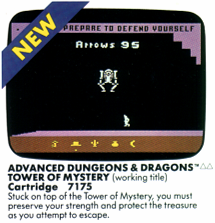
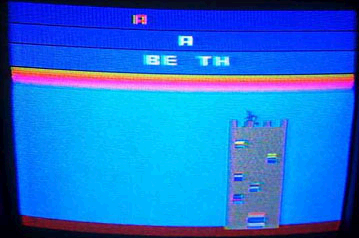
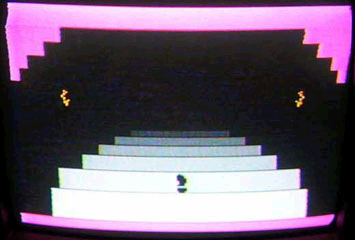

ADVANCED DUNGEON & DRAGONS: TREASURE OF TARMIN cartridge
Programmed by Synth Corporation. Officially completed.
Pictures #2 and #3 are from the actual prototype. Catalog description: “You’ve found the secret map to the underground lair of the
dreaded Minotaur. You can go in, but you’ll never come out unless you slay the
Minotaur and claim the Tarmin treasure. As you make your way through the
hallways and chambers, monsters wield their conventional or spiritual weapons.
You must gather the proper defenses along the way. But use them sparingly, the
Minotaur looms closer!”
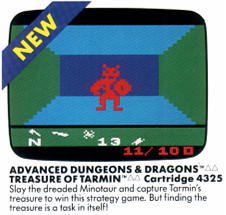
COMPUTER CORRIDOR
Never completed. Combination of two other games that were
in development – Computer Revenge and Moon Corridors (which was similar to
Battlezone). Marketing description: “You are captain of a star ship entering
unknown planets filled with hostile computer units. Score points by attacking
the computer force and hitting the computer units. Your mission is complete
when the full quadrant of planets is free of the computer force. Monitor your
fuel supply, shield strength, and phaser power. Use radar to locate units. Add
fuel by finding the computer friendlies. 3-dimensional graphics. Scrolling
grid. 1 player game.”

CUMULUS
Never completed. An original game by Jeff Ratcliff. He
was later pulled off the game to work on Masters of the Universe II. Game
description: “You must protect the cloud city of Cumulus from descending enemy
ships. Your first line of defense are battle pods that float above the city.
If the ships manage to destroy your pods, you must fight the enemy on the planet
surface where they will attack the generators that project a protective energy
shield around the city. Should the generators be destroyed, the city is
doomed!”
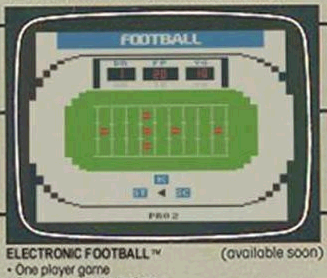
ELECTRONIC FOOTBALL
Port of the popular Mattel Electronic Football handheld
game.
FLAPPER
Unfinished game by Stephen Tatsumi. The drawing is from
Tatsumi’s original written proposal for the game. Game description: “You
control the Flapper to rescue baby Flappers from an underground maze. The maze
is filled with snakes, bats, and ghosts. Cave-ins and landslides keep opening
and closing the tunnels. Luckily, the Flapper is a unique fellow: he has three
types of beanies – chopper for flying, gun for shooting, umbrella for protection
– and four interchangeable types of legs: flying, jumping, running, and
walking. You have to find and change the appropriate beanie and legs for him to
overcome the obstacles and rescue the babies!”

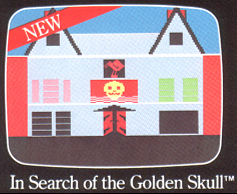
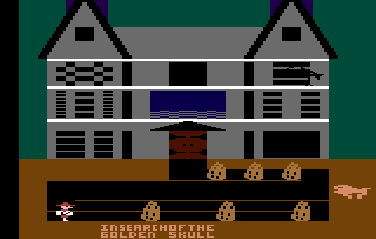
IN SEARCH OF THE GOLDEN SKULL
Picture #1 is from an Amiga catalog. Picture #2 is an actual screenshot
from the prototype. Programmed by VideoSoft for Mattel. It’s a 16K game, which
also required 2K of onboard RAM. Catalog description: “Your engaged in a
worldwide search for a priceless artifact – a solid gold, prehistoric human
skull. Use the treasure map to determine the Golden Skull’s location, then
begin your perilous search. Along the way you’ll encounter air battles,
steaming swamps, and the pyramid maze. How far will your obsession take you!
(One player).”
INTERNATIONAL SOCCER
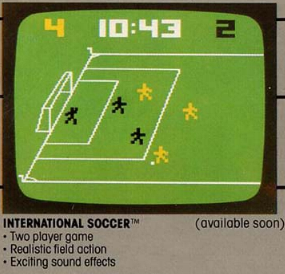
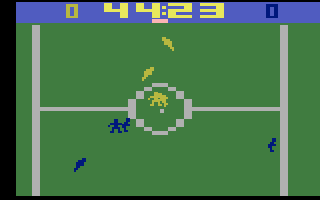
The catalog entry
(picture #1) shows a horizontally-scrolling game,
whereas the released version is a vertical affair (picture #2). Mock-up, or accurate
representation of an earlier version?
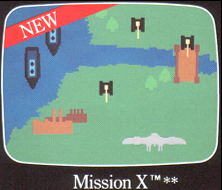
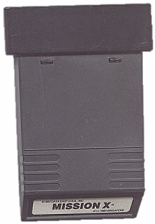
MISSION X
Port of the Data East arcade game. The artwork is from a
1983 full-size press catalog. A picture of a cart (picture #2) appeared online, but it’s
unknown whether or not this is a mock-up (used for advertising) or a fake.
According to the Keith Robinson (of the Blue Sky Rangers), programming never
started for the 2600 version.
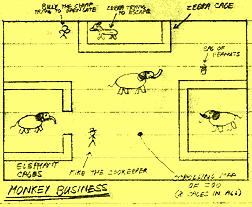
MONKEY BUSINESS
Unfinished original game by Eric Del Sesto, which began as
his training project in mid-1983. The game featured a seven-page scrolling map
of the zoo with a new graphics technique called “hidden V-clocks”, which
produced wider, cleaner displays (it was a programming technique that eliminated
altogether the horizontal lines that appeared on the left side of the screen).
The drawing is from Eric’s original written proposal for the game. Game
description: “In the zoo, things have gone awry. Billy the Chimp has escaped
and is up to no good. As any curious monkey would, he has managed to free the
elephants! It’s up to you, as Mike the Zookeeper, to return the elephants to
their cages. Once you have restored order in the elephant section, you must
quickly run to the next section of cages. Perhaps you’ll have to capture the
loose Koalas. Maybe you’ll have to avoid soaring hawks, battle fierce tigers,
or try to grab the slippery penguins. Along the way, you’ll find items which
will be of help to you, such as a bag of peanuts or a net. So grab your hat and
stop this monkey business!”
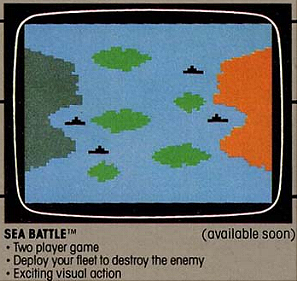
SEA BATTLE
The catalog screenshot (picture #1) is a bit different from the actual game
(picture #2), as it shows the bases
on the sides of the screen, as opposed to the top and bottom.

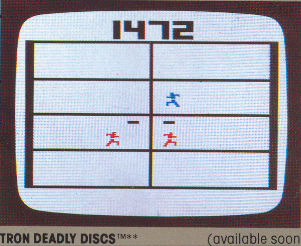
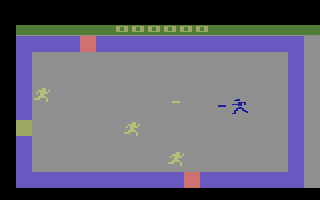
TRON DEADLY DISCS
The catalog screenshot (picture #2) is a bit different from the actual game
(picture #2), as it shows a grid in
the playing area.
|
MILTON BRADLEY |
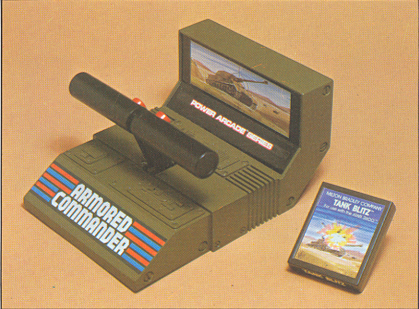
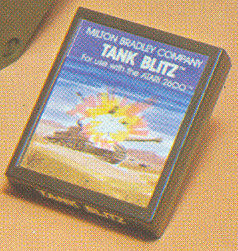
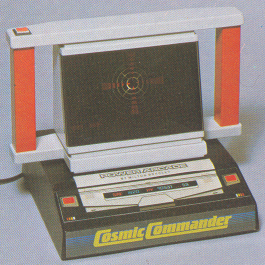
ARMORED COMMANDER + TANK BLITZ
Shown in a 1984 catalog. Was to be the 3rd
specialized “Commander” controller in the Power Arcade series, along with Flight
Commander and Cosmic Commander. Catalog description: “Now video game fans can
use a hand controller with some of the trappings you might expect in a real
battle tank! Players push both handles forward or back to move tank on TV
screen. Tank on screen comes to a stop when one handle is pulled forward and
the other pushed back. Picture in gun sight lights up, controller vibrates when
‘Fire’ buttons are pushed. Comes with ‘Tank Blitz’ game cartridge.”
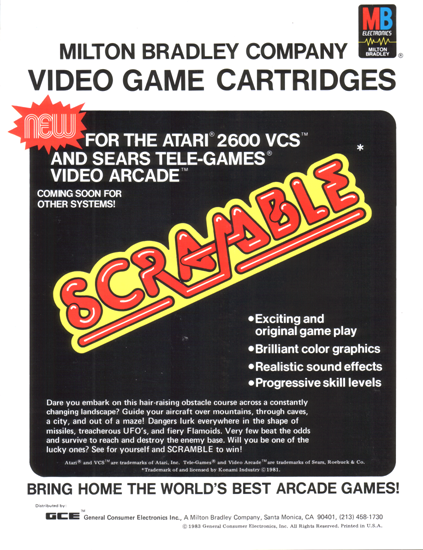
SCRAMBLE
Port of the arcade game by Konami.
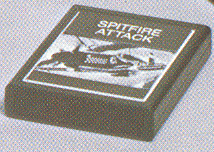
SPITFIRE ATTACK
Alternate artwork was shown in company literature.

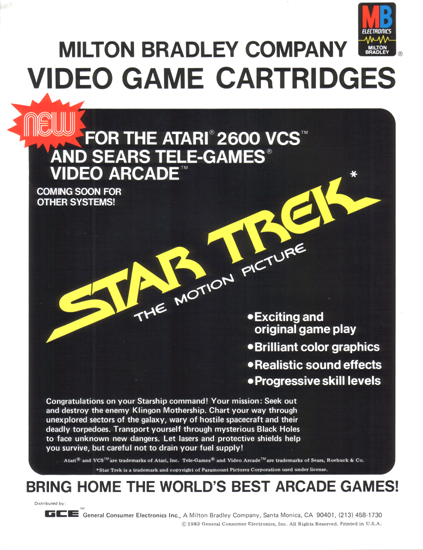
STAR TREK
This was one of the 3 games that Western Tech was originally developing for
Kenner, back in 1981; when they backed out, Milton Bradley picked up the rights
to it. We're guessing this was going to be similar to the Vectrex version.
Milton-Bradley planned to create games for the VCS to be distributed under the
GCE name. A sell sheet from their 1983 CES Press Kit had this to say:
"Congratulations on your Starship command! Your mission: Seek out and destroy
the enemy Klingon Mother ship. Chart your way through unexplored sectors of the
galaxy, wary of hostile spacecraft and their deadly torpedoes. Transport
yourself through mysterious Black Holes to face unknown new dangers. Let lasers
and protective shields help you survive, but careful not to drain your fuel
supply!".
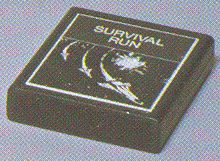
SURVIVAL RUN
Alternate artwork was shown in company literature.
|
MULTIVISION |
BATTLE OF THE SEXES
According to the programmer Michael Case, the game was finished but the only known copy was left with the designer: "It involved male and female figures coming
together from the top and bottom of the screen, to either shoot each other or
screw each other. It wasn't as good (as Harem). It was basically like Pong. I
knocked it out in a few weeks so we could say we had two games when we
approached distributors. The October 1983 issue of Videogaming Illustrated
featured a quote from Eugene Finkei about the game: "Battle of the Sexes is played
simultaneously by two players. It's very innocent. Each player has surrogate
partners scrolling across the screen. Each player must score with as many
surrogates as possible while trying to knock out the surrogates of the other
partner. There are different skill levels and variations. It can be played by
two guys with girls scrolling across the screen. To score, the player directs
the figure to bounce together with the surrogate for a fraction of a second. No
genitalia. And you don't shoot the other surrogates, you merely get them out of
the way." Below is a flyer for the game.

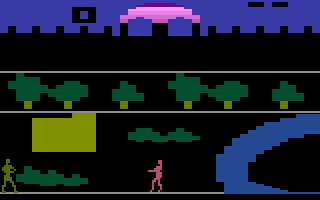
HAREM
The October 1983 issue of Videogaming Illustrated featured an article on
adult-themed video games, which included these actual screenshots (picture #1) of Multivision's
unreleased game, Harem. Picture #2 is a flyer for the game. DP tracked
down the game's programmer in 2007 and released the ROM with his permission.
Pictures #3 and #4 are of the actual game.

|
PARKER BROTHERS |
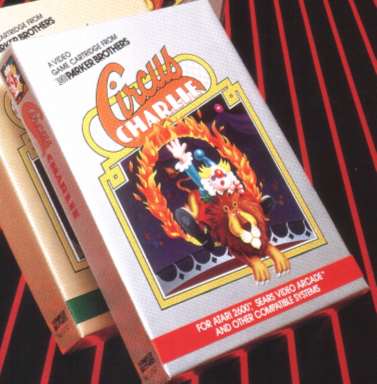
CIRCUS CHARLIE
Boxes were shown in photos at the 1983 CES for the 2600, Colecovision,
and Commodore 64. A press-release description mentions the 2600 version
having 4 screens, and the Colecovision and C-64 versions having 5 (the arcade
had 6).Philip Orbanes, who was the Senior VP for Research & Development at
Parker Brothers at the time, had this to say about it: "I saw the first work on
Circus Charlie for the Atari 2600. 1984 was a year of turmoil inside Parker,
esp. in regards video games due to the rapid downturn in the retail market.
Heartbreakingly, we laid off 95% of our formerly booming electronics R&D staff.
During this process, Circus Charlie was canceled and no one had the prescience,
or will, to archive unfinished work."
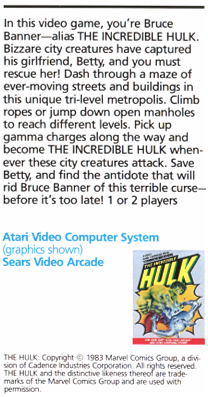
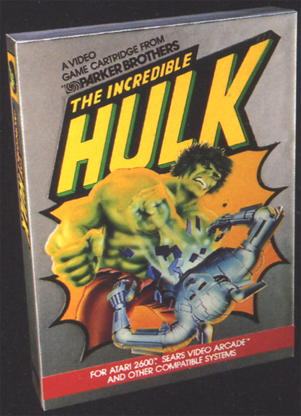
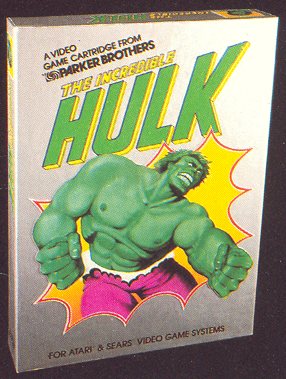
THE INCREDIBLE HULK
Artist rendering screenshot and description (pictures #1 and #2) are from a 1983 catalog.
Pictures #3 and #4 are 2 different versions of the box art. A fake,
pixel-perfect screenshot (picture #5) was created by Chris Bieniek, based on the
original. Here is a description from a Parker Bros. press release: “In Parker
Brothers' THE INCREDIBLE HULK, the new home video game based on the popular
Marvel Comics character, players learn to balance two sides of a dangerously
"explosive" character. As the mild-mannered scientist Bruce Banner, the player
encounters obstacles which – when the danger intensifies – propel Banner into
the emotion-triggered green reaction, transforming him into a raging monster.
Currently in development, the game capitalizes on the prime-time exploits of the
well-known TV hero, The Incredible Hulk. The game's realistic animation captures
the look and excitement of NBC's Saturday morning cartoon series based on the
Marvel Comics superhero. THE INCREDIBLE HULK, available in the summer of 1983,
will be compatible with the Atari 2600 and Sears Video Arcade."

JAMES BOND 007
The mystery surrounding this game is worthy of a secret agent. Charlie Heath
worked on a demo version based on the
final scene in Moonraker, before leaving Parker Bros in late '82, but no copies of the game exist.
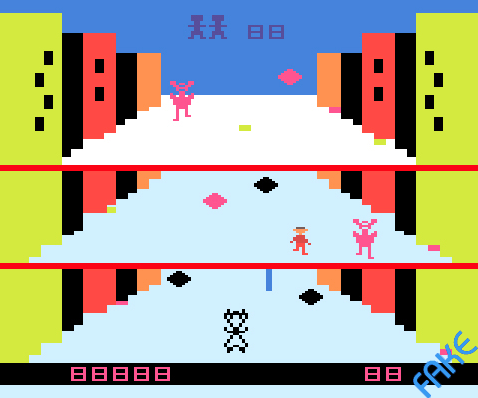
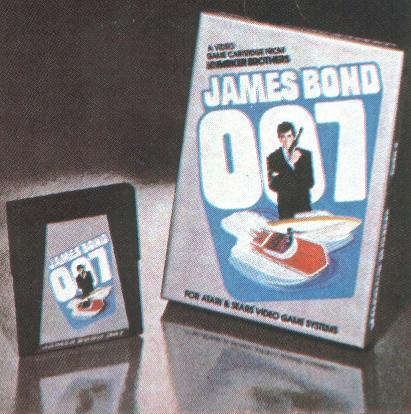
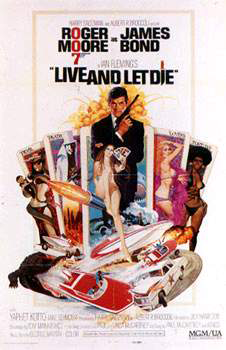
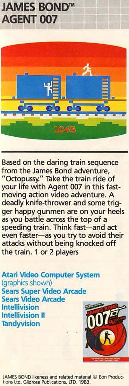
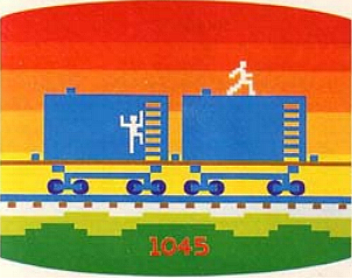
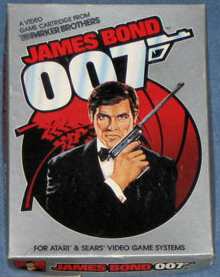
The first artwork/promotional material that appeared listed the title as JAMES BOND 007 and depicted the same artwork (picture #1) shown on the movie poster for Live and Let Die (picture #2).
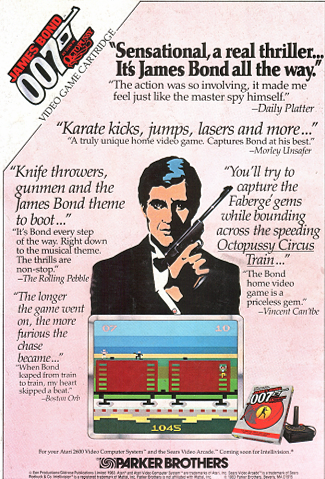
Later ads - complete with a screenshot, a box, and even fake reviews and catalog entries (pictures #3 and #4) - have it as JAMES BOND 007 As Seen In Octopussy. The title was reworked as JAMES BOND AGENT 007 and first appeared in a press release from Parker Brothers and later in a catalog with a picture similar to that of the Octopussy version (picture #5 and #6). The 2 existing screens depict the film’s famous train fight scene. Leonard Herman claims this version was shown at a CES show.
A few promo boxes for the game were produced, which features a close-up photo of Roger Moore (picture #6).
The released version is based on 3 different movies -
Diamonds Are Forever, Moonraker, and The Spy Who Loved Me -
though all these "missions" are basically the same game.
THE LORD OF THE RINGS: JOURNEY TO RIVENDELL
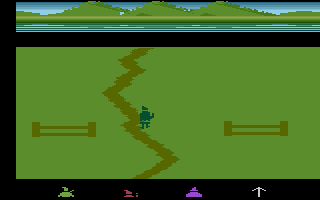
Early catalog screen depictions showed fences (picture #1). The graphics for
these were found in the
program, at byte locations $028f - $029d, along with some of the code used to
display them. Picture #2 shows how they appear in the game after the missing
parts of the code were reconstructed. For more information, check out the

McDONALD'S
The early catalog screenshot (picture #1) resembles the (very) incomplete
prototype that was found (picture #2).
2 different prototype versions have been discovered for the Atari 400/800
computers, which are far more developed (but still unfinished) - you can see
pictures of them
HERE.


SKY SKIPPER
A port of a very obscure 1981 Nintendo game. The catalog screenshot (picture #1) shows a
horizontally-scrolling game (much like the arcade version), with the actual game
being vertically-scrolling. There is a section of the 2nd maze that looks very
similar to the catalog picture (picture #2), so perhaps it was a perspective
error on the artist’s part.
STAR WARS: RETURN OF THE JEDI - EWOK ADVENTURE
The early catalog screenshot (picture #1) shows the base at the bottom of the
screen, instead of the top (picture #2).
|
PROBE 2000 (NAP) |
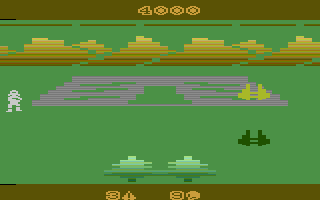
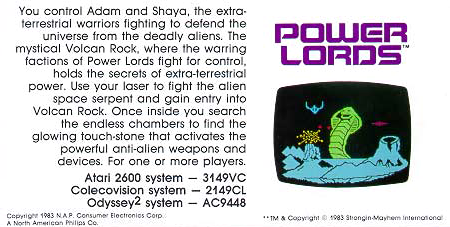
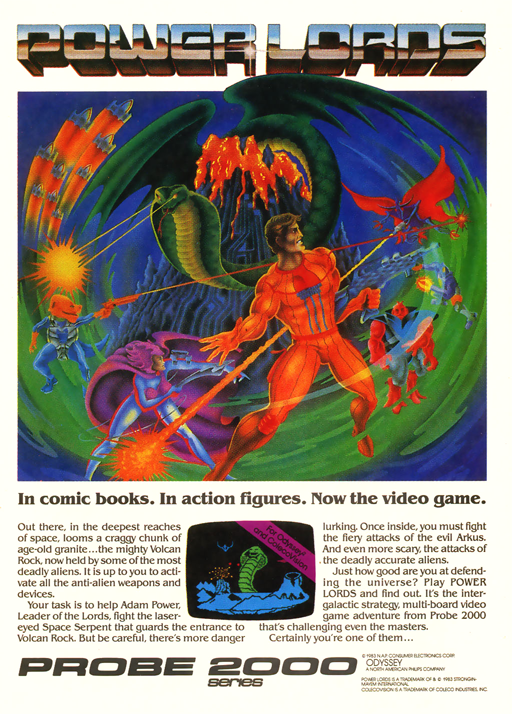
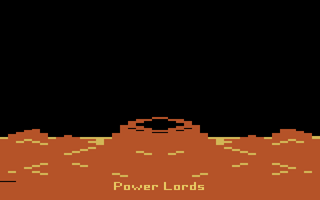
POWER LORDS: QUEST FOR VOLCAN
Based on the Revell
action-figure toys and licensed by Strongin-Mayem, International. The game was
developed after the Colecovision and Odyssey 2 versions. Scheduled release date
was September, 1983. A description of the game from NAP's 1983 Summer CES press
kit reads: "Adam, Leader of the Lords, and Shaya, Queen of Power, are
extra-terrestrial warriors who battle deadly aliens on the mystical Volcan Rock.
Using lasers to fight the alien space serpent, the Power Lords can gain entry
into the rock and search its endless chambers for the glowing touchstone that
activates powerful anti-alien weapons and devices." At least 2 prototypes are
known to exist and and the game only has 2 screens (it’s missing the stairway
screen found in the Colecovision version). A description of the game from NAP's 1983 Summer CES press kit reads:
"Adam, Leader of the Lords, and Shaya, Queen of Power, are extra-terrestrial
warriors who battle deadly aliens on the mystical Volcan Rock. Using lasers to
fight the alien space serpent, the Power Lords can gain entry into the rock and
search its endless chambers for the glowing touchstone that activates powerful
anti-alien weapons and devices."
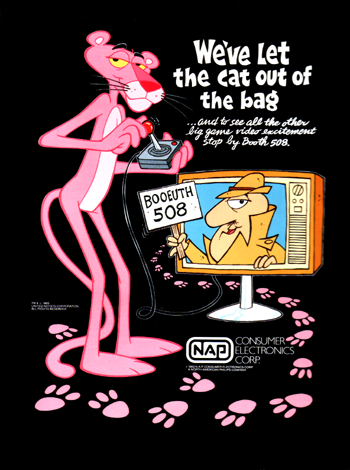
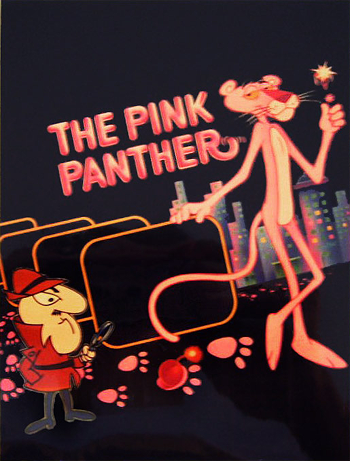
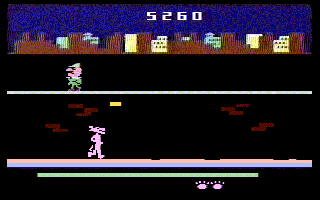
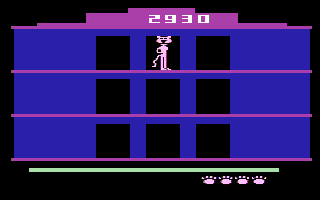
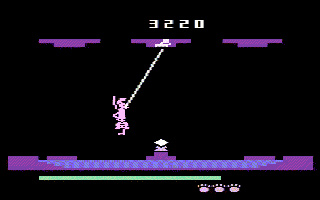
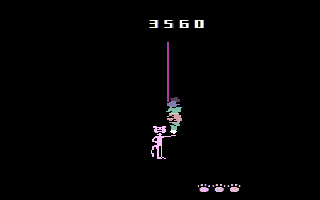
PURSUIT OF THE PINK PANTHER
NAP bought the game from U.S. Games, as reported in the October 1983 issue of
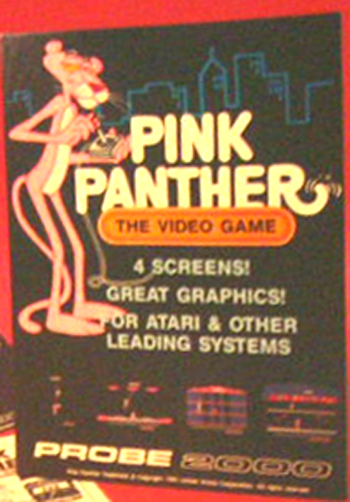
Video Games magazine. It was announced in NAP’s summer 1983 CES literature as
"The Pink Panther", "Pink Panther: The Video Game", and
"Adventures of the Pink Panther" before NAP's marketing
finally settled on "Pursuit of the Pink Panther" (as shown in the Nov 83 issue
of Videogaming Illustrated; an Atari 8-bit version also exists with the same
name. ). Scheduled release date was September, 1983. A screenshot was shown in
the Jan 1984 issue of Elec Fun w/ Computers and Games magazine (page 10) and
mentioned NAP permanently cancelled it (along with Lord of the Dungeon and Power
Lords) due to problems with the RAM chips used in the carts. However, according
to an interview with Bob Harris in the Spring 2001 issue of Classic Gamer
Magazine, NAP hired a company to fabricate the new "RAM/ROM" chip that U.S.
Games had developed for Pink Panther. Unfortunately, the new chips failed and
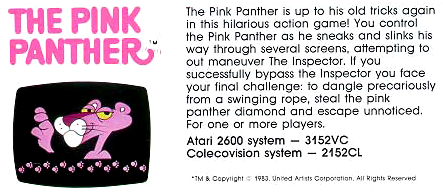
the Probe 2000 division was shut down as a result. Description: "Players control
the Pink Panther as he sneakily makes his way through several screens,
attempting to outwit the Inspector. For his final challenge, he must dangle from
a swinging rope, steal the famous Pink Panther diamond and escape unnoticed."
The Pink Panther is the property of and was licensed by MGM-UA Home
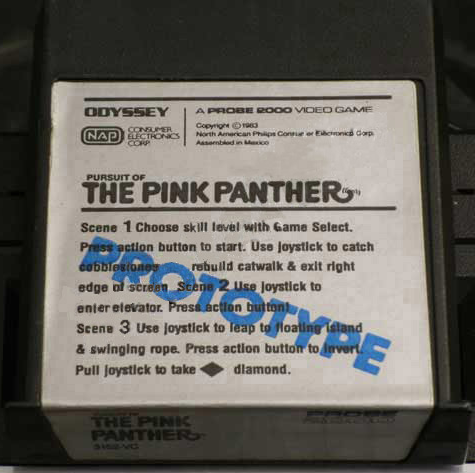
Entertainment Group, Inc. At least 4 prototypes are known to exist. Pictures #7-#10 are the few photos
we have of the prototype in action.

|
SEGA |
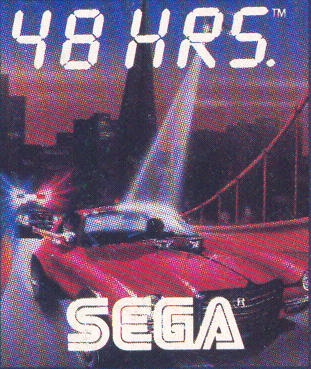
48 HRS.
Based on the movie of the same name. Mentioned in the Aug./Sep.'83 issue of
Video Games Player.
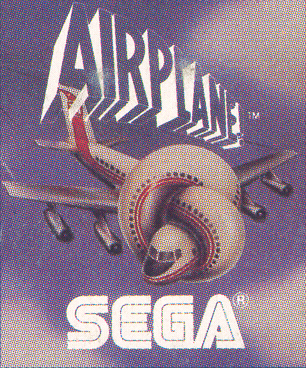
AIRPLANE!
Announced at the 1983 Winter CES. Also mentioned in the Aug./Sep. ’83 issue of
Video Games Player and April 1983 issue of Creative Computing magazines. Based
on the movie of the same name.

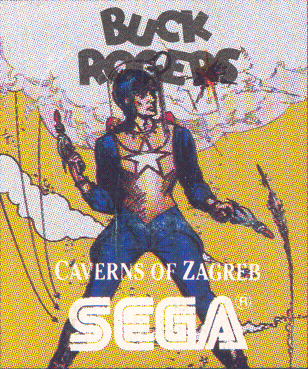
BUCK ROGERS: CAVERNS OF ZAGREB
Announced at the 1983 Winter CES. Also mentioned in the Aug./Sep. ’83 issue of
Video Games Player and April 1983 issue of Creative Computing magazines.

BUCK ROGERS: MARATHON OF ZENDA
Announced at the 1983 Winter CES. Also mentioned in the Aug./Sep. ’83 issue of
Video Games Player and April 1983 issue of Creative Computing
magazines.
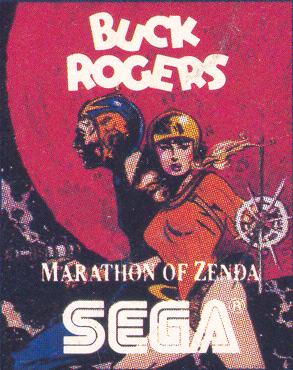
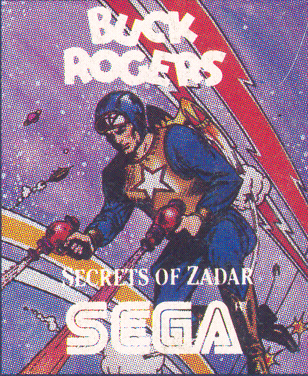
BUCK ROGERS: SECRETS OF ZADAR
Announced at the 1983 Winter CES. Also mentioned in the Aug./Sep. ’83 issue of
Video Games Player and April 1983 issue of Creative Computing
magazines.

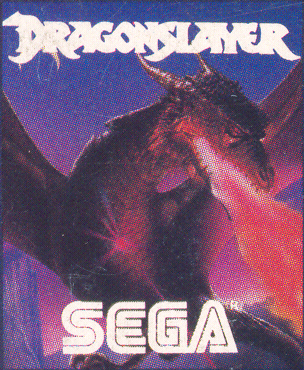
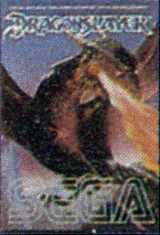
DRAGONSLAYER
Mentioned in the Aug./Sep. ’83 issue of Video Games Player.
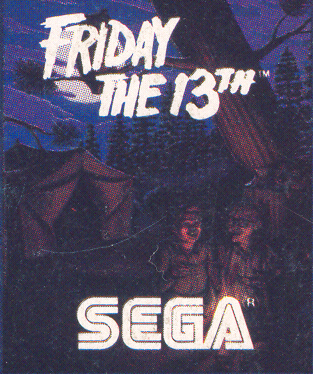
FRIDAY THE 13th
This game isn’t based on the movie by the same name, but rather the nasty things
that can happen to a person on Friday 13th. 'Announced at the 1983 Winter CES.
Also mentioned in the Aug./Sep. ’83 issue of Video Games Player and April
1983 issue of Creative Computing magazines. This title was scheduled for
an October 1983 release.
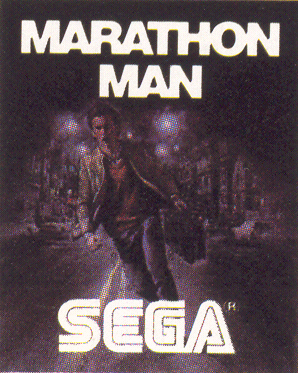
MARATHON MAN
Based on the TV show of the same name.
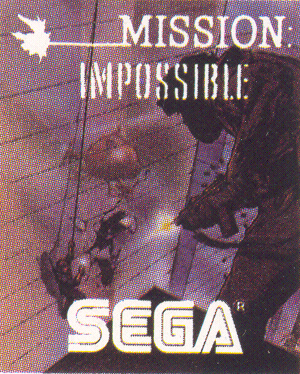
MISSION: IMPOSSIBLE
Mentioned in the Aug./Sep. ’83 issue of Video Games Player. Based on the TV show
of the same name.

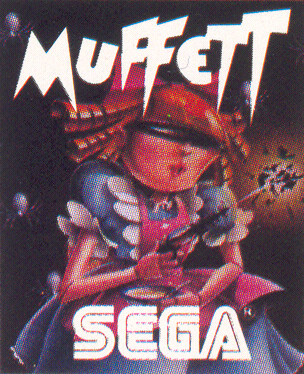
MUFFET
Described in the April 1983 issue of Creative Computing magazine as a “cute
cartoon game”.
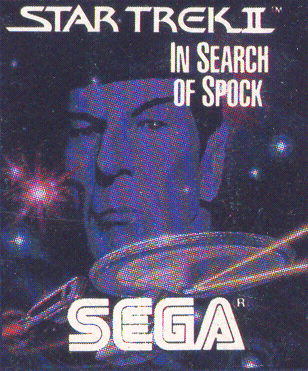
STAR TREK II: IN SEARCH OF SPOCK
This one is a bit of a mystery. It was mentioned in flyers. Why it's titled “II”
and not “III” is unknown, since the second Star Trek movie was already out by
the time this was shown. Most likely a typo by the artist.
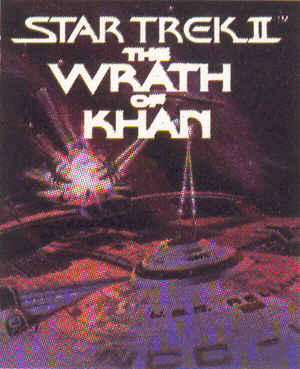
STAR TREK II: THE WRATH OF KHAN
Announced at the 1983 Winter CES. Also mentioned in the Aug./Sep. ’83 issue of
Video Games Player and April 1983 issue of Creative Computing magazines. Based
on the movie of the same name.
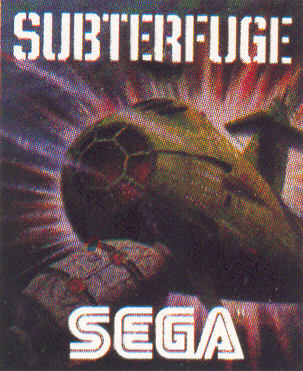
SUBTERFUGE
Announced at the 1983 Winter CES. Also mentioned in the April 1983 issue of
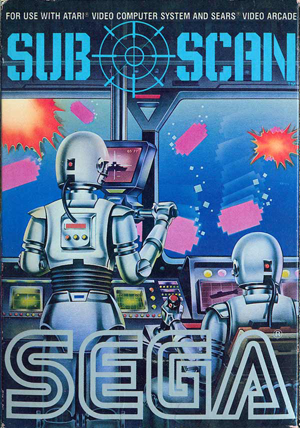
Creative Computing magazine. The 2nd box (picture #2) has the same artwork as Sub-Scan,
and given the original artwork, we're 99% sure Subterfuge was an early name for
Sub-Scan.
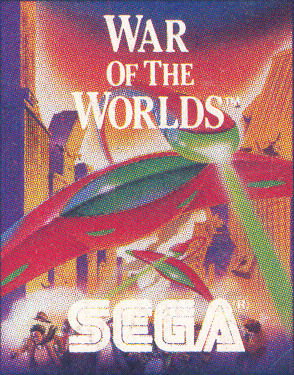
WAR OF THE WORLDS
Announced at the 1983 Winter CES. Also mentioned in the April 1983 issue of
Creative Computing magazine. The box art resembles the design of the Martian
war machines from the 1953 movie.

|
SPECTRAVIDEO/SPECTRAVISION |
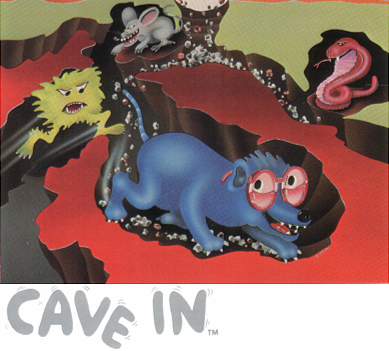
CAVE IN
Released for the VIC-20 (pictures #2 and #3). Catalog description: “After many years of futility,
your search is over! You have found the kingdom of Meese. Power and riches shall
soon be yours. But remember the legend of Meese. Are there really creatures
called ‘Meese-kites’? Are the ‘Magic Lips’ still hidden below? Are you brave
enough to find out?”

CHINA SYNDROME
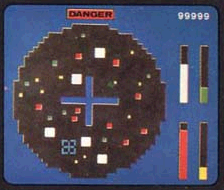
The 1st artist rendering screenshot (picture #1) is from an early 1982 catalog,
and looks nothing like the actual game. A later version (picture #2) is from a later catalog the same year (titled “Meet
the Challenge Vol II 11/82”, which is accurate to the actual game (picture #4).
The box art is completely different as well (picture #3).


DRIVE ‘EM KRAZY
Port of the (very obscure) Status Games arcade game. Catalog description: “A
Spectravideo exclusive! Now the popular arcade game from Status Games comes to
the home with al the action of the original arcade version! Drive ‘em Krazy is a
fast action car chase that is sure to drive you crazy!”

EAGLE MOUNTAIN
Catalog description: “Far away from the civilized world high above the clouds
likes ‘Eagle Mountain’. Many stories are told by the natives about the great
treasures hidden in a secret labyrinth high on the peak. No one knows for sure
how many brave souls have attempted the journey up the Eagle Mountain – none
have returned. We dare you to take the journey!”

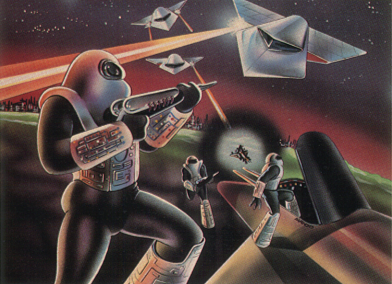
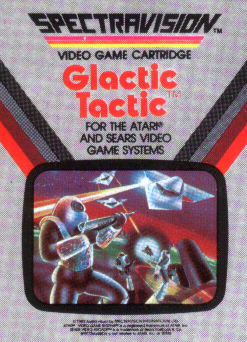
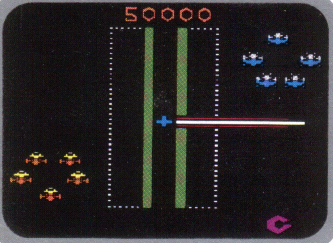
GLACTIC TACTIC
Announced at the 1983 Winter CES. Catalog description: “Intergalactic war has
broken out between those troublesome ‘MORPULS’ from the planet ‘TZORIS’ and the
‘MIRPODS’ from the planet ‘MAMZER’. As a SPECTRA-WARRIOR, your mission is to
protect the ‘GLACTIC TACTIC’ border observation station, and prevent contact
between the MORPULS and MIRPODS. The ‘GLACTIC TACTIC’ is protected by a high
energy force field and bi-directional laser cannons. The entire universe is
depending on you!”

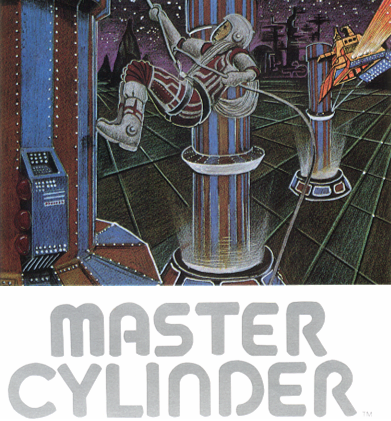
MASTER CYLINDER
Catalog description: “The planet Spectra has enjoyed many years of peace and
prosperity since the evil Morpils from the Planet ‘Tzoris’ were defeated. But
now an evil force permeates the galaxy. The long range sensors have detected a
strange war machine in the Delta Quadrant. As a member of ‘Legion of the Chosen’
it’s your duty to destroy this unknown enemy before it can enter the ‘SPECTRASPHERE’.
Little did you know that this mysterious force is the evil ‘Master Cylinder’.“
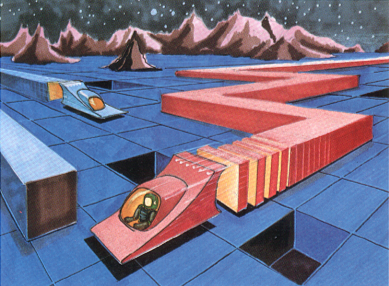
PROTOBOB
Judging from the artwork, this looked to be a variant on Surround. Catalog
description: “Strategy is the name of the game! Challenge your opponent or the
computer to fill the screen with PROTOBOBS. Capture the majority of the
battlefield to win. Endless possibilities and combinations of play are sure to
make this game a classic!”

ROMPER ROOM SERIES
A series of early learning educational programs. Titles were DoBee’s First
Alphabet, Romper Room’s Countdown to Fun, and The Street Where You Live. Catalog
description: “Spectravideo is pleased to announce the official Romper Room
series of early learning educational programs. Join ‘DoBee’ and his friends in
teaching pre-schoolers about numbers, the alphabet and much more. Our experts
use the latest in proven educational methods to educate and entertain children.
These series of programs will add new value to your computer system.”

SECTOR ALPHA
Featured “Spectra-Sound” (speech) – first in a series of planned games. Catalog
description: “At the core of army defense command lies ‘Sector Alpha’. Equipped
with the latest computerized defense console, your mission is to repel the
invading enemy. The attack force is both by air and armoured land assault. Only
Sector Alpha remains to save the battle!”


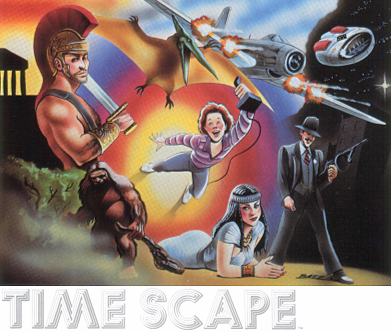
TIME SCAPE
Catalog description: “The following message has been sent to SPECTRA COMMAND:
ATTENTION ALL INHABITANTS OF SPECTA ‘We are the Shieppers from the planet Yutz.
Our planet can no longer sustain our life form, so we have chose the planet
SPECTRA as our new home. We have placed two metanomic bombs somewhere in the
future or past of your planet. If you surrender immediately, your lives will be
spared and you will become our slaves. If you do not respond in 24 hours –
you’ll be destroyed!’ As a member of the Legion of the Chosen, you are the only
one capable of using the time penetrator to save Spectra!”
VERTINKO
Variation on Pachinko. Catalog description: “The famous oriental game of
‘Pachinko’ comes to VCS with an interesting twist! Catch the pellets as they
randomly fall from the grid. Only true skill can meet the challenge of the fast
paced game.”
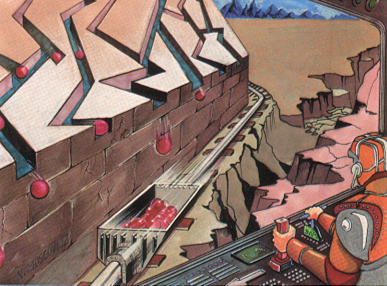

VORTEX
Shown at the 1983 Winter CES, along with versions for the Atari computers, Vic
20 and TI 99/4A, and described in the April 1983 issue of Creative Computing
magazine as requiring typical red/blue 3-D ‘movie’ glasses (

|
STARPATH |
DRAGONSTOMPER
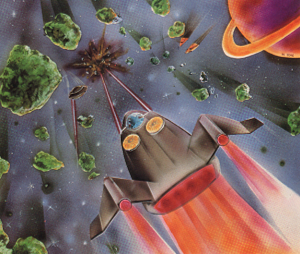
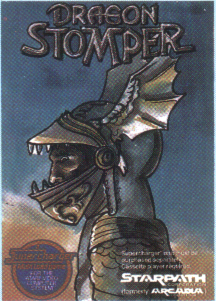
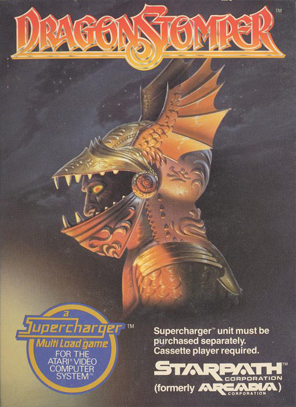
The original name for this was Excalibur. Picture #1 shows the artwork for it. Picture #2 was the early artwork for DragonStomper (note that the title is two words). Picture #3 is the released artwork.
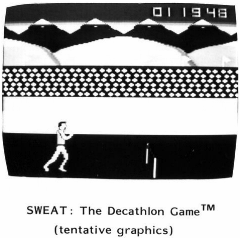
SWEAT: THE DECATHLON GAME
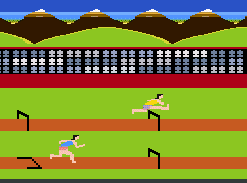
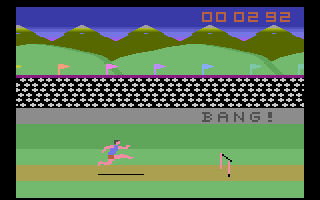
An early marketing photo (picture #1) ended up being a picture of a later
prototype version (picture #3); an earlier version has a smaller athlete
(picture #4). The 2nd photo (picture #2) was on the Stella Gets A New Brain CD but it’s
unknown where it originally came from. For more information go
HERE.

|
TECHNOVISION |
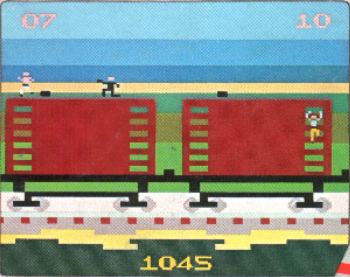
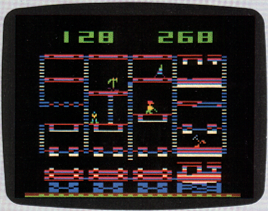
LOCOMOTIVE
The picture is from a brochure. Leonard Herman claims this was shown at
the 1983 Summer CES show.
|
TIGERVISION |
CHANGES
A description of the game from both Tigervision's 1983 CES flyer (picture #1)
and brochure (picture #2) reads: "Guide the
caterpillar through the maze in the forest eating all the power pills but beware
the maze is infested with monster insects. This is a maze game like none you've
ever played before; multiple mazes, multiple and changing paths, horizontally
scrolling mazes and surprises you'll find only by playing." The
screenshot shown was either for the C-64 or IBM versions (or possibly the
TI-99/4a, which isn't listed).


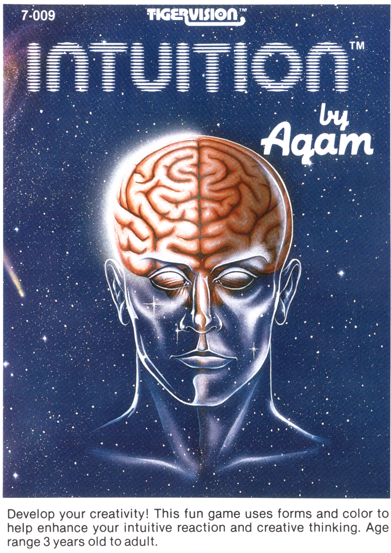
INTUITION
A description of the game in Tigervision's 1983 catalog (see picture) reads:
"Develop your creativity! This fun game uses forms and color to help enhance
your intuitive reaction and creative thinking. Age range 3 years old to adult."
SCRAPER CAPER
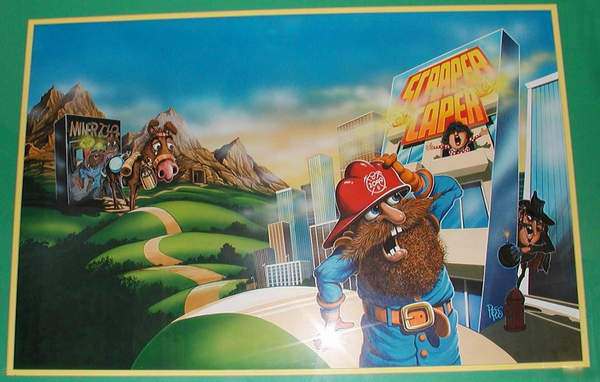
It's very likely that this title exists in some form or another as it was
advertised for several systems including Atari 2600, 5200, and ColecoVision.
A description of the game from Tigervision's 1983 CES flyer (picture #1) reads:
"The adventurous Bounty Bob's travel has taken him to the Big City. He
immediately is selected to be a member of the Big City Fire Department. The
first major fire he fights is in a skyscraper owned by the notorious Yukon Yohan.
Knowing the trickery of the treacherous Yukon Yohan, Bounty Bob must muster all
of his skills to rescue the people trapped in the burning skyscraper. Will Bob
survive the multiple disasters he faces? You hold the key to his survival in
your hands." From programmer Bill Hogue: "After Miner 2049er I worked with
Curtis Mikolyski while we attempted to create an even better game than Miner
2049er. It was pretty hard trying to top ourselves. The licensees of Miner were
crying out for another game. We came up with a vertical scrolling game we called
Scraper Caper. We did a fair amount of work on it. It had Bounty Bob leaving the
mine and moving to the big city as a fireman. He'd also lost a little weight!
The game started outside a tall building on fire. A hysterical woman would flag
down Bob and give him instructions for going up to her apartment to save
something valuable. Bob would salute and then he'd be under your control. You'd
go in the automatic door at the base of the building and start exploring. We
even had the artwork done for the game before it was finished (picture #2); Scott Ross
created this artwork for ads teasing the public with Bounty Bob's new
occupation (picture #3) - that's the evil Yukon Yohan lurking in the shadows.
Notice the donkey with a teardrop in the background! We never finished Scraper Caper because the game just seemed to go
nowhere. Looking back I realize that we were setting our standards too high. We
should have released the game as it was."


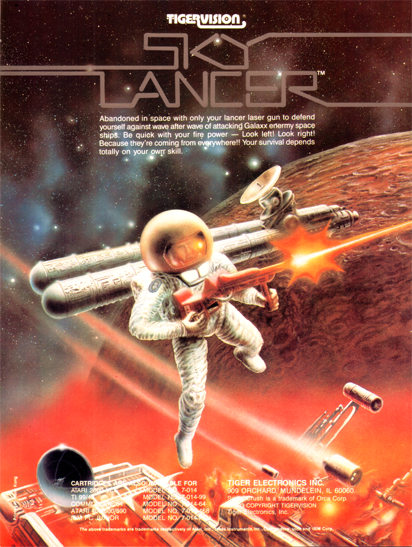
SKY LANCER
A description of the game in Tigervision's 1983 CES flyer (see picture) reads:
"Abandoned in space with only your lancer laser gun to defend yourself against
wave after wave of attacking Galaxy enemy space ships. Be quick with your fire
power - look left! Look right! Because they're coming from everywhere!! Your
survival depends totally on your own skill."
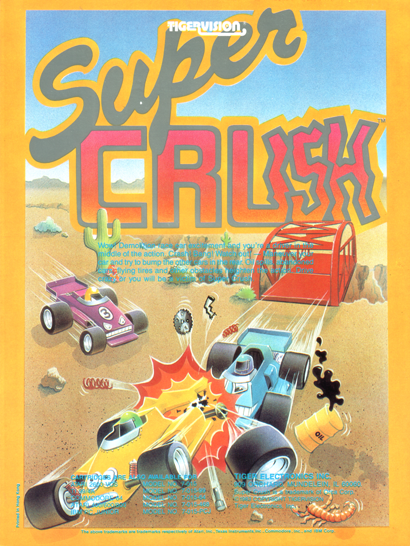
SUPER CRUSH
Based on an obscure coin-op game of the same name by Orca Corp. A description of
the game in Tigervision's 1983 CES flyer (see picture) reads: "Wow! Demolition
race car excitement and you're a driver in the middle of the action. Crash!
Bang! Watch out! - Maneuver your car and try to bump the other cars in the rear.
Oil spills, abandoned cars, flying tires and other obstacles heighten the
action. Drive crazy, or you will be a victim of Super Crush."
|
U.S. GAMES |
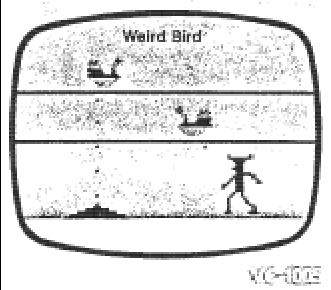
Eggomania
This picture is from literature from the 1982 CES show, and was when the game
was referred to by its original name, Weird Bird.
|
UNITRONICS |
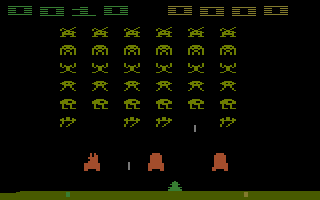
“Space Invaders-type clone”
This picture (actual screenshot) is from a brochure for the Expander System.

EXPANDER SYSTEM
An unreleased add-on peripheral similar to the Supercharger, except that it
includes a built-in tape deck, and the entire unit plugged into the 2600's cartridge slot. Games specifically developed
for the Expander were to take advantage of the additional memory (16K) to
produce better graphics and enhanced game play, and
were to be sold in cassette format and retail for under $15.
High scores could be saved via a feature called Gamescore. The
system had a cartridge slot on the top for use either with standard VCS carts or
an optional 16K memory expansion. Other options included special Gamealbum
cassettes which contained four 4K games.
The Expander II had all the features of the Expander I and included its own 8K BASIC cassette program, Expander BASIC (though one press release stated it was built-in to the keyboard...), but allowed for optional devices to be connected (Expander Keyboard, Expander Printer, and Expander Modem). In addition, they had plans for optional equipment like a Speech Program, which turned the system into a Speech Text Synthesizer, along with a Home Improvement program, plus VideoComp Command joysticks. Note that the literature mentions a 64-key keyboard, but a 55-key keyboard is shown.
Several of Unitronics' cassette games were to be developed in a joint venture with ET Marketing, which was a coin-op manufacturer in Arizona. Some of the tentative titles were:
Buggers
Dazzler
Desert Race
educational programs
Expander BASIC
Home
Improvement
Kaleidosketch
Leprechaun
Pirate's Treasure
"Space Invaders
clone"
Speech Program
Treasure Hunt
Tugboat
Uni-Calc
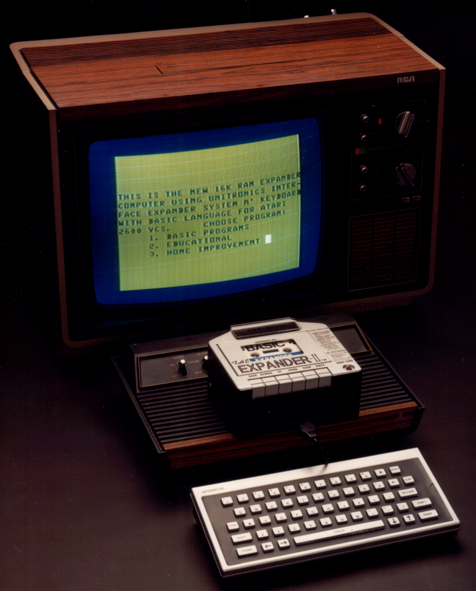
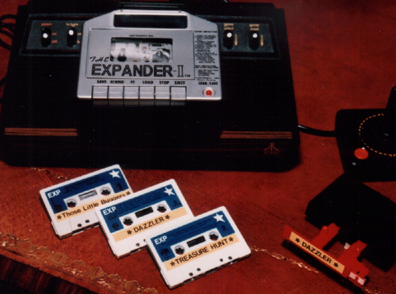
|
VENTUREVISION |
INNERSPACE
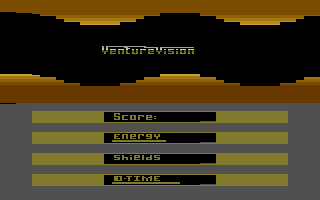
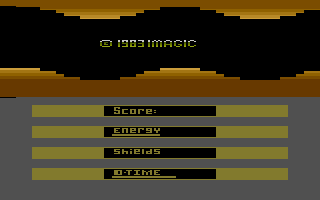
SOLAR DEFENSE
This was the 2nd sequel to Rescue Terra I. The first screenshot below was shown in the
April '83 issue of Videogaming Illustrated magazine; the second appeared
in the May/June 1983 issue of Tilt magazine. A description of the
game from the company's 1983 CES press release reads: "You have traveled to
Terra I and destroyed the computer system thus returning planetary control to
the colonists. Terra I is now shipping Zenbar crystals to Earth's solar reactors
for energy conservation. Solar Defense is a 4K game depicting action on one of
Earth's orbiting solar reactors. The station is under heavy alien attack and you
have all you can do to defend it. Help is on the way if you can hold on long
enough."
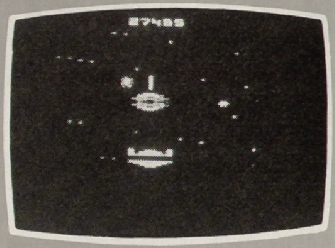

|
WIZARD VIDEO GAMES |
FLESH GORDON
Based on the 1974 softcore porn movie of the same name, and advertised in the
December 1982 issue of Electronic Games as "Coming for Christmas '82". According
to the programmer, "The game was pretty much finished, except for a few final
touches. It was a horrible game with a lot of sex and the payoff was the ability
to hump using the joystick". He sent a review copy to Wizard Video, who first
refused to pay for it and then tried to publish the game using the prototype!
Description: "Become FLESH GORDON, the immoral doer of good, in the first ever
adult participatory game, as you travel the underground labyrinths of the planet
Porno. It will take power and cunning to survive the perverse traps of his protruberance, Wang. Do so and win the favors of the lovely Dale Ardor... grab
your joysticks and play the hottest game on earth!... FLESH GORDON."
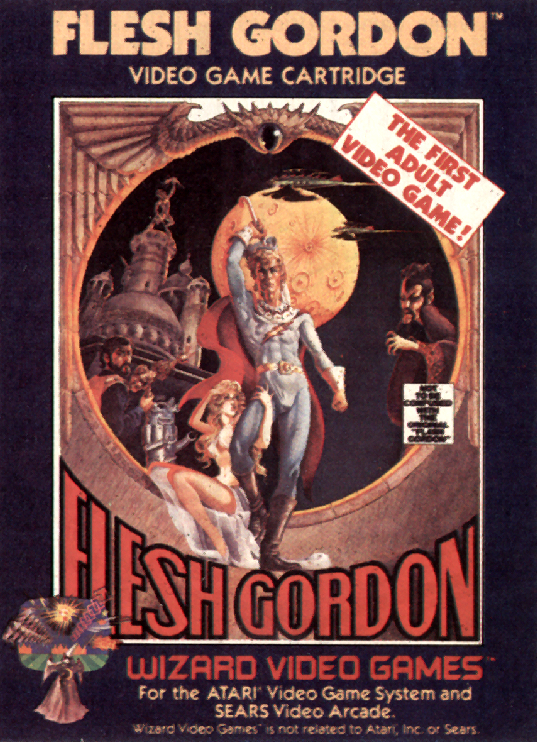
THE TEXAS CHAINSAW MASSACRE
A prototype version exists (picture #1) that is completely different from the released
version (picture #2).
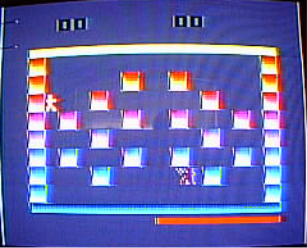
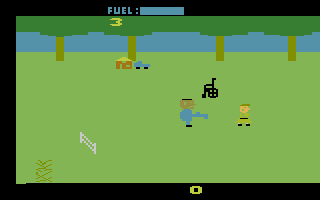
|
XONOX |
HERCULES VS. THE TITANS
An 8K game planned as a double-ender with Chuck Norris Superkicks that was later
dropped for Artillery Duel. Flyer description (picture #1): "You are mighty
Hercules. Olympus is under siege by Titans and your gods are powerless to stop
them without your help. First, though, you must fortify yourself with the Herb
of Invulnerability. It grows in one of ten dark caves flashing briefly as it
blooms. But the caves also hide hungry lions. Will you risk a fatal mauling or
wait for the lionis to betray their presence? As you ponder, another god dies at
the hands of the Titans... In screen two, you're climbing the golden stairway to
Olympus. Watch out for speeding fireballs, tumbling boulders, and rain-slicked
footing! Your club, brute strength, and jumping prowess are your only defenses.
Finally, you reach the Olympian battlefield. Your gods continue to die in a
holocaust of fire and brimstones. The survivors help by stunning Titans briefly
with thunderbolts, but only you can kill them. The entire course of mythology is
at stake."
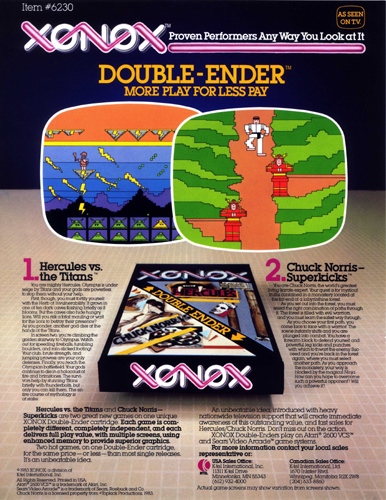
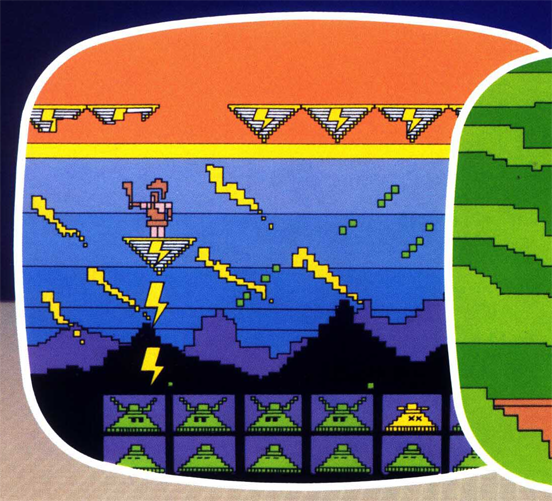
|
ZIMAG |
CAT-NAP
The catalog screenshot (picture #1) is accurate to the Atari 400/800 version
that was released (pictures #2 and #3). Catalog description: “Oh no! Not
again! Can you believe those cats are making all that racket? And just outside
your window! If you are ever to get back to bed you have to take steps – now.
But don’t wake the dog – he makes more noise than the cats. Watch out for the
police if it gets too noisy. A game of skill and chance that will leave you
howling for more – after, of course, a good nights sleep.”


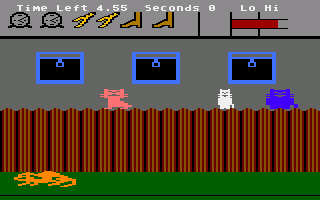
COLLISION COURSE

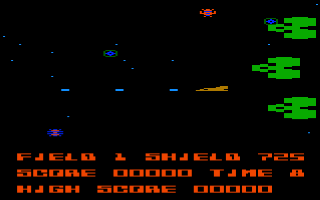
KERPLOP
Catalog description: “You wouldn’t want to drop water balloons on poor,
unsuspecting citizens, would you? You would? Then climb aboard Kerplop’s
mischievous hot air balloon, float high above the city and let ‘em fly. Kerplop!
Sorry, mister. Kerplop! Pardon me, lady. Isn’t this fun? Funny, that cop you
just hit doesn’t seem to think so.”
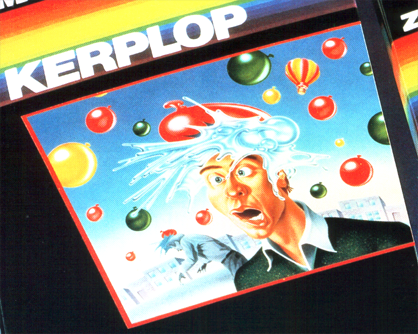
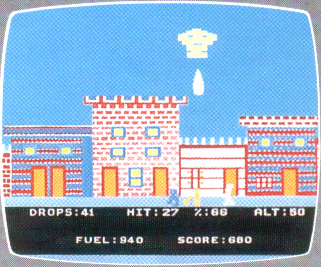
NINEBALL
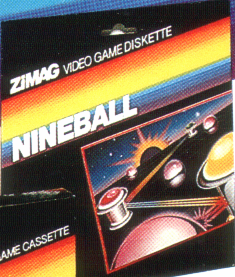
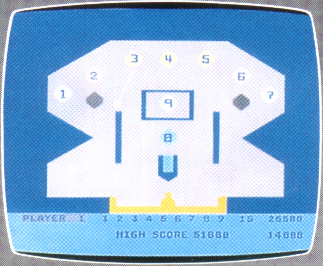
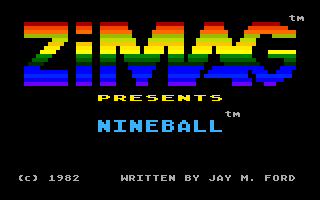
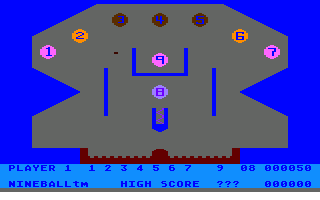
PIZZA CHEF
Aside from a catalog mock-up screen (picture #1), a pirate copy surfaced under
the CCE company name (picture #2). Catalog description: “Mama mia! It’s dinner
time at Mama Zabazoni’s and the pizza chef just stomped off without so much as a
‘ciao’. Uh-oh. There’re a lot of hungry customers out there waiting to chow
down. And they’ve only got so much time. Why not help Mama out and make a little
dough? Here come the orders – tomato, cheese and onion. That’s easy enough.
Ham-onion-olive. The pace is picking up. Mushroomonioncheesehamolive – whoa! How
are you going to keep your combinations from getting all mixed up?”


QUEST FOR INCA GOLD
Catalog description: “You can’t say they didn’t warn you. But the fabled golden
Inca Sun God is worth the risk. Or is it? After a couple of close calls with
booby traps, earthquakes and horrible beasties, you’re not so sure. But you’ve
already lost your map and your guide and, quite possibly, your sanity. So on you
go. That’s when you notice it – there doesn’t seem to be any way out.”

RIVER RAT
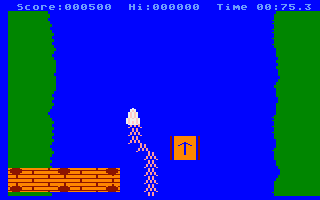
SPACE MINES
No description of the game has been found, but the box artwork is some of the
coolest ever done.