(Original article first appeared in the "2600 Connection" newsletter, 2001)
The SwordQuest Challenge was conceived by Howard Scott Warshaw and Steve Wright, and originally was called the Adventure Series. It encompasses 4 separate games: EarthWorld, FireWorld, WaterWorld, and AirWorld, which each game having its own contest. The prizes were valued at $25,000 (although the first 2 were worth a bit less at the time they were awarded).
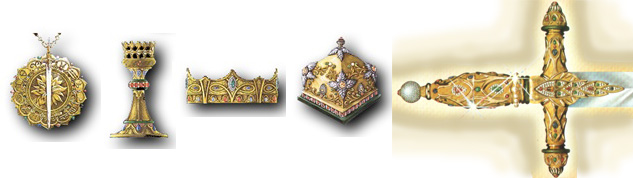
(Prizes: EarthWorld Talisman; FireWorld Chalice; WaterWorld Crown; AirWorld Philosopher’s Stone; Sword of Ultimate Sorcery)
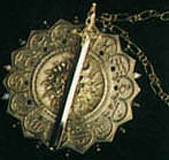
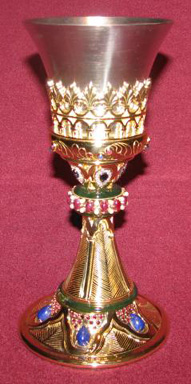
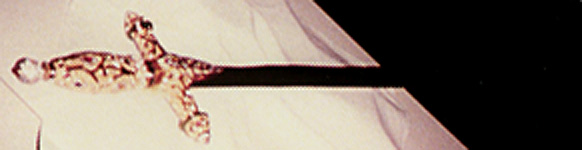
(Actual photos of the Talisman, Chalice, and Sword of Ultimate Sorcery)
The series was to culminate in 1984 with the winner from each of the 4 contests facing off for the grand prize: the $50,000 SwordQuest sword. From Howard Scott Warshaw:
“We were driving back from a brainstorming session in Monterey. Warner had just bought D.C. Comics and we were going back-and-forth talking about getting a comic book series tie-in with D.C. Tod Frye did all the designs, with the four elements and how to tie everything together, which added up to about $200k worth of code! It was a cool concept, but early on though I felt that it wouldn’t come together the way we imagined.”
Each game represented one of the 4 Symbols of Astrology:
Earth (directed
will - energy radiating out from the center; action)
Fire (physical -
force that holds the atoms together; practical applications; consolidation)
Water (Intellect; the energy
that shapes the pattern of things to come; communication)
Air (Soul, Emotions; power
of the unconscious mind; connecting to the source; reception).
Atari hired marketing firm Amrein Marketing Associates, Ltd. to handle the SwordQuest contest. All contest entry forms were to be mailed to P.O. Box 8902, Westport, CT 06888. The series was heavily promoted by Atari, and the first game, EarthWorld, was released in October 1982.
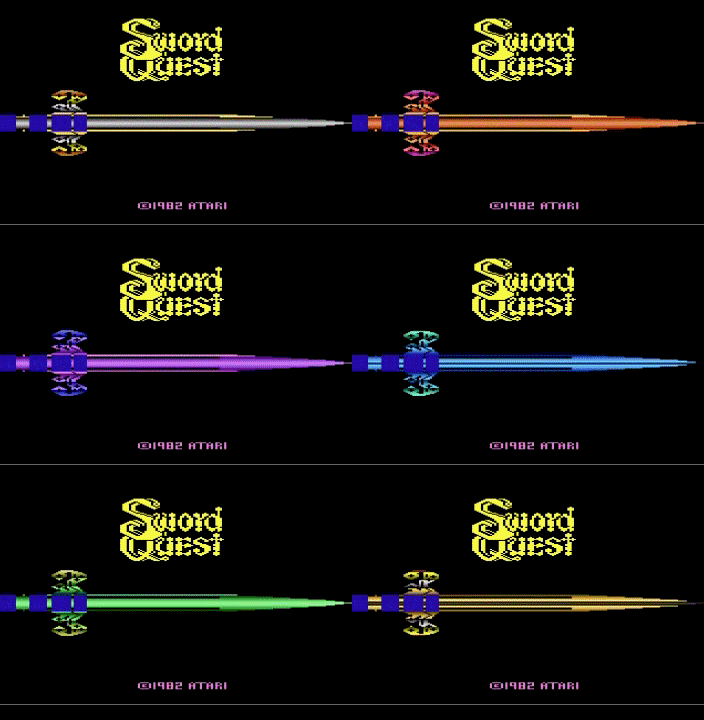
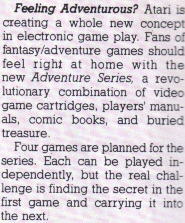
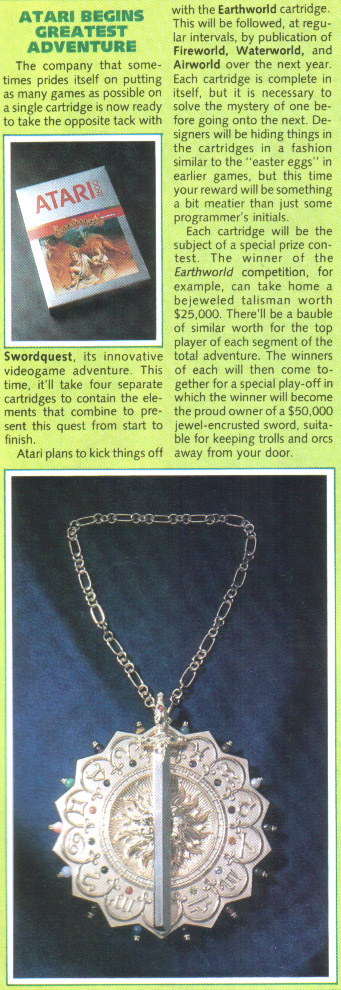
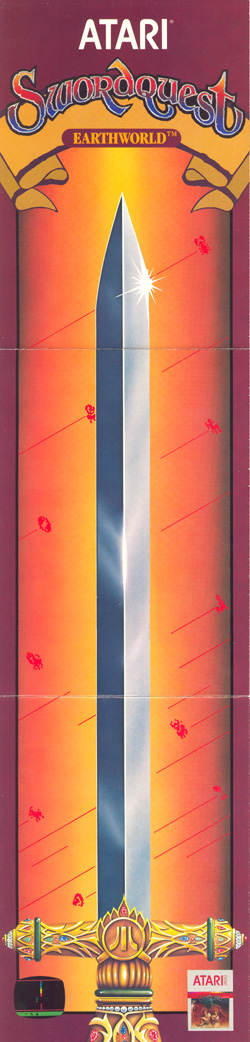
(Article from the 1st Atari Age issue; 1st Electronic Games announcement – 12/82 issue; EarthWorld pamphlet)
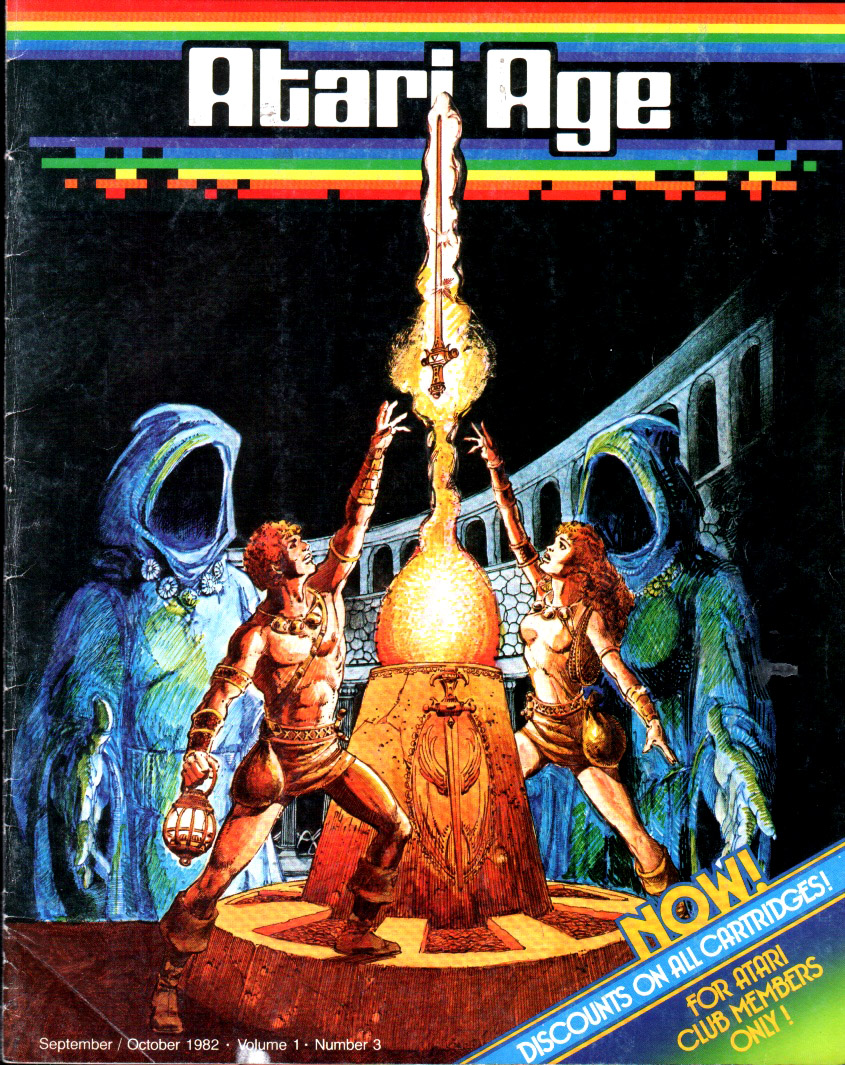
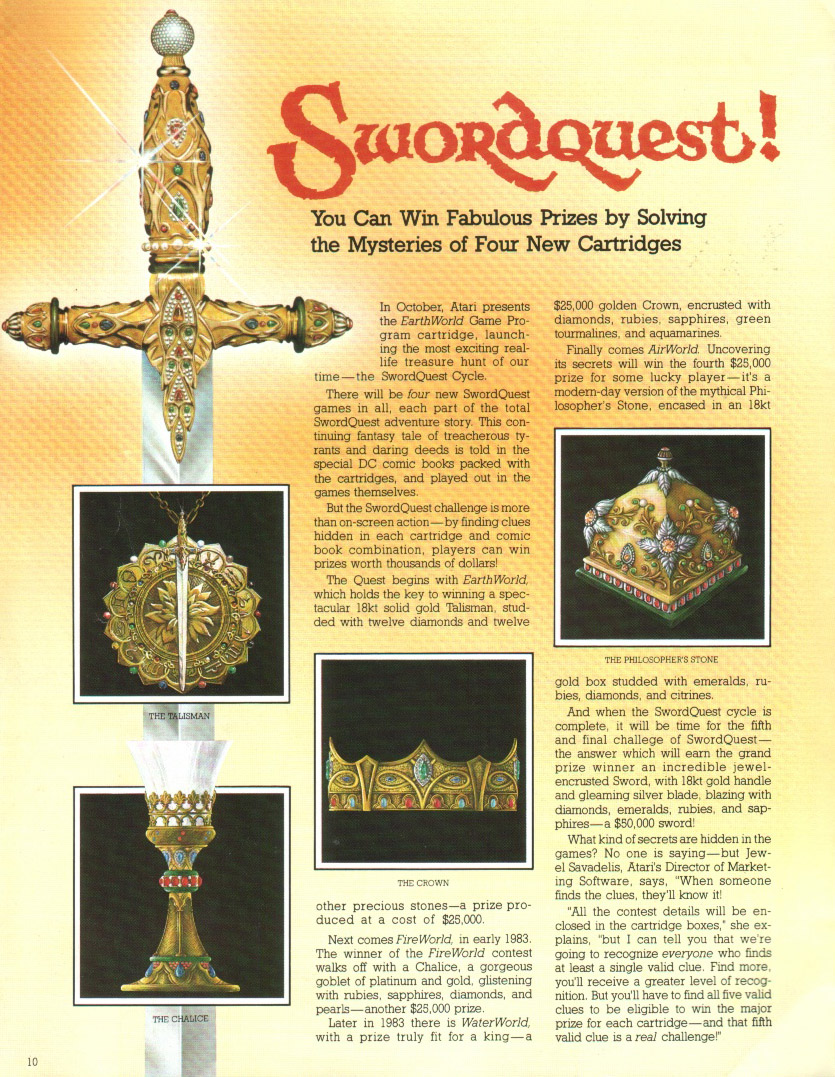
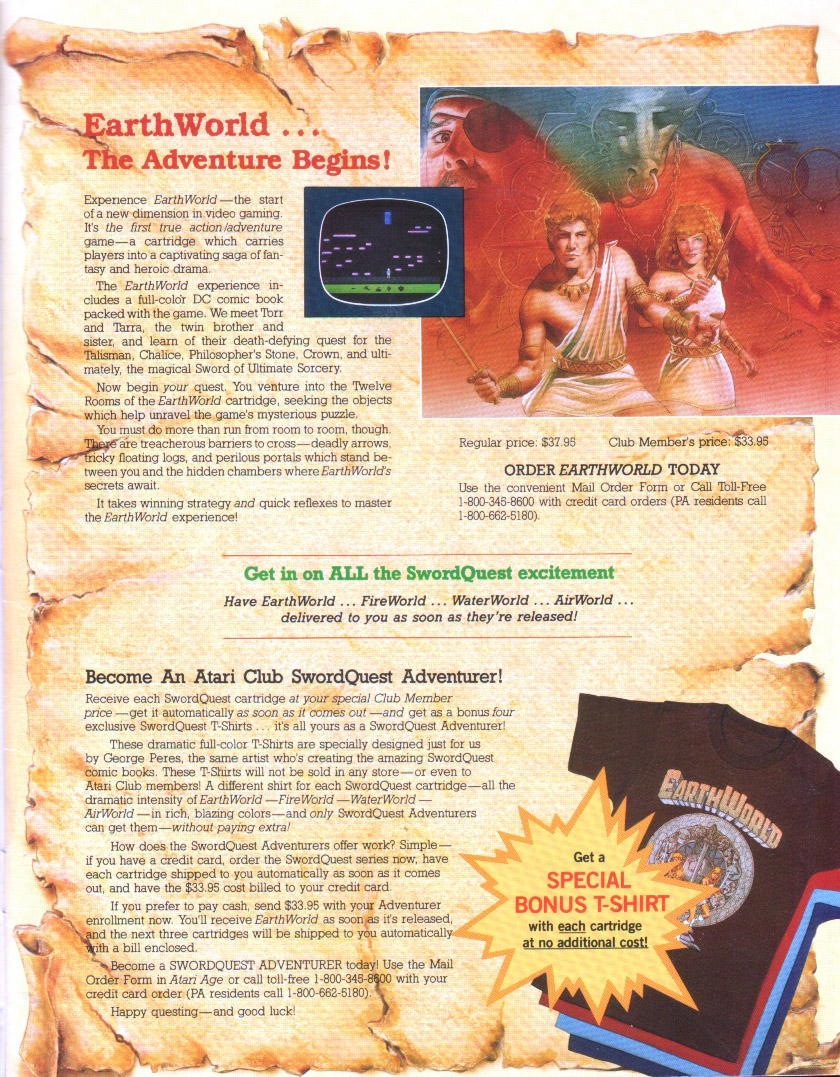
(Atari Age official announcement, from the 3rd issue. Note that T-shirts for all 4 games are shown.)
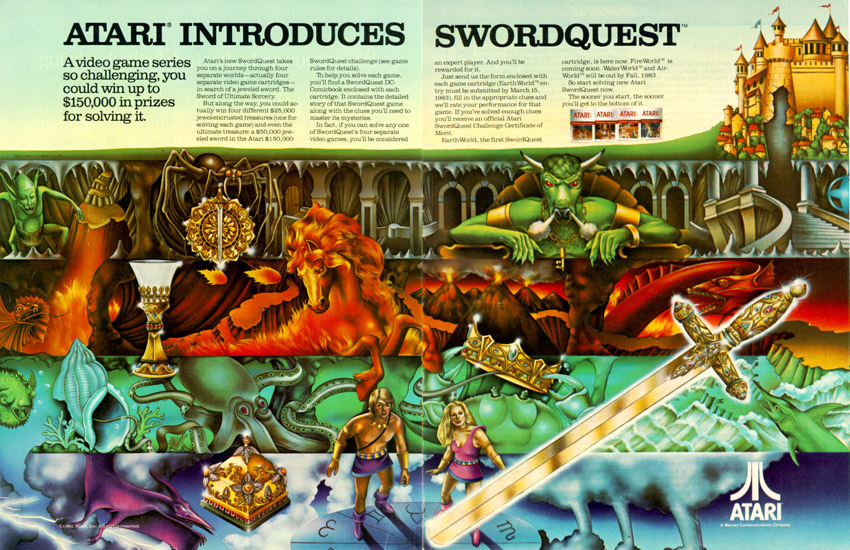
(Magazine ad)
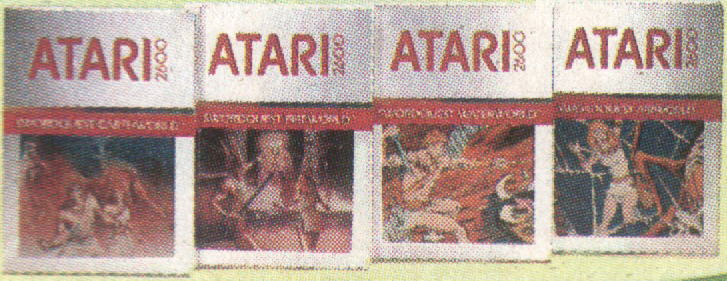
(Close-up of boxes from above ad. Note the different artwork for WaterWorld and AirWorld.)
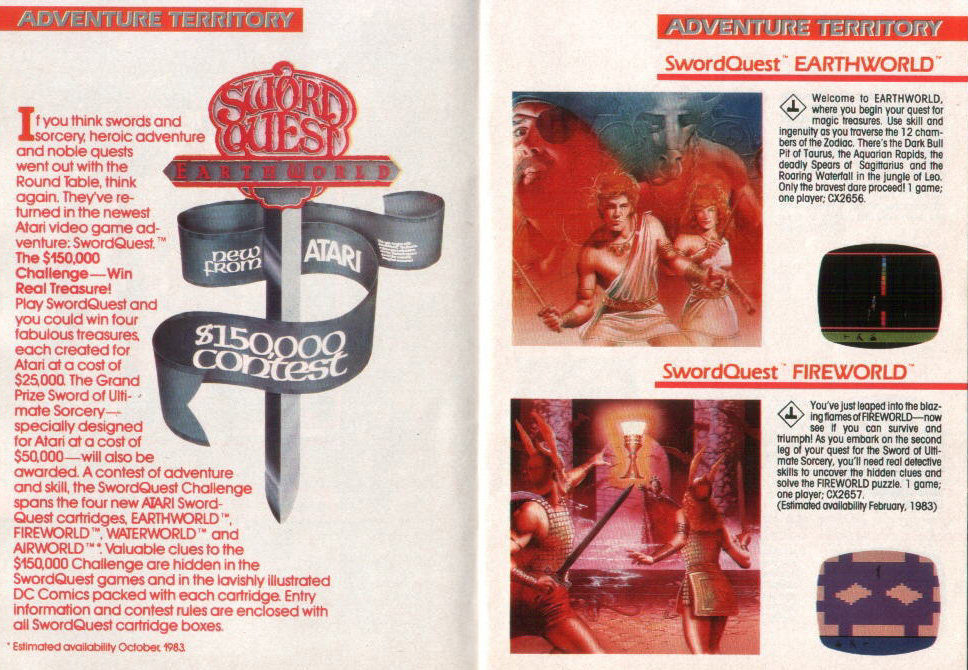
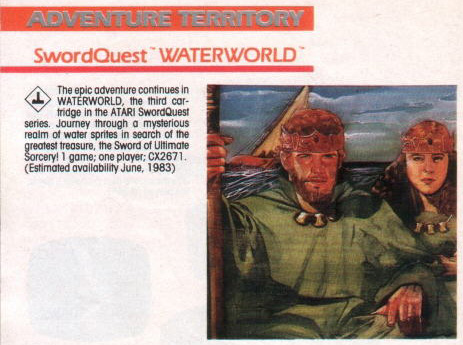
(Catalog entries. Note early artwork for WaterWorld.)
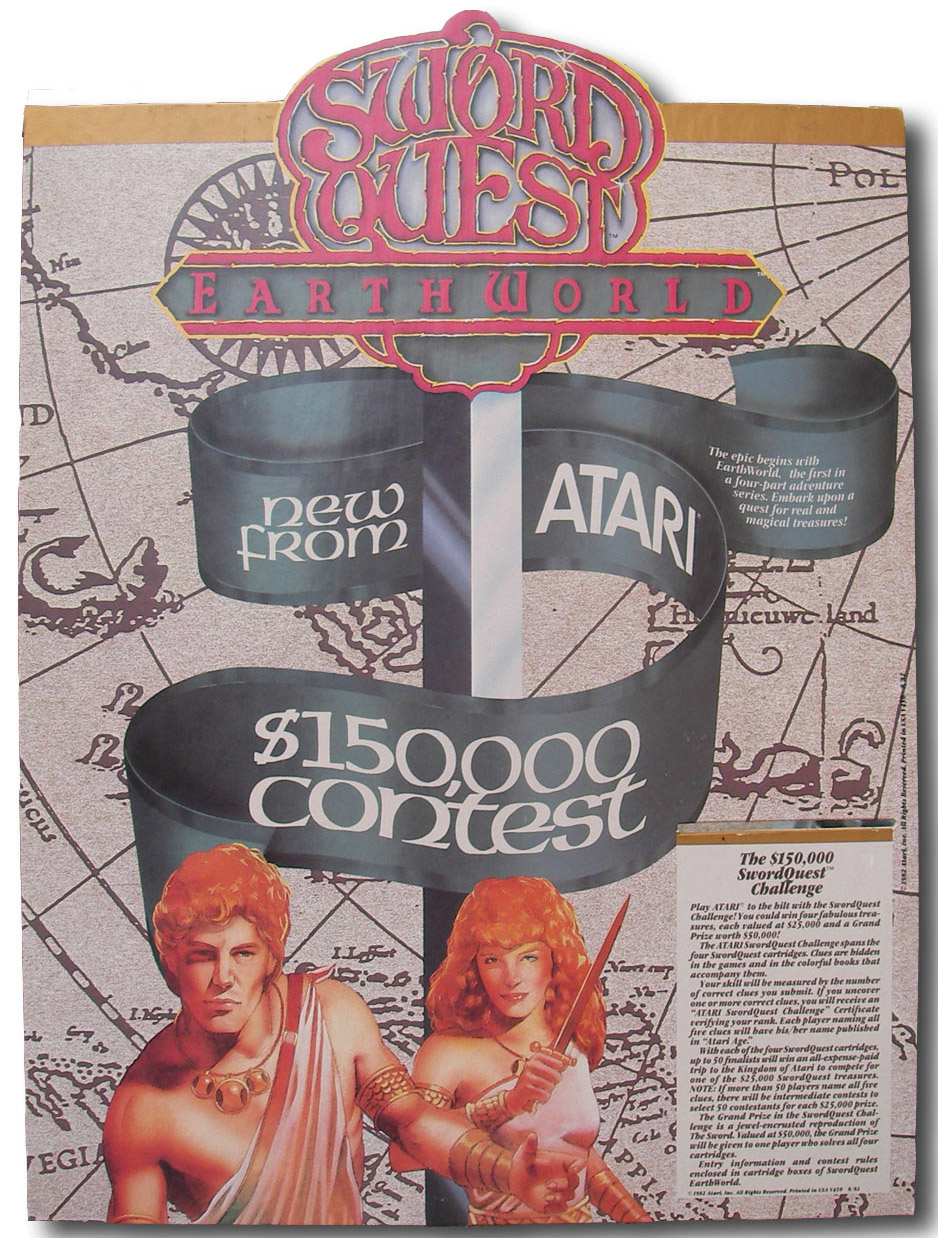
(Atari store display)

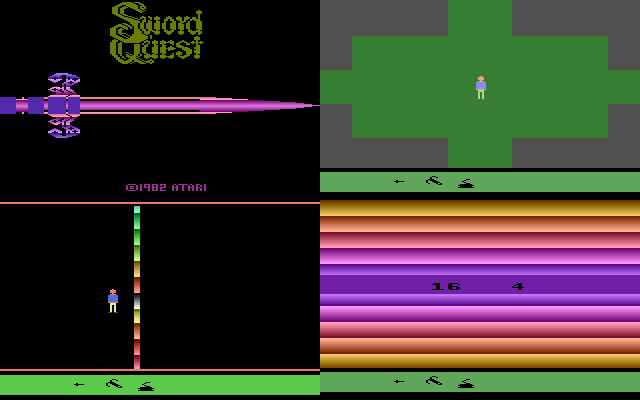
SwordQuest EarthWorld
Programmed by Dan Hitchens
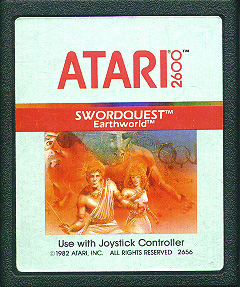
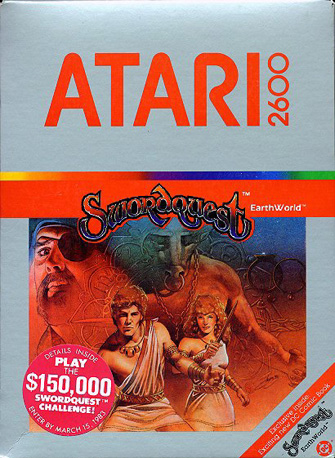
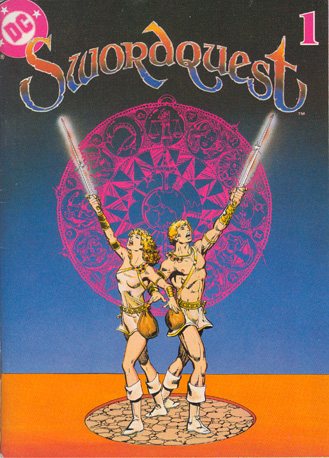
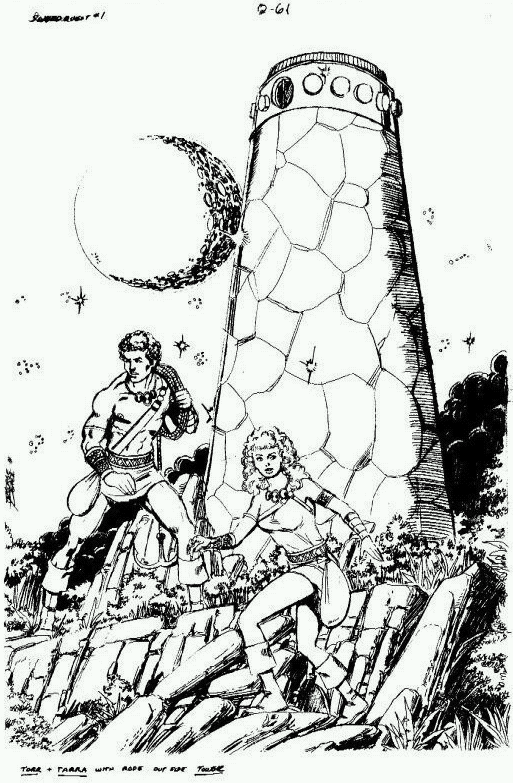
(Early comic cover art by George Pérez)
† The game was coded by Dan Hitchens, under the design direction of Tod Frye.
† The band of the sky in which the planets move is called the Zodiac, which is divided into 12 Signs (each sign represents a specific energy pattern or mode of expression, and contains 30 degrees, or 1/12th of a circle). Together they comprise the 4 basic Elements, and each act in ways, or modes. Each group of 3 Signs of the same element is called a Triplicity, and each group of 4 Signs of the same mode is called a Quadruplicity. The game is based upon these Signs, and the rooms are laid out in a circular pattern for this reason.
† Going left 1 room is equivalent to going up 4 rooms (clockwise on the Zodiac “wheel”); going right 1 room is equivalent to going down 4 rooms (counter-clockwise). Michael Rideout noticed that by using the left and right exits, you can see how the layout also incorporates the Triplicity groups:
Taurus
– Virgo – Capricorn denote Earth
Aries
– Leo – Sagittarius denote Fire
Cancer – Scorpio – Pisces denote Water
Gemini
– Libra – Aquarius denote Air.
The comic book further illustrates the significance of the Zodiac. Each Zodiac “room” has a corresponding House (there are 12 Houses in Astrology, and each House has a planet which is its natural ruler), and the main characters eventually cross paths with all the rulers of each House.
† It’s possible to run through all the
different waterfalls (in Leo) without stopping.
† There are invisible “lines” running vertically down the screen that (when
crossed) trigger the next waterfall, or the entrance to the zodiac room. Notice
that the waterfalls slowly move to the left. If you let one (the first one is
the most difficult since there’s little room to maneuver) of them pass w/o
triggering the next line, it will eventually wrap-around the screen!
† There was no comic book, poster, contest entry form, or contest sticker on the box. Atari Benelux promised there would be a contest when they released the games, but that never happened.
† Did you know the PAL version has a different solution? Luc Pycke obtained a fax from Atari Benelux (who obtained it from Atari International) containing the solution, which was supposedly hand-written by Dan Hitchens. The solution does have a few errors - #5 and #10 were incorrect. The correct solution appears below, along with a copy of the fax.
† The inventory bar/strip actually extends to the very bottom of the screen, unlike the NTSC version. Also, each clue gives a bit more of the EarthWorld “fan fare” (as mentioned in the manual), rather than different tunes for each, as in the NTSC version.
† It’s interesting to note that there are only 11 levels, since the game is based around the 12 Zodiac symbols. Perhaps there is a yet-unfound 12th clue?
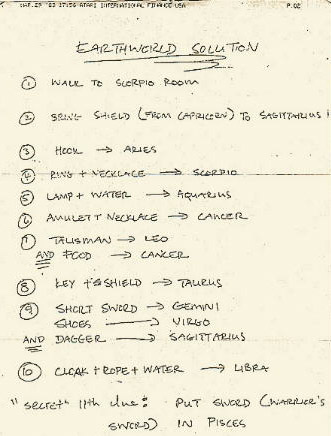

(PAL end label)
† The deadline for entering the contest was March 15, 1983. According to Robert Ruiz Jr., over 4,000 entered the contest. Of those, only 8 had the correct solution - "QUEST IN TOWER TALISMAN FOUND". Here is the list of the finalists, along with their ages and then-locations:
Matthew Balasa, 21, Bayshore, MI † At least 7, possibly 8, special
edition “championship” carts were made. The championship was held on May 2, 1983 at Atari’s
headquarters in Sunnyvale, CA. The contest had a 90-minute time
limit. Steven Bell finished the game in 46 minutes, 49.4 seconds. † An interview with finalist James
Schweitzer can be found
HERE. † It was long believed the PAL version
was the same “Special Edition” version used for the contest, since it was
mentioned that the contest version comprised 11 “levels” of play. This is
not the case. John-Michael Battaglia, who was a writer at Atari, kept a
copy of the
EarthWorld Playoff Contest Rules, along with programmer Dan Hitchen's
handwritten notes for the solution to the contest version, and made them available on his WEBSITE.
Steven Bell, 20, MI (either St. Clair or St. Clair Shores) - the eventual winner
Jacquie Custer, 30, Arleta, CA
Stephen Perry Doussa, 18, Arabi, LA
- absent from contest?
Douglas Ferry, 18, Chalmette, LA
John D. Hoffman, 30, Waterloo, NY - absent from contest?
Thomas J. Neill (or Heil?), 32, Clairton, PA
James Schweitzer, 16, No. Charleston, SC
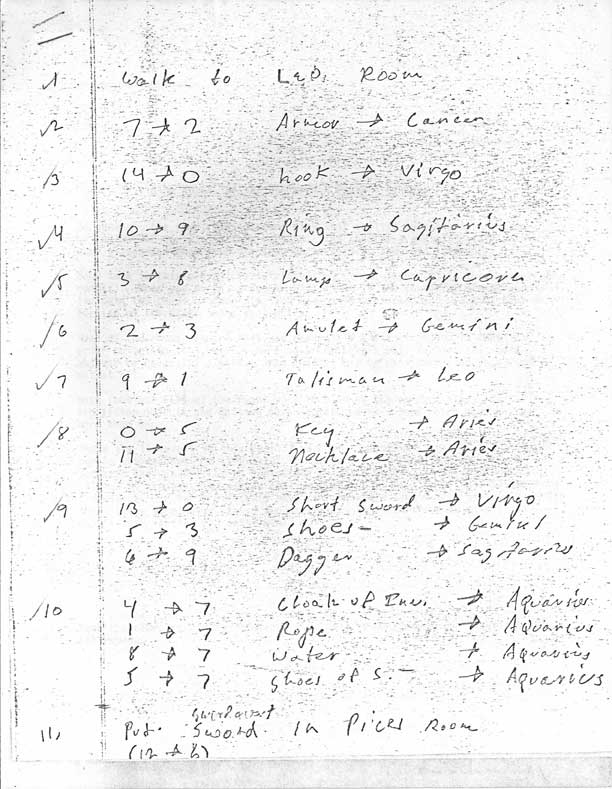
† John-Michael Battaglia had this to say about the SwordQuest contest:
I was a Senior Copywriter
at Atari in the early days of the video game industry. I wrote instruction
manuals and packaging copy for several Atari 2600 and Atari 5200 video games. I
also worked on special projects, like the Atari Swordquest Challenge, around the
same time that I was writing the manual for WaterWorld, one of the games in the
four-part SwordQuest series.
For one of the four playoff competitions in the Atari SwordQuest Challenge, I
had all of two days to come up with a way to allow a half-dozen contestants to
compete in a race to get through all the levels of EarthWorld, a brute-force
adventure game that had required gamers to spend weeks of their lives trying to
figure out the astronomical permutations regarding which 16 magical objects
needed to go into which 12 rooms of the Zodiac at various points in their quest
for a magical sword. Atari had sold over 500,000 of these games in a gigantic
cross promotion involving DC Comics and the Franklin Mint, and, without clues to
guide them through the adventure, only 7 people managed to get themselves
invited to participate in the quarter-final playoff tournament. The playoff
winner would walk off with a $25,000 prize, as well as earn a chance to compete
in the final SwordQuest Challenge for a jewel-encrusted sword worth $50,000.
Since all the rooms in Earthworld were named after the houses of the Zodiac, I
wrote a series of arcane clues that directed the keenest reader among the
contestants where to place the correct magical objects and race to victory
within less than two hours. Essentially, I provided word-clues with an
astrological theme to blend aspects of the game's key elements in the context of
a puzzle based on the game's theme. As the participants later acknowledged, the
arcane word-clues added a twist that elevated the original design of the game to
a more entertaining level, while also making it possible for someone to actually
solve the game/puzzle in time for the luncheon award ceremonies. I got a nice
memo of appreciation from the product manager for making the playoff competition
a success, and the whole episode was written up in Atari Life, the Atari
employee newsletter.
Of course, while it is not possible to play the limited edition playoff game
that was programmed exclusively for the playoff, anyone wishing to try their
luck deciphering the arcane clues can do so now by first getting very familiar
with both the list of magical objects and the signs of the Zodiac. Your eye-hand
coordination won't be tested like it was in the original game play, but at least
you might have some fun trying to figure out what magical objects go into what
astrological houses —based on the Earthworld play-off word-clues that I wrote
for the playoff. Just don't expect a jewel-encrusted sword to be waiting for you
if you succeed!
The playoff winner navigated through the puzzle in less than an hour, leaving us
all plenty of time to enjoy the luncheon ceremony that followed. How well can
you do?
† A copy of the memo from Joel Oberman to Battaglia, dated May 3, 1983, can be found HERE or on Battaglia's site.
† A copy of the Atari Life magazine article can be found HERE or on Battaglia's site. Note that Stephen Perry Doussa isn't listed as one of the finalists, but that John Hoffman is! Thomas Neill's last name is also spelled as "Heil" and Steven Bell's hometown as St. Clair Shore.
† Battaglia is also in possession of a one-of-a-kind SwordQuest EarthWorld Sears-style manual!
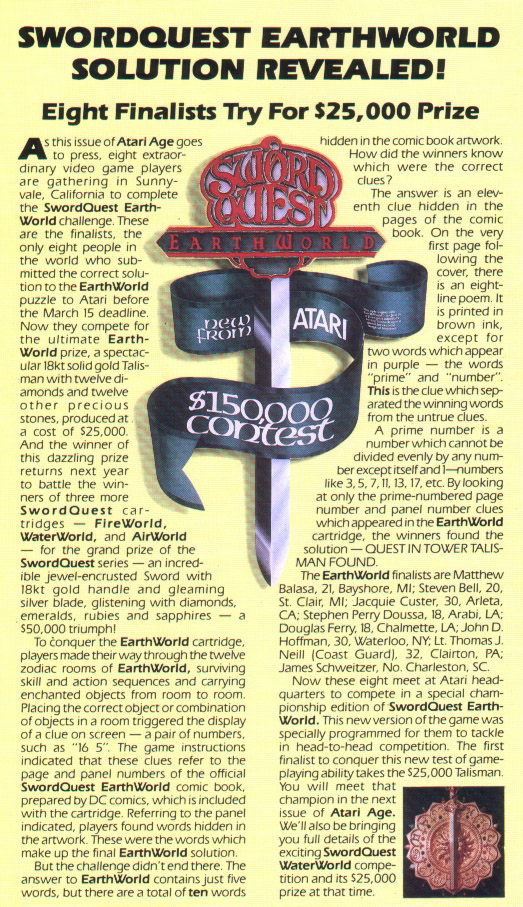
(Atari Age EarthWorld contest finalists article, from issue V2N1)
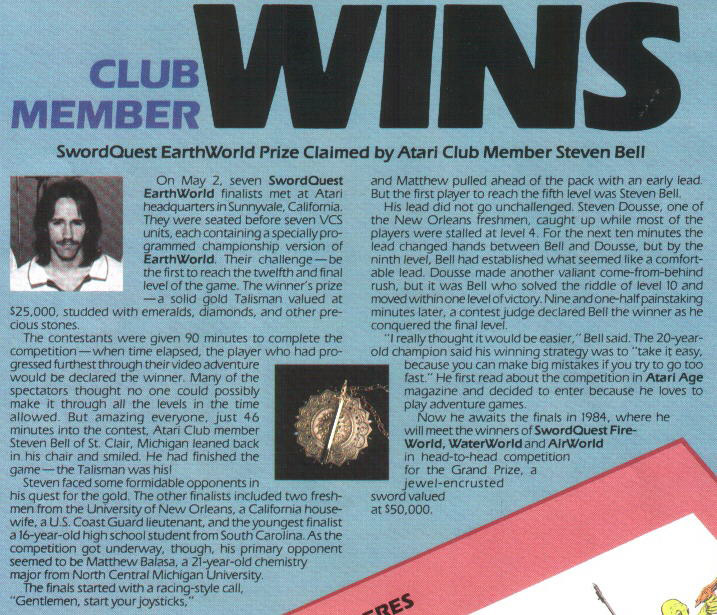
(Atari Age EarthWorld winner announcements article, from issue V2N2)
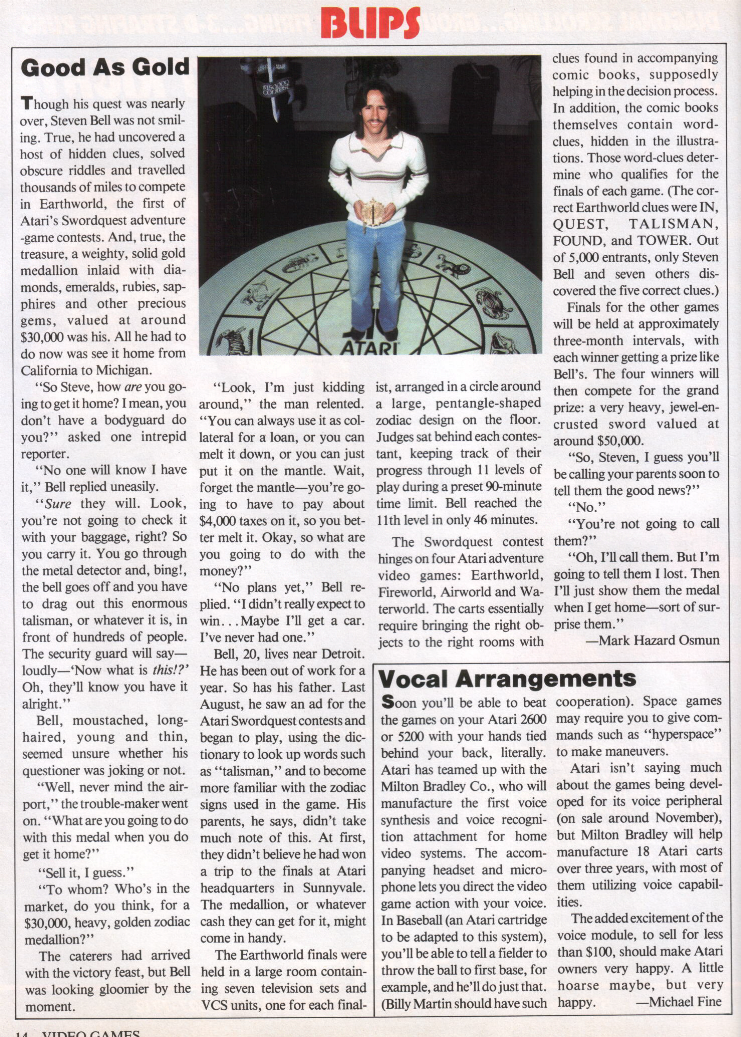
(Video Games magazine article, August 1983)
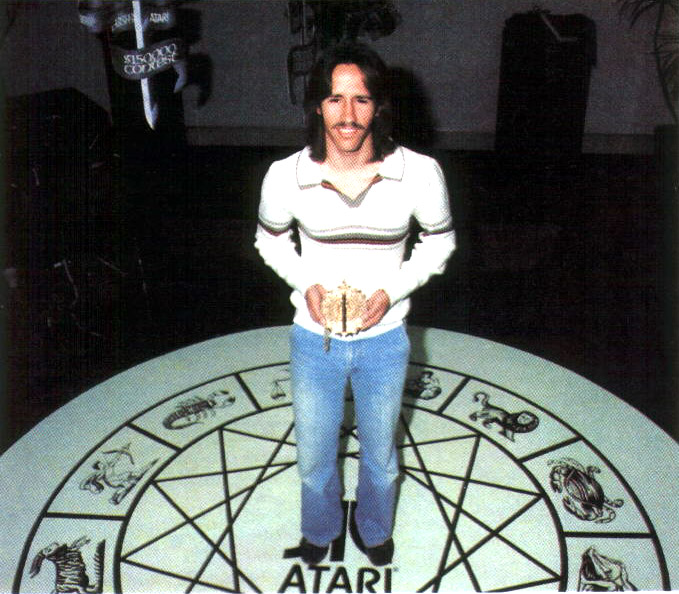
(Close-up picture of the Atari Zodiac Mandala)
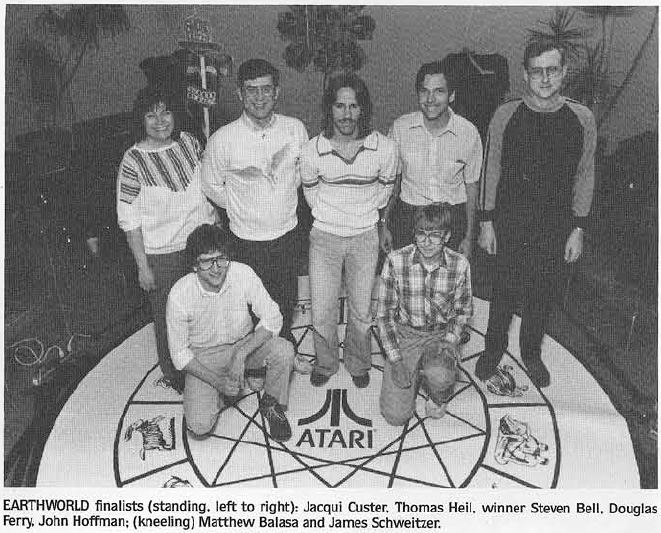
(Photo of EarthWorld contest finalists from Atari Life magazine, V2N10)
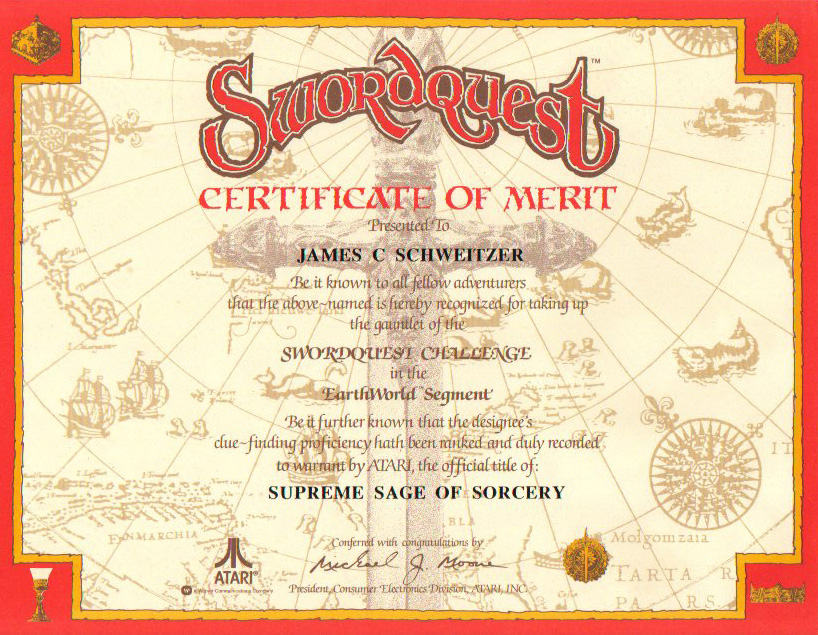
(Certificate of Merit)
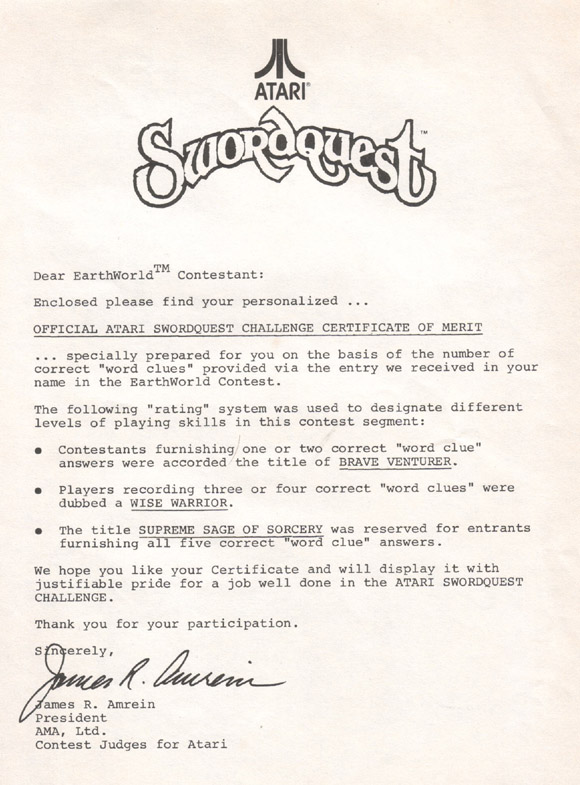
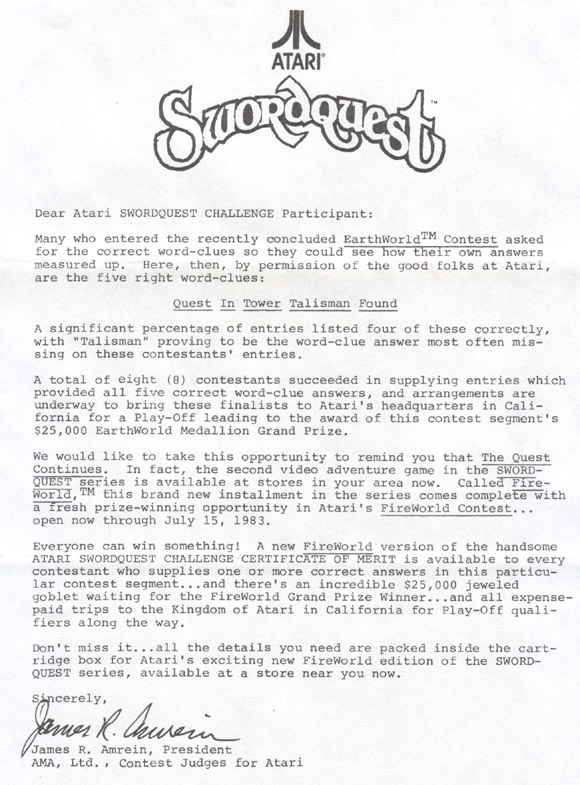
(Certificate of Merit letters)
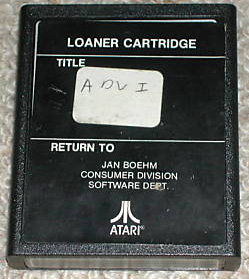
(EarthWorld prototype)
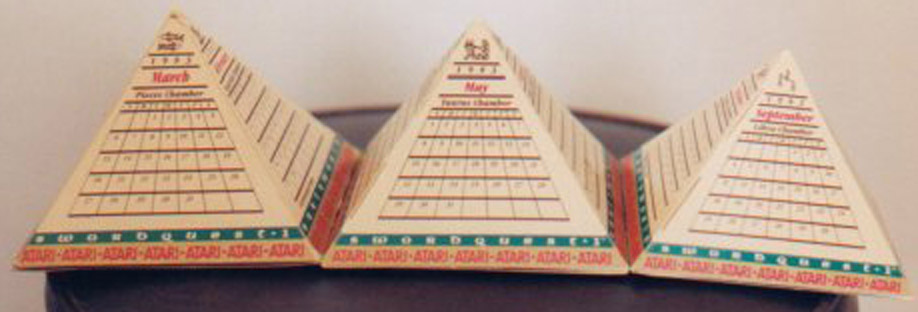
(SwordQuest "pyramid" calendars. Photo courtesy of James Schweitzer)
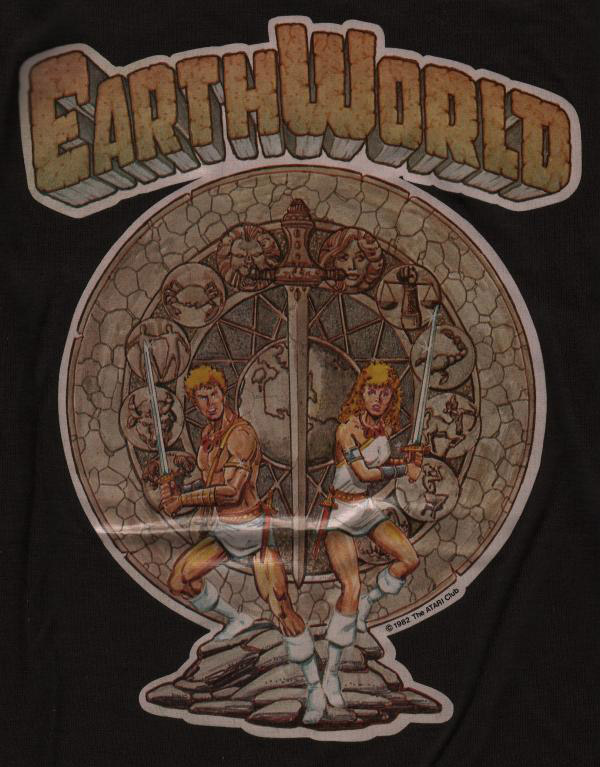
(Rare EarthWorld T-shirt, only available through Atari Age. Artwork by George Pérez.)
SwordQuest FireWorld
Programmed by Tod Frye
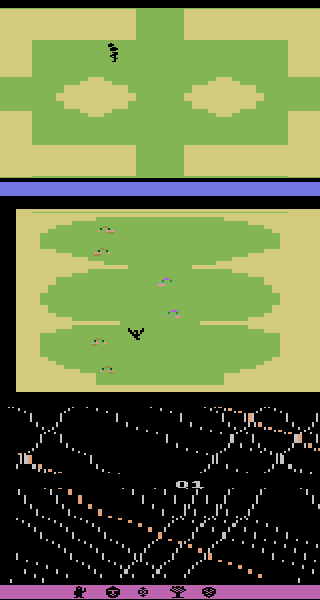
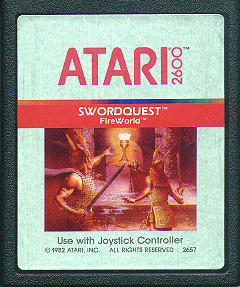
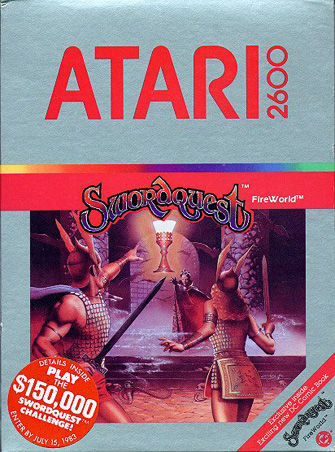
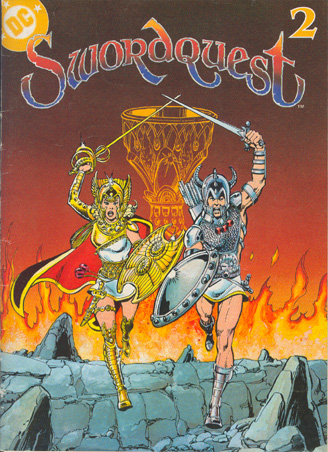
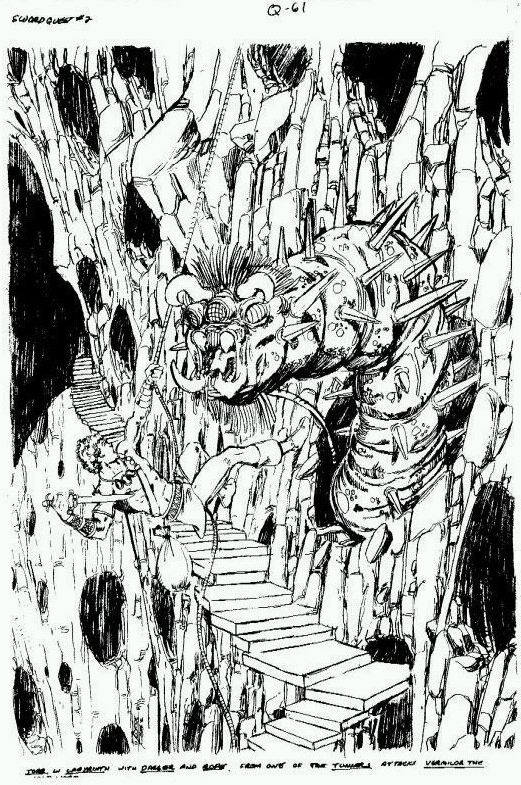
(Early comic cover art by George Pérez. Click HERE for the complete comic, uninked!)
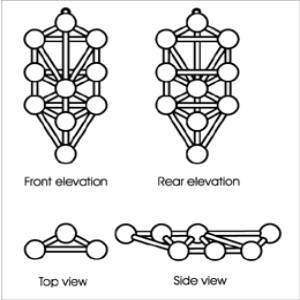
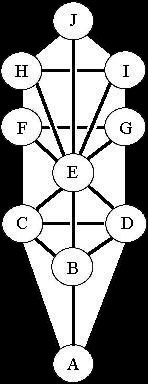
† The game is based on the Tree of Life, which is found in the Jewish Kabbalah. The Kabbalah is based on 4 worlds, and has 10 "spheres" or "levels" called the Sephiroth. The 4 worlds are as follows:
Atziluth
(Kether & Daath): The World of Origination
Briah
(Chesed, Geburah & Tiphareth): The World of Creation
Yetzirah
(Chokmah & Yesod): The World of Formation
Assiah
(Binah, Netzach, Hod & Malkuth): The World of Expression
† It’s possible to “warp” up into adjacent rooms. In some rooms corner warping can be used to also go left, right, and down. Was this by design or a glitch? In room E, sometimes when trying to warp to room G you will reappear on the other side of the room instead. You can also get stuck on the walls in this room when trying to do corner warps.
† The doors in room E are affected by what items are placed inside. While the B doorway is always open, and holding the chalice opens all doors (including J), the following doors are opened with these objects:
F – Dagger† Pictures of the FireWorld contest were found by Clive Young in 1999 and appeared in issue #58 of the “2600 Connection”. They can be found on their site HERE or on DP HERE.
† The clues don’t have to be found in order. The meaning of the clue numbers is unknown, but it’s possible that being they were simply numbered from 00 to 09 meant that there were 10 word clues to find in the comic book.
† In the Salamanders skill test (room J), your “line” character gets longer each time you are hit.
† When you find a clue, occasionally a block (cursor) will appear in the inventory. To get rid of it, go in a treasure room and place your cursor over it and “drop” it, otherwise you won’t be able to carry 6 objects.
† Normally you have 8 chances to finish some skill tests (all but the Snakes and Dragons). Each time you fail, you’ll hear a “miss” sound. With the Goblins test though, you only get 7. Notice that when you first start the test you’ll hear a “miss”. There’s also a way to hear 9 “miss” sounds with the Goblins test– at power up, wait until you see the screen showing your character and then start the game. If the very first test you do is the Goblins, you’ll actually hear 2 “miss” sounds at the start, instead of 1.
† There are numerous glitches that appear with the skill tests. With the Snakes test, you may be stuck on the screen when you start (your character won’t appear) or when you kill all of them (and the screen doesn’t change); with the Flamedragons, you may see a “bolt” of fire shooting up from the bottom when you start; with the Salamanders and Firebirds, the bottom border may disappear as you are hit. All tests seem to suffer from poor sprite-collision detection (ex. a goblin or knife may slip past you and not be counted as a miss).
† Luc Pycke programmed a Commodore 64 version of FireWorld, back in 1983! Unfortunately, programming was never completed.
† As with the PAL EarthWorld, there was no comic book, poster, contest entry form, or contest sticker on the box.
† Did you know the PAL version of FW has a different solution? The solution below was also obtained by Luc Pycke
† The PAL FireWorld box is also slightly different from the NTSC version – “SwordQuest ” appears in solid white lettering, with “FireWorld” in large letters underneath it.
† It is believed the PAL version is actually the “Special Edition” version used for the contest, although it was later discovered this did not hold true for EarthWorld.
† The inventory “block” glitch is more prevalent in this version. Clearing the block creates another rope item, which will appear in the room. You can actually create enough ropes to have 6 in your inventory and one in each room!
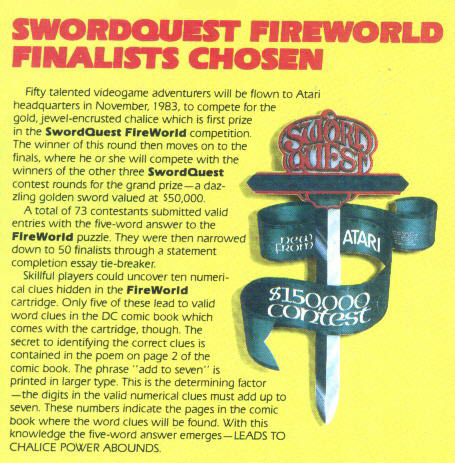
† There were 73 total finalists - according to the winner, Atari had a “run-off” whereby they sent everyone a piece of paper with some questions, and the finalists had to write in so many words or less what they liked about the game. Out of those entries, the judges picked 50 contestants.
† At least 50 “championship” carts were made.
† The deadline for entering the contest was July 15, 1983. All the finalists were to be flown to Atari to compete in November of 1983, but the contest didn’t take place until January of 1984. The reason for the delay is unknown.
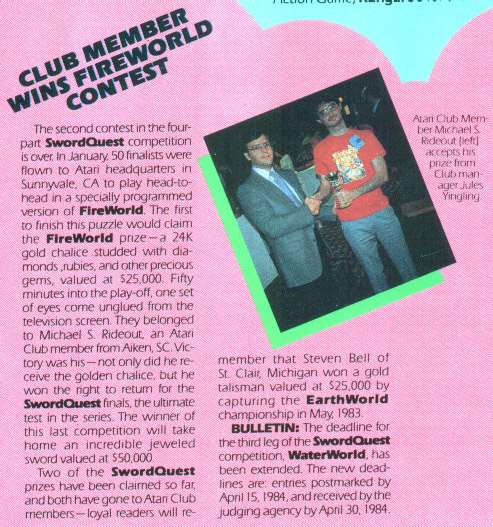
† The winner was Michael S. Rideout of Aiken, SC, who finished the game in 50 minutes.
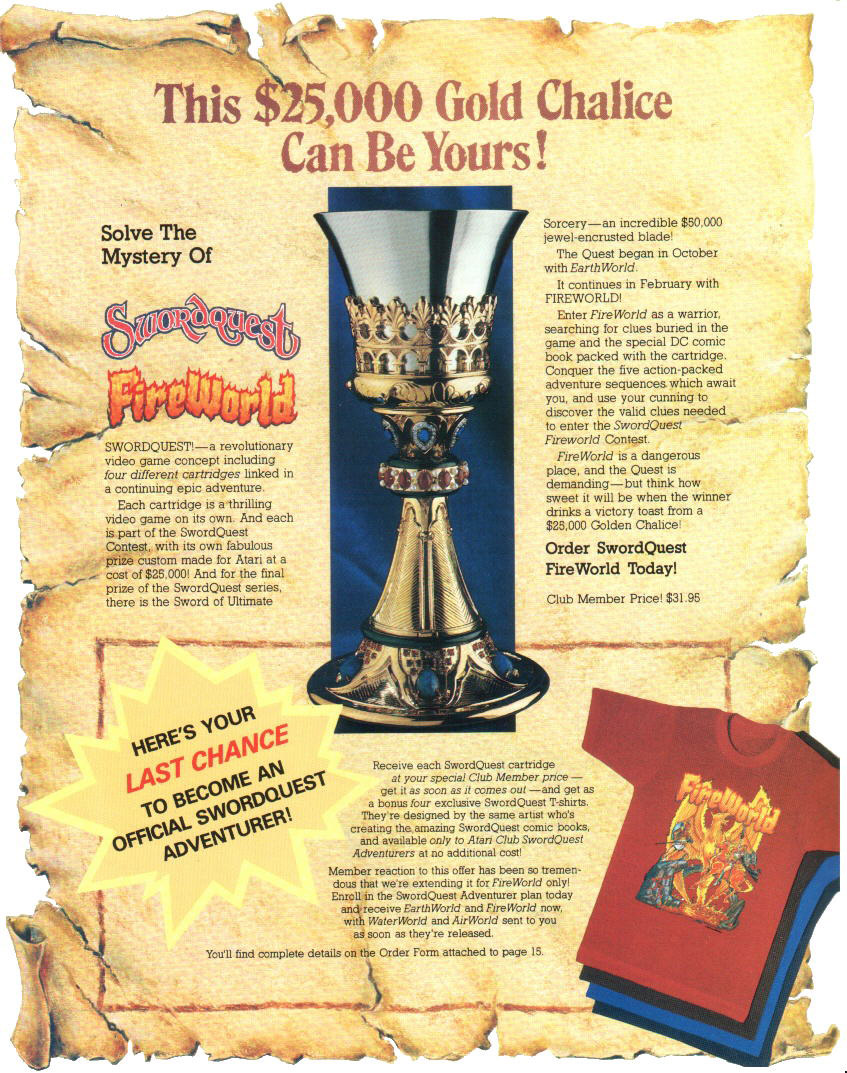
(Atari Age ad, from issue V1N5)
(Atari Age FireWorld contest finalists article, from issue #9)
(Atari Age FireWorld winner announcement article, from issue #11)
(The Tree of Life glyph)
(Room layout, using Russ Perry Jr.’s solution)
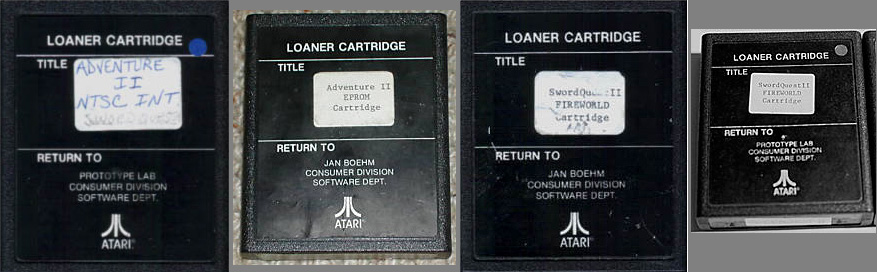
(FireWorld prototypes)
(PAL end label)
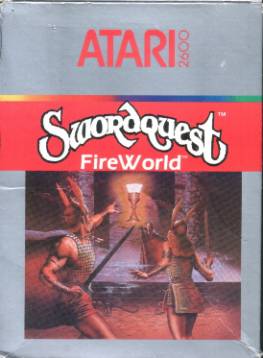
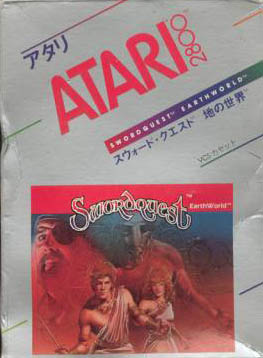
(PAL box) (2800 “Japanese” box)
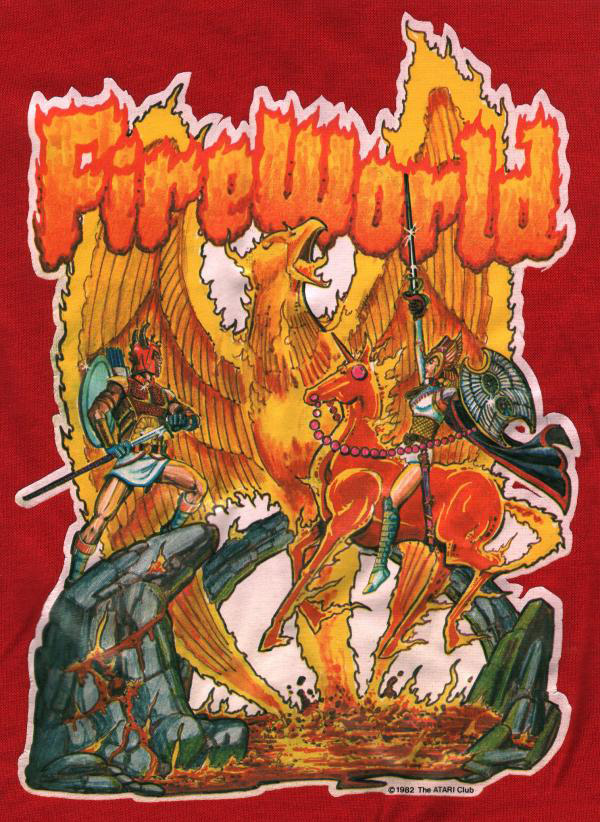
(Rare FireWorld T-shirt, only available through Atari Age. Artwork by George Pérez.)
SwordQuest WaterWorld
Programmer unknown

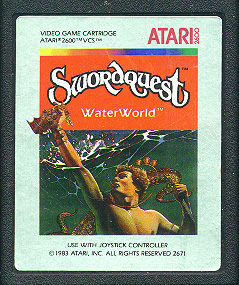
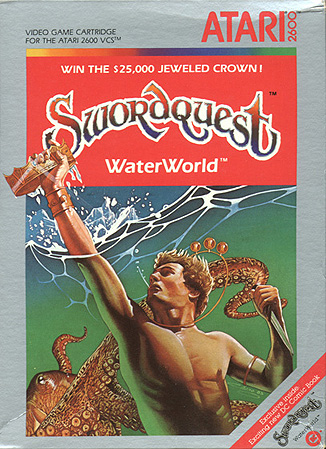
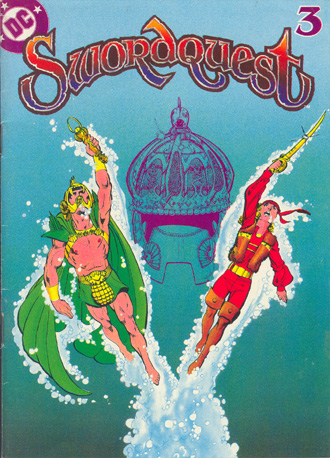
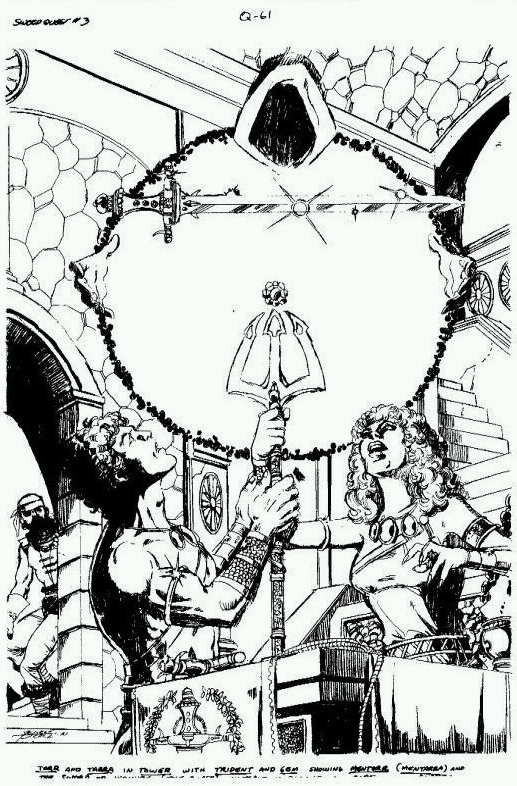
(Early comic cover art by George Pérez)
† The game is based on the Kundalini Chakra. Go to http://www.tantra-kundalini.com/chakras.htm to learn more about this, and to see a chart showing the 7 Chakras, and how it relates to the room layout.
† The original contest entry deadline was December 15, 1983, but was extended to April 15, 1984.
† According to an interview with FireWorld winner Michael Rideout, “They (Atari) chose the finalists although if I remember correctly, they reduced the number to 15 instead of 50. This caused a lot of people to get upset. This was right at the time Atari was sold and everything went into limbo. I don't think the Crown was ever awarded…”. The interview can be found HERE. Atari cancelled the contest before a winner was declared.
† A PAL version was never released.
The following are letters that Russ Perry Jr. received from Atari during the time of the WaterWorld contest:
(letter #1)
(letter #2)
(letter #3)
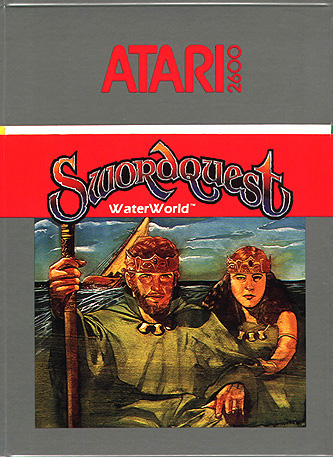
(Prototype box/artwork)
.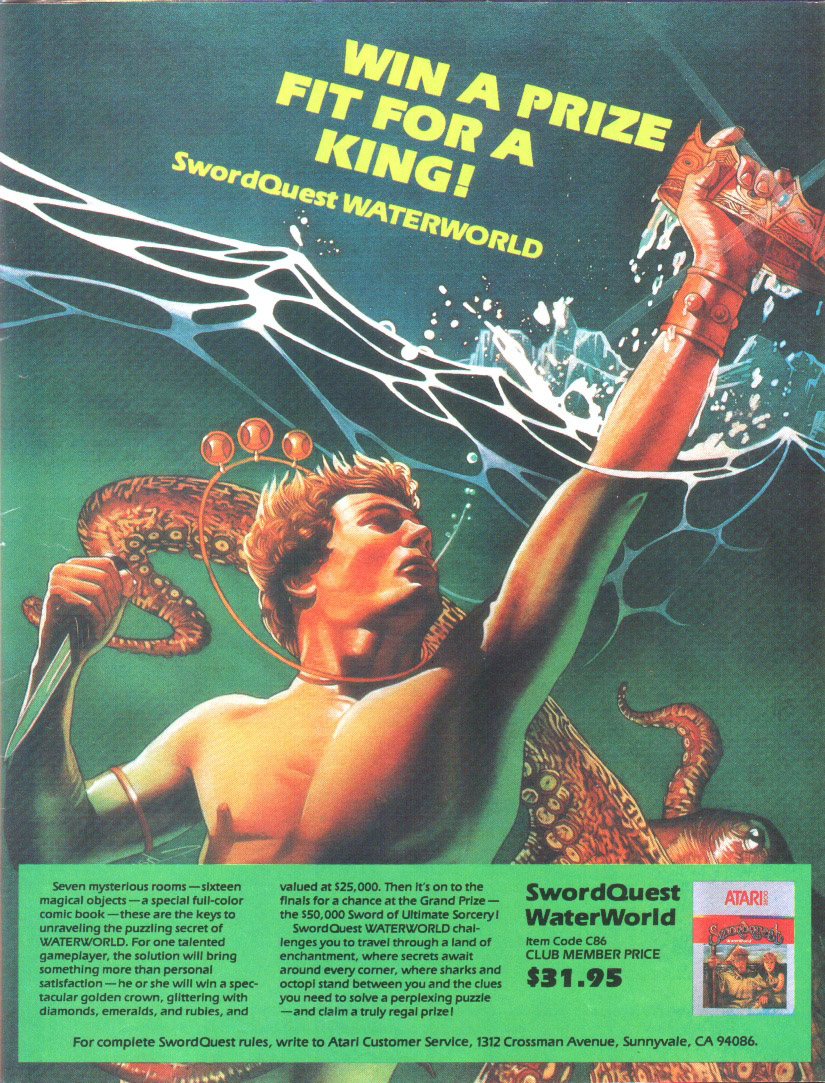
(Atari Age ad, from issue #9. Note the background art is mirrored, and the box shown has earlier artwork!)
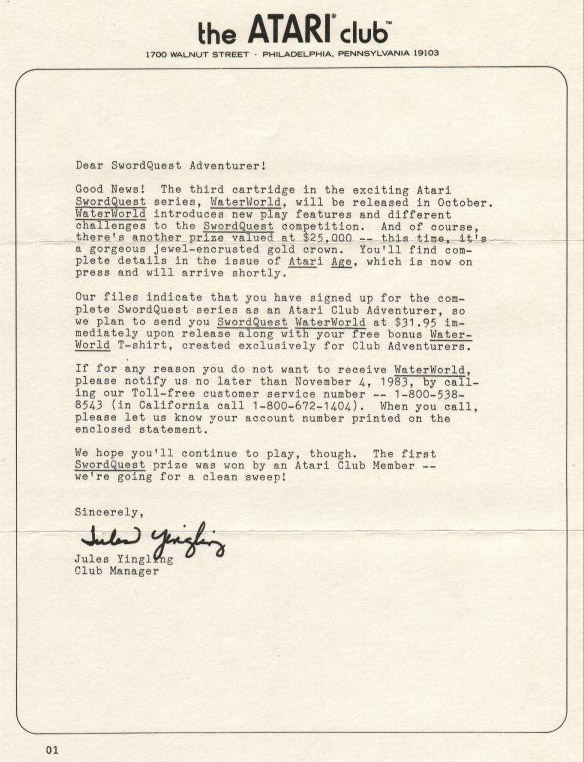
(Atari Age Club letter for upcoming WaterWorld release.)
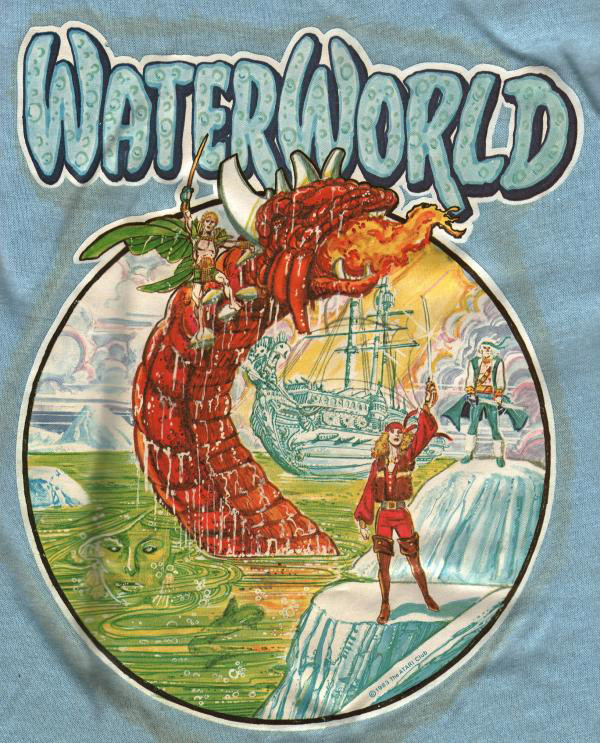
(Rare WaterWorld T-shirt, only available through Atari Age. Artwork by George Pérez.)
SwordQuest AirWorld
Programmed by Tod Frye
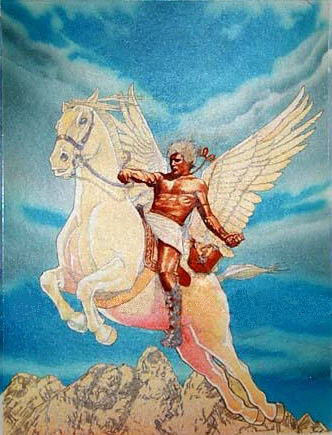

(Rare artwork for AirWorld. Note the Philosopher’s Stone just under the rider’s left arm)
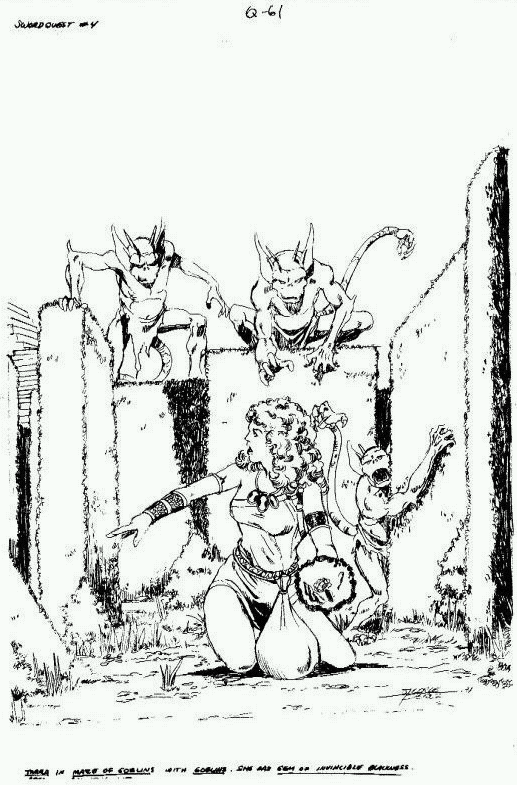
(Early comic cover art by George Pérez)
Gaming notes
† The game is based on the Chinese I Ching (the “Book of Changes” - see www.power-press.com or www.ichingwisdom.com for more information). It consists of “tribars” – sets of 3 bars that can be either whole or split – and there are 64 different tribar combinations, called hexagrams. The gameplay in AirWorld was based on a 64-bit game language that determined the player’s speed, enemy A.I., and other factors.
† The above artwork supposedly came from Brian Ballestri, who was an editor for the internal Atari company newsletter, Atari Life.
† A copy of Atari's internal product assembly list for AirWorld can be found HERE.
† According to Tod Frye, he was only about 20% done with the game, but was pulled off the project to do the 2600 version of Xevious. Soon after, the entire SwordQuest project was cancelled. Here are some of his comments (dated 8/02):
“AirWorld did get started, and I was digging it, but I got asked to port Xevious to the 2600 after 2 other programmers gave up on it.
AirWorld prototypes never reached the playable stage. In the game, there was a screen where one flies about, and then centers on a hexagram on the horizon. One then flies into the hexagram, which zooms to fill the screen, and then plays one of 64 scenarios - one per hexagram. I would be really surprised if it were even possible to find the code for the initial AirWorld prototypes.”
“AirWorld was based on the I Ching. As far as I got, it was never fully playable. But I was psyched to be doing it. One flew around in a (sort of) first-person flying scenario with 64 hexagrams on the horizon, dodging some stuff in the air, and picking some other stuff. When you picked up a certain token, you entered the 'in hexagram' phase, where you locked on a hexagram of your choice on the horizon, and it zoomed up to fill the screen, where you played one of 64 simple games (the 64 simple games never got finished, too ambitious).”
† According to former Atari programmer John Seghers, he remembers seeing Tod Frye testing out AirWorld, and confirms the room structure (layout) was based off of the I Ching (possibly 8 rooms, each representing a different tribar?). The game screen he saw was a first-person flying perspective of your character flying over a landscape – he believes it was suppose to be Torr on the flying horse (as depicted in the above artwork). Howard Scott Warshaw also confirmed the I Ching was the basis for the game during his presentation at the 1997 Electronicon show.
† The final comic book in the series was rumored to have been at least written and story-boarded – possibly even completed, or very close to it. There was once talk of DC completing the book series and releasing it as a graphic novel, but this never came to pass. Whatever artwork still exists is currently “lost” within DC Comics’ vaults. I asked DC artist George Pérez about this HERE:
“No, there was no "AirWorld" story ever written or drawn. The whole SwordQuest project was terminated by Atari before we could even start on the art. Roy Thomas and Gerry Conway, the original writers of the comics, may have worked out some sort of plot synopsis dealing in the generalities of that final chapter for Atari approval, but it never got to plot form. “
† Jeremy Jones attempted to perpetrate the biggest SwordQuest scam to date, trying (not once, but twice!) to sell off an alleged AirWorld prototype. Here are the fake screenshots he created, along with a fake cart:
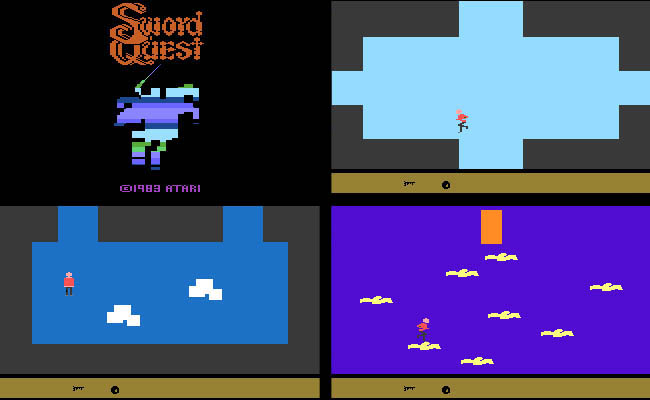
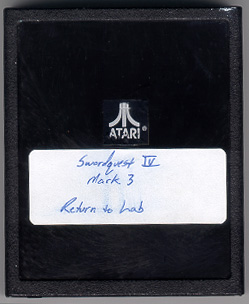
Below are 2 replies from Tod Frye, who helped to prove these pictures were fake:
(reply 1)
“All bogus. AirWorld was
started, but never completed. The screens shown on his (Jones’) website are
variants of the FireWorld concepts.
This
website is completely bunk. So sayeth me, who knows.“
(reply 2)
“That AirWorld cart I saw? Screenshots look like EarthWorld, with some modifications to the graphics data. This would not be all that hard for a moderately competent 'hacker' to do. Just find the data tables in ROM, and patch them. So, what the heck. Those screen shots were almost definitely from a modified EarthWorld.“
In actuality, the fake screenshots were not from a hacked ROM but rather a Photoshop creation using a combination of EarthWorld screenshots, original artwork, and even a character from a different game (the horse on the title screen is actually the Nazgul from Parker Brothers' Lord of the Rings game). Also, the inventory objects are too detailed for the system’s hardware, and (on close inspection) the player’s character reveals a green background pixel from the original screen the character was taken from.
† An excerpt from an interview with Michael Rideout (which can be found HERE) states:
“When I was in the FireWorld contest, there was a group of people that had been in EarthWorld, that said to me "Now, if Atari ever comes to you, make sure you don't agree to anything about canceling the contest." I guess they had a suspicion that Atari might try to do that. After a while, I got a letter from Atari stating that they wanted to cancel the contest. They offered Steven and myself $15,000 each to agree and they offered a smaller amount, maybe like $2,000 to each of the finalists for WaterWorld. I think the reason Steven and I got more than everyone else was because as winners of the first two contests, we had a definite chance of winning the Sword. Everyone involved had to agree or else the contest would continue. I tried to call Steven and some of the other people from the contest to see what they were going to do but I couldn't get in touch with anyone. I talked it over with my father and decided to accept the offer, figuring that someone else would decline. “
† In 7/09 I asked James Amrein what he recalled about the contest. His comments:
"An Atari
attorney named Angelo Pisani stepped up to take responsibility for attending to
prize awards due contestants, and that was the last we knew of the Swordquest
matter, our firm's judging responsibilities having been fulfilled.
If you can find Angelo, you may very well be on to the final chapter in this.
Other client-side names that date back to that time in Sunnyvale included
Marketing Director Jewel Savadelis, a fellow in Marketing with some involvement
in Swordquest named Steve Bengston, and a Marketing Dept. promotion type name
Ralph Giuffre ... Ralph moved on to Activision and later an area of Disney in
Burbank and then I lost him. I believe he's an alum of Santa Clara so it's
conceivable its Alumni Relations area would have current contact info for him."
† It is rumored that the Sword (and possibly the other prizes) ended up in the hands of Jack Tramiel, and that it’s hanging over the mantle of his fireplace. The person who posted this story noted that the sword in question also reportedly has an Atari “fuji” symbol on it, although it’s not depicted in any of the artwork photos that were released.
† One of the SwordQuest FireWorld contest finalists was Robert Ruiz Jr. His first (?) letter appeared in the May 1984 issue
of Computer Fun magazine, offering copies of the EarthWorld solution (his phone # and address were listed, but the # is no
longer valid). Not everyone who ordered his solution received it (most notably, Russ Perry Jr.). One of those who did,
Anthony Sandridge, was kind enough to send copies. It includes 6 pages of maps and notes for solving Earthworld, and a
2-page letter dated 7-7-84 and signed by Ruiz. Consequently, Anthony also mentioned that Ruiz also offered solutions for FireWorld and
WaterWorld, which he ordered as well, but never received them.  Another person who wrote Ruiz was Dan Amrich, who received not only the
same 2-page letter, but 7 pages of maps and notes for solving Fireworld, as well as another 2-page hand-written letter (dated 9-27-84)
on his "Adventurer's Club" letterhead, where he mentions the future plans for his club:

* The Progression
* Tips on different video and computer games
* Solutions
* The "Gamer's Choice" Contest
* Phase II: the Club's official magazine
The address listed As far as we know, none of his future plans ever materialized.
† In the April 1985 issue of Electronic Games, he wrote a letter urging people to contact Atari and pressure them to complete the contest. As it turns out, he was the person who sued Atari when they cancelled the contest.
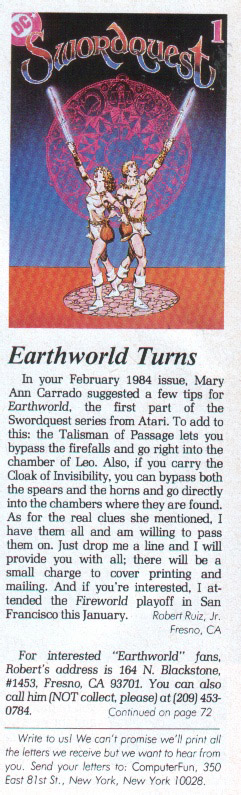
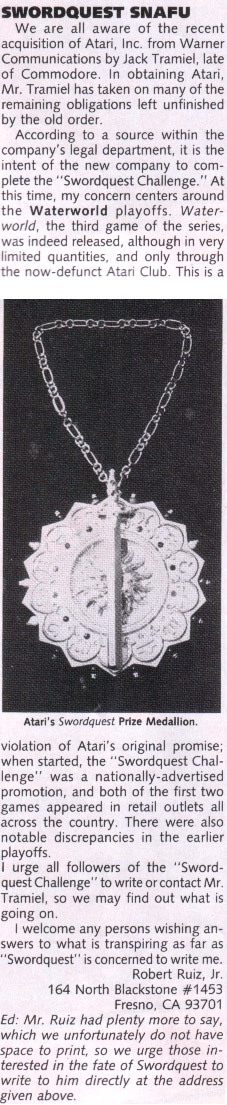
(Computer Fun 5/84 letter) (EG 4/85 letter)

† This article is intended as a companion to Walton C. Gibson and Keita Iida's incredible SwordQuest “Archive of Adventure” website. Lafe Travis did an excellent job of converting Russ Perry Jr.’s (NTSC) ‘SwordQuest solution’ articles, which originally appeared in the "2600 Connection" newsletter.
† To date, no one is sure who actually solved the NTSC versions of EarthWorld and FireWorld. It’s possible either the programmers or an associate “leaked” this information out (as they did for the PAL versions) but there was never a formal announcement from Atari. If anyone has any information concerning this, please email us.
† Was a T-shirt designed for AirWorld? The Atari Age article from issue #3 suggests all the shirts were done at that point, although only the artwork for EarthWorld is shown.
† Check out http://www.djay.com/astrol/intro.html for more information on Astrology.
† Special thanks to Russ Perry Jr., Luc Pycke, James Schweitzer, George Pérez, John Hardie, Tod Frye, Howard Scott Warshaw, John-Michael Battaglia, James Amrein, Anthony Sandridge, and Dan Amrich.
Last updated: Saturday, October 23, 2010 05:32 PM