I have been to several gaming gatherings, such as the Classic Gaming Expo,
Philly Classic, and the East Coast Gamers Expo. However, this year for the
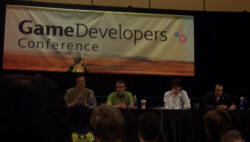
first time, I attended the Game Developers Conference. This year’s conference
was held in San Francisco, California at the Moscone Convention Center on March
7th-11th, 2005. On these five days, over 300 sessions
were held, which included workshops, keynotes, roundtable discussions and
lectures touching on every topic in the industry, including game design,
programming, art, audio and business.
Overall, the conference is exciting, and is
extremely beneficial for those already in the industry, or for persons wanting
to break into the industry. This is the place where you can meet the designer
of your favorite game, learn about upcoming industry trends, or make contacts
with professionals in the industry.
The main part of the conference is the
sessions, but the biggest and most publicized press events are the keynotes. This year’s keynotes were delivered by representatives from Microsoft and
Nintendo. Each presented differing opinions and direction for the upcoming
future.
J Allard from Microsoft delivered
a keynote entitled “The Future of Games: Unlocking the Opportunity”. He
describes the future as being rich in high definition content (which will be
unlocked by Microsoft’s XBOX2 platform). Key to the new platform will be a set
of APIs that will provide a standardized interface amongst games. Also, new
games for the system will allow sets of “micro transactions”, that allow the
player to purchase “mods” or extras within the game. It appears that Microsoft
has recognized the business model of “ringtones” on cell phones, and is
attempting to apply it to games. So to sum it up, they are betting on better
graphics and customization.
Nintendo’s presentation, on the
other hand, focused on the innovation that is needed in the industry, and came
from a more personal note. Nintendo President, Satoru, Iwata, delivered a
keynote entitled “The Heart of a Gamer”. He began by describing his history
within the gaming industry. Then he went on to describe what has and hasn’t
changed. Among what has changed: “bigger” – bigger games, bigger budgets,
bigger business, but smaller risk taking. And what has not changed: the level
of emotional attachment needed in gaming, the pride of accomplishment when
playing a game, and the notion that software sells the hardware (not
vice-versa). Continuing in this vein, he defined the standard of successful
software business as being innovative, intuitive, inviting, and having a
friendly interface (of course noting the Nintendo DS matches all of these.) He
showed some demos of upcoming Nintendo DS titles, and an impressive
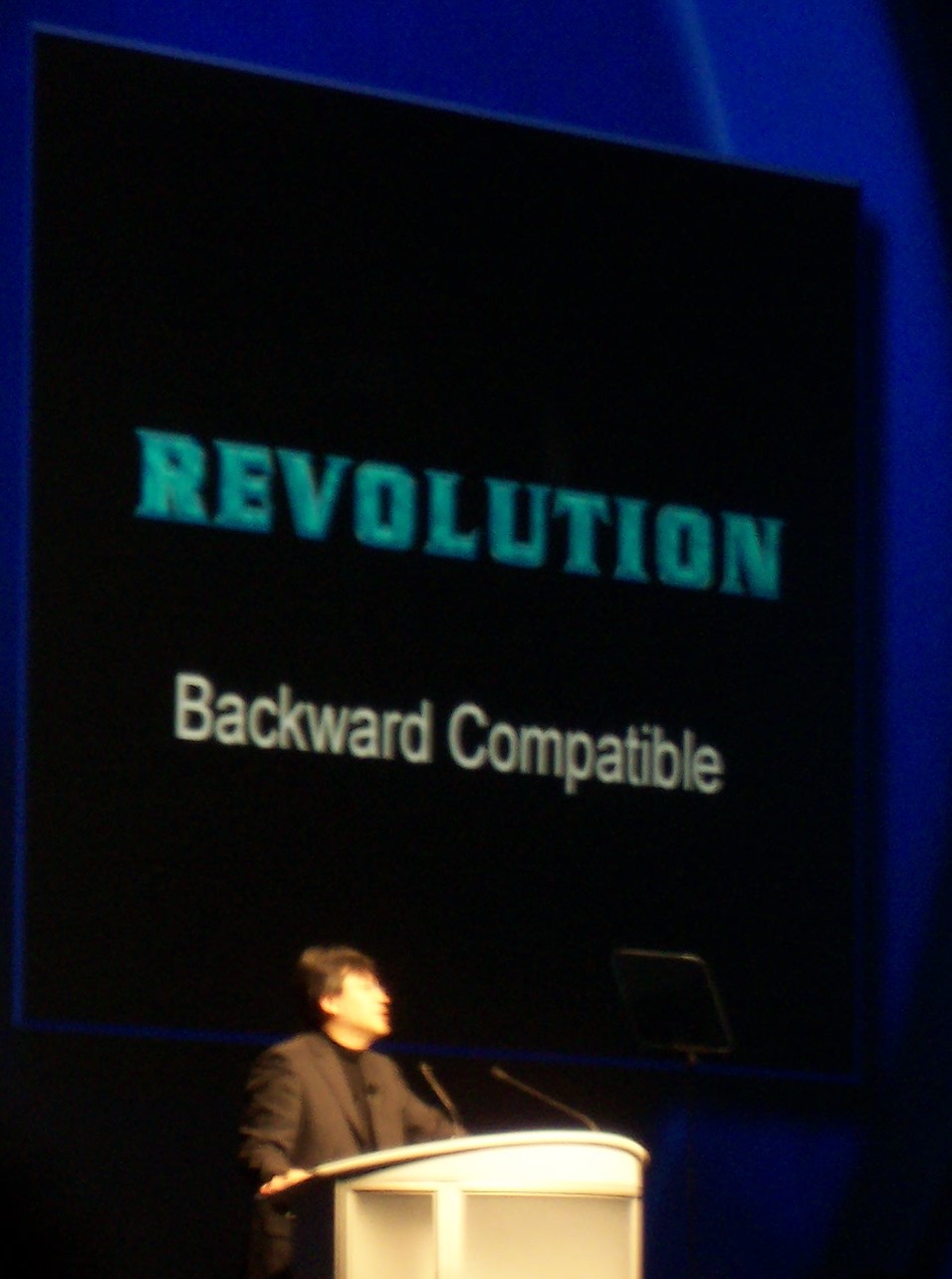
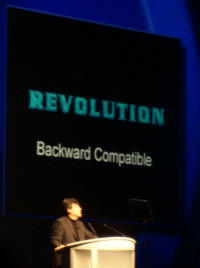
demonstration of 8 player wireless Mario Kart. To wrap up, he announced some
details on the upcoming Nintendo Revolution: it will support WiFi out of the
box, and will be backward compatible. Overall, the presentation was upbeat, and
showed that while Nintendo is still relying on the tried-and-true franchises,
they are willing to take risks in new innovations.
 |
 |
Aside from the keynotes, the other
big events at GDC are the Independent Games Festival and the Game Developers
Choice awards. The independent games festival offers exposure to some lesser
known titles. During the conference, booths were set up displaying all the
entries, where anyone could try out the games, and even start up a conversation
with the developers. It was exciting to see that many of these are 2D titles,
such as Gish (by Chronic Logic), N (by MetaNet Software), or Alien Hominid (by
The Behemoth). Also, there were 3D titles that would appeal to a casual gamer,
such as Rocket Bowl (by Large Animal Games). A list of all the entries and
winners can be found at
www.igf.com.
The Game Developer’s choice awards
hosted recipients for more well known titles, such as Halo 2, Half Life 2, World
of Warcraft, and Katamari Damacy. Also presented, was the lifetime achievement
award to Eugene Jarvis (creator of Defender and Robotron 2084). Other industry
legends, Nolan Bushnell (founder of Atari) and Shigeru Miyamoto (creator of
Donkey Kong, Mario Brothers, etc.) were also honored for lifetime achievement,
by given permanent floor plaques at the Walk of Game in the nearby Metreon
Center.
The rest of the conference
consisted of workshops, keynotes, roundtable discussions and lectures. Many of
these were held simultaneously, so the attendance is much lower per session than
the keynotes. One of the sessions included a full day “summit” on the state of
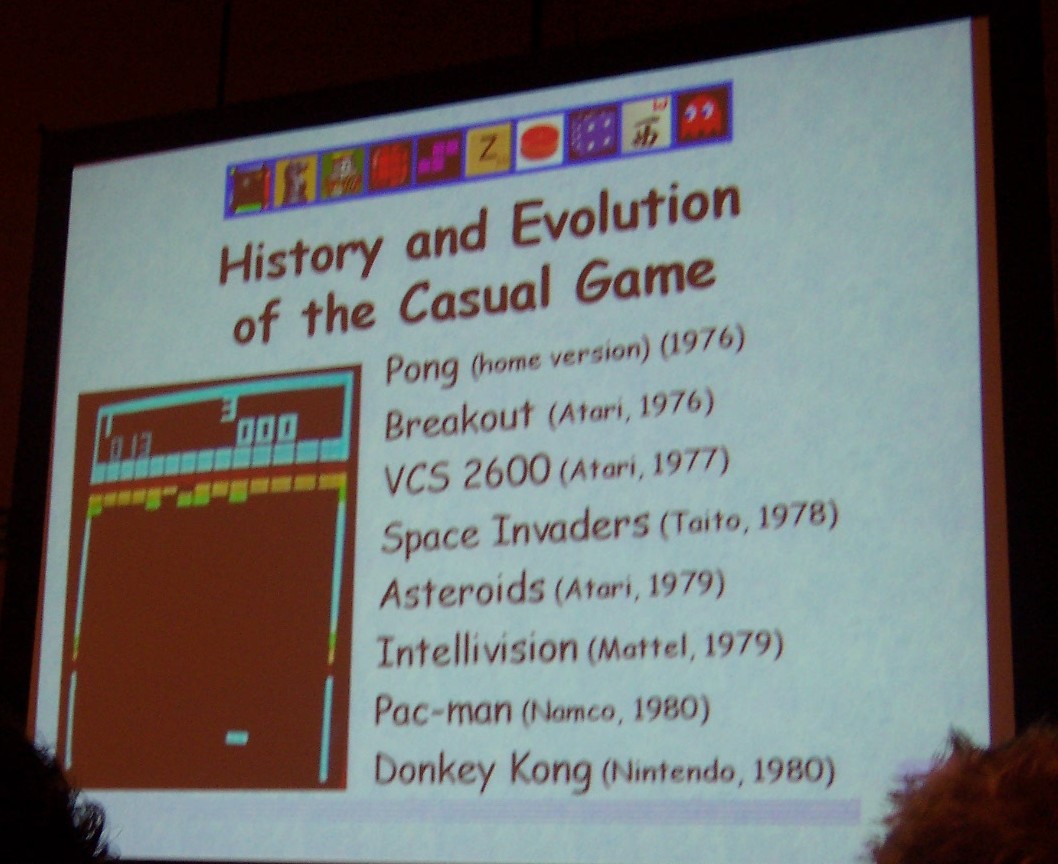
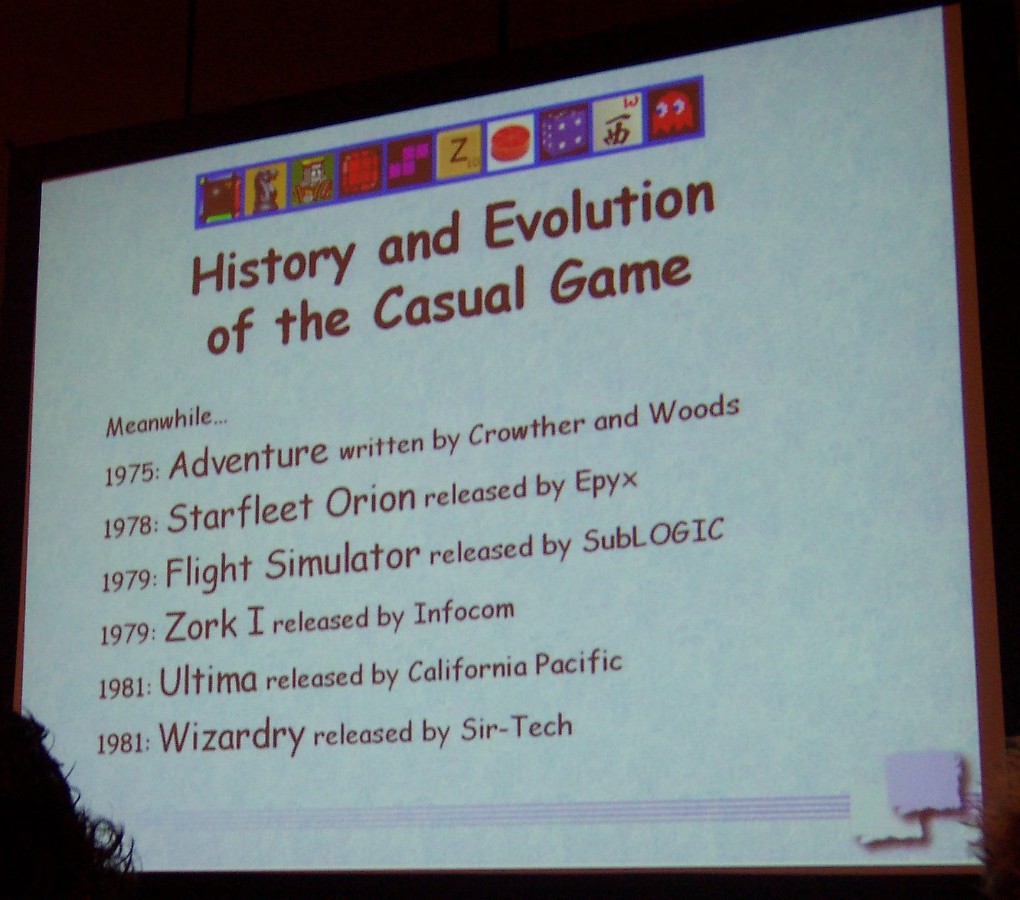
the growing casual games market. It started with a history of games in the 70’s
and 80’s to demonstrate the connection between the simplicity of the gameplay of
today’s casual games. The market for the casual games industry not only covers
PC web games, but also downloadable, mobile and even coin-op games. Casual
games are defined by their simplicity, and “pick up and play” gameplay. Many of
the development teams are extremely small, often only one or two people, harking
back to the similar days of Atari and Activision. This market perhaps will
interest the aspiring game developer, who’s influenced by classic games.
An interesting lecture was given
by Keita Takahashi, on the development of Katamari Damacy. What words of
wisdom did the creator of one of the most innovative modern games have to say? Basically, he said that video games are not important! If video games were to
disappear, the world would continue, and that developers would suffer the most. He went on to describe the motivations that brought him to design Katamari
Damacy, and gave a sneak preview of the upcoming sequel. He declared that the
shooting and killing in most modern games is nothing new, and that he wanted to
make something that would be easily understood. His presentation was one of
those where the audience was packed with many people who were saying “I played
that game – wow this is the guy who created it!”
 Another of the most anticipated,
and highly attended lectures was given by Will Wright (designer of the Sims), on
the Future of Content. The line to enter went half-way around the conference
center, so unfortunately I missed it. However, information on his upcoming
game, Spore, can be readily found on-line. Another of the most anticipated,
and highly attended lectures was given by Will Wright (designer of the Sims), on
the Future of Content. The line to enter went half-way around the conference
center, so unfortunately I missed it. However, information on his upcoming
game, Spore, can be readily found on-line.
One of the speakers I was most
excited to see, as most classic gamers, was Toru Iwatani, the creator of
Pac-Man. Now, a big difference: at the Classic Gamers Expo, he would have
received a standing ovation, but at GDC, before he was introduced, I’m not sure
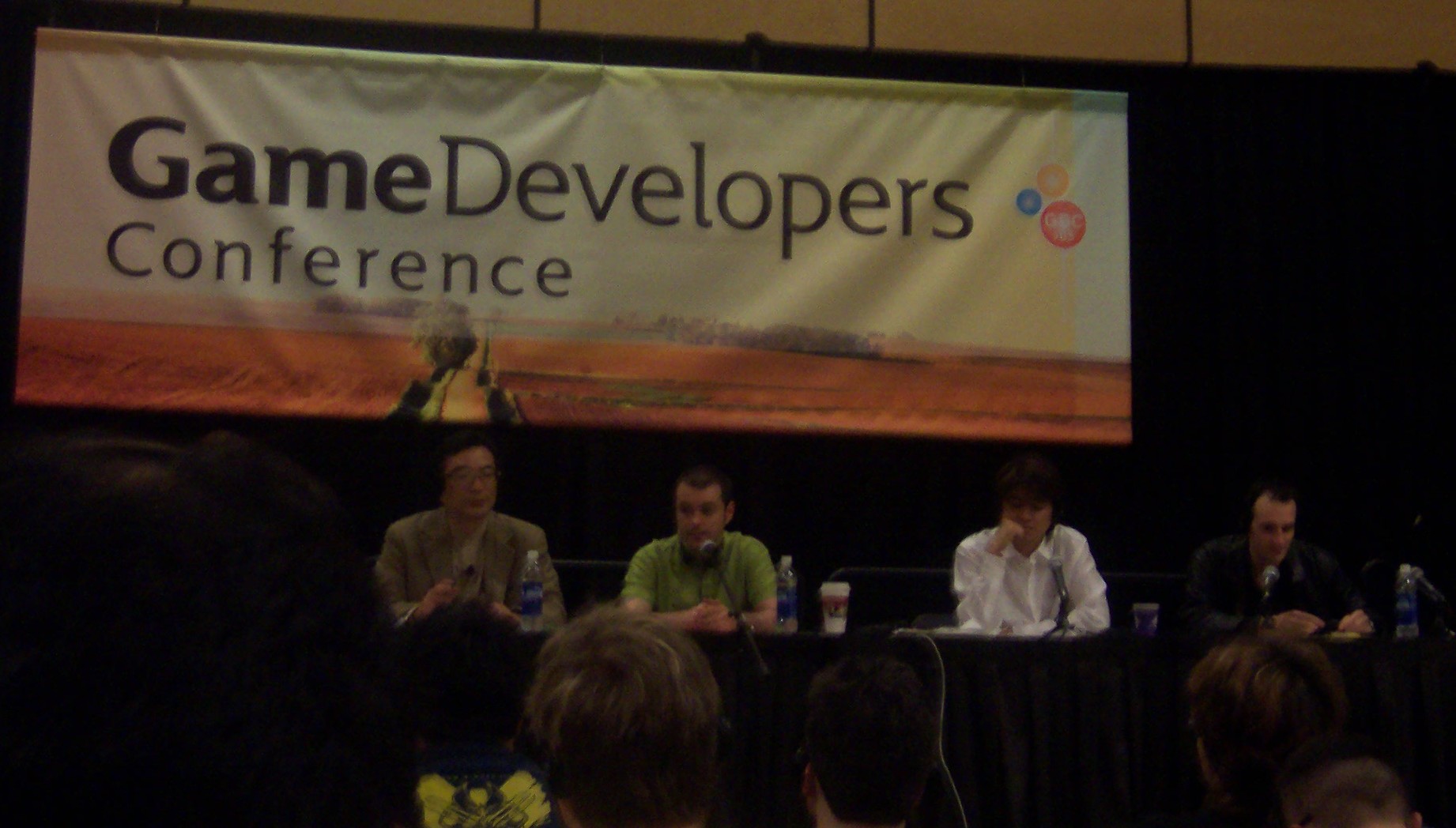
if many people knew who he was. He participated on the International Game
Designer’s panel, along with Clint Hocking (Splinter Cell), Tetsuya Mizuguchi
(Space Channel Five, Rez), and Alex Rigopulos (Frequency), and discussed such
things as what to do to overcome writer’s block, and the process of iterative
game design. (I was ecstatic as I could have listened to him speak a full day
on Pac-man alone.)
The Experimental Game Design
workshop was a three-hour jam session of all kinds of crazy ideas. This session
detailed and demonstrated insight into projects that don’t fit into established
genres, to see if the aspects of gameplay could hold. This included the Indie
Game Jam, where contestants were given art from “The Sims”, and designed a game
themed around people interacting. The games were mostly very simple prototypes,
like short stories. Overall, the workshop gave a refreshing offering of new and
bizarre game ideas. This reminded me back to the old days, before every other
game was a first-person shooter, and you’d frequently see new innovation. More
information can be found at
http://www.experimental-gameplay.org
Another innovative session was the
Emily Dickinson Design Challenge. Designers Clint Hocking, Peter Molyneux, and
Will Wright took up this challenge to design a game around the life and poetry
of Emily Dickinson, a far cry from the usual themes in modern games. Chris
Hocking’s design utilized the touch screen of the Nintendo DS to simulate poetry
writing. Peter Molyneux used a more visual approach, where in a 3D environment,
one could manipulate virtual clay, that when formed into a recognizable shape,
transforms into an object in the environment. Will Wright presented a hybrid of
Tamagotchi and the annoying “paper clip”, where for example, Emily would
interrupt your e-mails to discuss her latest poetry, and harass the user if
she’s ignored. Seeing all of these presentations was humorous, entertaining,
and inspiring in the sense of asking the question, “Can you really make a game
out of anything?”
Classic gamers often complain that
the industry has gone stagnant, and that modern games are just repetitions of
the same ideas. That’s one of the biggest reasons for playing games that are
over twenty years old. However, it’s clear that from attending GDC, that there
are others that agree and that there is an energy out there being used to create
original ideas, despite the marketing and business pressures.
Overall, GDC has something for
everyone already involved in the industry, or interested in getting involved. It gives an opportunity to learn, meet accomplished industry veterans, and
network with other professionals. If you are interested in more information, be
sure to check out the coverage at the GamaSutra, GameDev.net, and Gamespot. Also, the proceedings for all the sessions will be available shortly online at
the GDC website,
www.gdconf.com.
|